Choosing Home Dojo Flooring: What Karateka Actually Need to Know
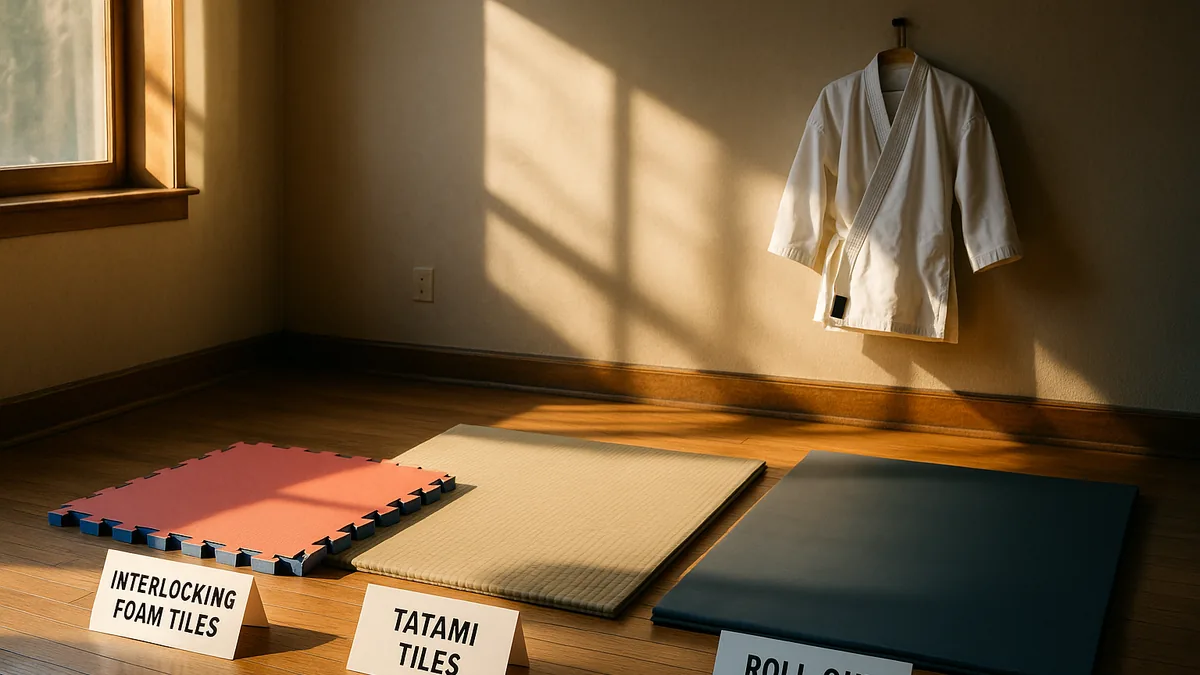
Setting up a home dojo means making decisions that will affect every session you train there. Flooring is one of those decisions that looks straightforward until you realise how many options there are and how little useful guidance exists for karateka specifically. This guide cuts through the noise so you can make a sensible choice before you spend anything.
Why Density Is the Specification That Actually Matters
Most people shopping for foam tiles focus on thickness. Thickness does matter, but it is not the number that separates a tile that will support your training from one that will undermine it.
Foam density - measured in kilograms per cubic metre - determines how the material behaves under load. A low-density foam compresses unevenly when you shift your weight, which means your heel and the ball of your foot are not sitting on the same plane. If you have ever tried to hold a solid zenkutsu-dachi on a very soft surface and felt your stance wobble despite doing nothing wrong technically, that is the problem. The floor needs to push back against your foot, and foam that is too soft simply does not.
Budget tiles aimed at general fitness use typically sit in the 60 to 70 kg/m³ range. They feel fine at first, but regular training compresses them permanently within months. For karate, the range to look for is 90 to 110 kg/m³. This is also consistent with the specification used for competition-level karate tatami. The figure is rarely printed on tiles sold through general sports retailers, which is a good reason to buy from a martial arts specialist who can tell you what you are actually getting.
Interlocking Tiles Versus Roll-Out Mats
Interlocking EVA tiles are the most practical choice for the majority of home training spaces. They are modular, which means you cover exactly the area you have, expand later if you need to, and stack them away if the room serves another purpose. A tatami-grain or ribbed surface texture is preferable to smooth EVA for bare feet - smooth foam becomes a slip hazard once you start to sweat.
One genuine drawback is the joins. The seams between tiles are not just a cosmetic issue. During jiyu-kumite, a join can catch your foot mid-pivot. Orienting your tiles so the joins run parallel to your main movement direction reduces the risk, but does not remove it entirely. Check how tightly the puzzle edges fit before committing to a brand - loose connections that open up under lateral movement are a sign of lower quality.
Roll-out mats eliminate the join problem entirely, which sounds appealing. The catch is that the manufacturing process prioritises flexibility over density, so roll-out mats are typically softer than good interlocking tiles. They also require a completely flat subfloor to stay in place, and a full-length roll is heavier and more awkward to store than people tend to expect. They work well as a secondary surface or a temporary solution, but they are not the right primary surface for most practitioners.
Matching Your Choice to Your Subfloor and Training
What sits underneath your tiles changes what you need from them. A suspended timber floor - common in UK houses - has some structural give of its own, so 20mm high-density EVA is adequate for solo training, kata, kihon, and bag work. Concrete offers no give at all, which means the mat has to do all the work of protecting your joints. On concrete, 40mm is the sensible minimum.
If your training includes any partner drilling, light sparring, or ground practice, go to 40mm tatami-surface tiles regardless of subfloor. The extra thickness is not about comfort - it is about absorbing falls safely and giving your feet a surface that grips without abrading.
One thing no floor mat fully solves: impact noise transmission on a suspended timber floor. Foam reduces it, but the vibration still travels through the structure. If you are training above a living space, jumping and kicking drills will still be audible below. That is a real constraint worth factoring in before you plan your training sessions.
As the full article puts it:
"The floor matters, but it's not the most important variable in your home training setup."
Get the floor right, then put your remaining budget into the striking equipment and training aids that will actually develop your technique.
Checklist for Your Next Purchase
- Check the density figure before buying - look for 90 to 110 kg/m³ and buy from a martial arts supplier if the specification is not published
- Match thickness to your subfloor - 20mm on suspended timber, 40mm on concrete
- Choose tatami-grain or ribbed surface over smooth EVA for bare-foot grip
- Go to 40mm tatami-surface tiles if your training includes any partner work or groundwork
- Orient tile joins parallel to your primary movement direction to reduce the risk of catching your foot mid-pivot
- Avoid roll-out mats as your main surface unless your subfloor is perfectly flat and storage is genuinely practical
- Press the tile firmly underfoot before buying - if it compresses like memory foam, it is too soft for serious stance work
For the complete version, with every drill explained, read Foam Flooring for Home Dojo: Interlocking Mats, Tatami Tiles, and Roll-Out Options Compared for Karateka Who Train at Home on Karate Lifestyle.
Join the conversation: X · LinkedIn · Pinterest · Threads · Bluesky · YouTube · TikTok
More from Karate Lifestyle


Comments
Post a Comment