Solo Karate Training That Actually Prepares You for Sparring
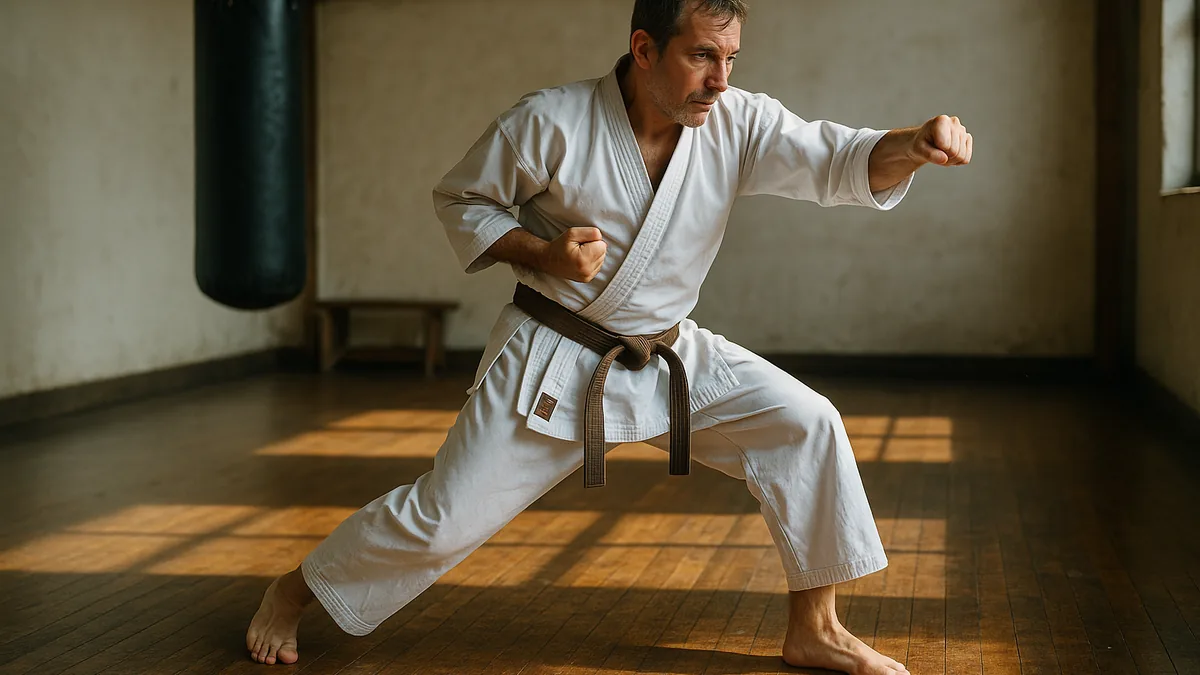
Most of us have been there: basics that look solid in the line, combinations that feel powerful in the air, and then jiyu-kumite arrives and it all goes sideways. The problem is rarely fitness or technique in isolation. It is that the training we do on our own rehearses movement shape rather than the responses kumite actually demands. The drills below are built around fixing that specific gap.
Why Most Solo Training Misses the Point
Kihon trains mechanical execution in predictable conditions. Kumite is the opposite - it is reading distance, committing under pressure, and making decisions in fractions of a second. When solo training does not include any of those qualities, the transfer to sparring is weak regardless of how many reps you put in.
The fix is not to abandon solo training. It is to redesign it so that pressure, rhythm disruption, and genuine commitment are present in every session. As the full article puts it:
"The goal of solo training is to simulate pressure, not rehearse shape."
Every drill below is built around that principle.
Four Drills Worth Adding to Your Practice
Scenario shadow sparring - This is the most underused approach on this list. Rather than free shadow sparring, where most practitioners drift toward their favourite techniques and win every exchange in their own heads, you assign a specific situation before the round starts. You have just had an attack blocked - what is your exit? You are being pressured backwards - where is your counter? The scenario keeps you in the uncomfortable territory that actually mirrors kumite, rather than the highlight reel your brain defaults to when left unsupervised.
Reaction snap drill - Stand in your fighting stance and use a random audio cue to trigger a single committed technique. The key instruction is to stay relaxed between cues. Tensing up in anticipation produces a limb-led, thought-out response. The goal is a technique that fires from a relaxed state and initiates from your centre outward. When it is working, it feels almost automatic. When it is not, you will notice the limb moving before anything else does.
Interval pressure combinations - Assign a base combination of three or four techniques and run it in short, intense work periods with brief rest. The critical detail is rhythm variation: fast-fast-slow one round, slow-fast-fast the next. A combination drilled at constant pace becomes readable, and readable combinations get picked apart in sparring. Once the varied rhythm is solid, add a decision point mid-combination - continue the base sequence or shift to an exit movement. That branching is something kihon training simply cannot provide.
Slow-motion solo work - Move at roughly 20 percent of full speed and freeze at the completion of each technique. Check your guard position. Check your weight distribution. Ask honestly whether an opponent could land a counter at that exact moment. The moments where your guard drops or your balance tips forward during a combination are the same moments that get exploited at full speed - they are just invisible until you slow down enough to see them.
The Habit Underneath All of It
There is a thread connecting all four drills: commitment. A technique that ends half-heartedly in solo training is rehearsing half-heartedness. Over enough reps, hesitation becomes the default. The drills above only work if every repetition is finished with genuine intent - not performed for appearance, but committed as if the situation is real.
This applies to the scenario you assign, the technique you fire on the cue, the decision point mid-combination, and the freeze-check in slow motion. Each one requires you to make a real choice and follow through on it.
Checklist for Your Next Session
- Assign a specific scenario before starting shadow sparring - no free-roaming
- Keep your guard hand live throughout every shadow sparring round
- In the reaction snap drill, stay genuinely relaxed between cues
- Vary the rhythm of every combination - never the same tempo twice
- Add one mid-combination decision point per session
- Run at least two minutes of slow-motion work and freeze at each technique
- Finish every single rep with full commitment - no half-measures
For the complete version, with every drill explained, read Solo Training Drills That Transfer to Kumite on Karate Lifestyle.
More from Karate Lifestyle


Comments
Post a Comment