Bassai Dai: Why Knowing the Sequence Is Not Enough
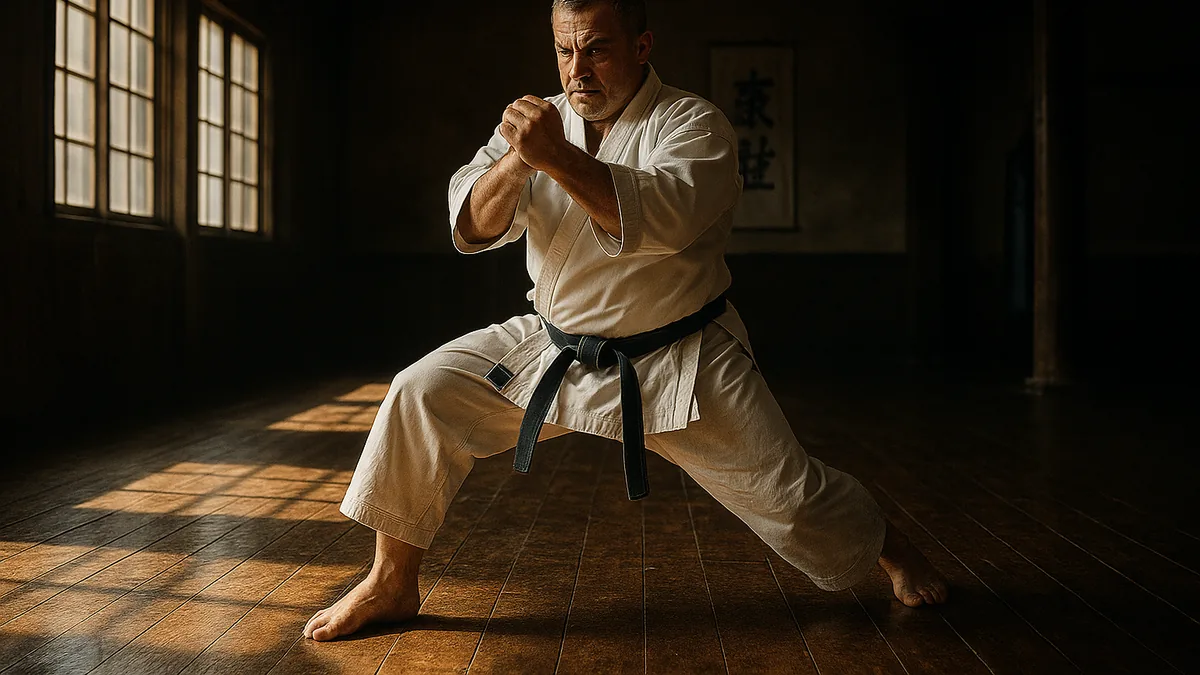
Most brown belts can get through Bassai Dai without falling over. The sequence is there, the stances are roughly in place, and the timing is close enough. But there is a particular feeling that creeps in during practice - a nagging sense that you are moving through the kata rather than actually doing it. If that sounds familiar, you are in the right place.
The full article on KarateLifestyle.uk goes into considerable depth on where Bassai Dai is misunderstood and why. This companion guide pulls out the mechanical and conceptual points that are most useful to have in your head before you step on the mat.
The Opening Is Not a Warm-Up
The most common mistake happens in the first few seconds. Students treat the opening morote-uke as something to get through before the kata properly begins. It is not. It sets the physical logic for everything that follows.
The step forward and the arm movement are a single action, not two. The hip drop drives the block. If your arms complete the movement before your hips have settled and committed, you have produced a shape without any weight behind it. The block looks fine but has no mechanical substance.
Slow this down in practice until you can feel the hip drop pulling the arms through - not as a conscious thought but as a physical sensation. Once that connection is real, bring the speed back. If you try to learn it at full speed, you will keep separating the two actions without realising you are doing it.
Hip Rotation Is the Technique, Not an Addition to It
Bassai Dai uses hip rotation in ways that most students have not encountered before Heian Godan. The uchi-uke sequence in the middle of the kata is where this becomes obvious.
Done incorrectly, those techniques look like arm movements. Done correctly, the arms are almost passengers - the sharp hip rotation does the work and the arms are simply attached to it. Try isolating the arms and performing the technique without the hips. Then add the hip rotation back. The difference in what you feel is the difference between performing the kata and executing it.
The same applies to the tetsui sequence. The surface reading is two hammer fist strikes. The more useful reading - and the one that makes the body mechanics make sense - is that you are breaking a grip and controlling an arm. When you train it that way, the hip rotation stops being a stylistic choice and becomes a mechanical necessity. You need that rotation to generate the force to break a hold, not just to swing an arm.
"A student can know every movement of Bassai Dai perfectly and still fail to convince anyone watching that they understand what they are doing."
Stance Transitions: Move Your Weight, Not Just Your Feet
The transitions between zenkutsu-dachi, kiba-dachi, and kokutsu-dachi in Bassai Dai are harder than they look, and the error is almost always the same: students move their feet into the new stance without moving their centre of gravity.
You can end up in the shape of kiba-dachi with your weight still sitting where it was in zenkutsu. From outside it looks roughly correct. From inside you have no stability and no power platform for what comes next.
Think about where your hips are going before your feet start moving. In kiba-dachi, the hips need to sit down into the stance equally over both legs. In kokutsu-dachi, the weight goes back but the front leg stays live - coiled rather than passive - because the techniques that follow require you to generate forward movement quickly. If you have genuinely collapsed into the back leg with no tension in the front, that option is gone.
Checklist for Your Next Class
- Opening movement: can you feel the hip drop driving the block, or are your arms arriving first? Slow it down until the connection is physical.
- Uchi-uke sequence: perform it once with arms only, then again with full hip rotation. Notice what changes.
- Tetsui section: think "break the grip, control the arm" rather than "strike into space." Does the hip rotation feel different with that intent?
- Stance transitions: before you move your feet, decide where your hips are going. Check your weight distribution when you arrive.
- Any section you rush through: that is the section to slow down, not speed up. Speed should follow confidence, not mask the absence of it.
- Kiai points: the kiai should come from full commitment in the technique. If you are holding back the technique to set up the shout, you have it the wrong way round.
For the complete version, with every drill explained, read Bassai Dai Breakdown on Karate Lifestyle.
Join the conversation: X · Pinterest · Bluesky
More from Karate Lifestyle


Comments
Post a Comment