Is Your Bunkai Actually Working - Or Just Looking Good?
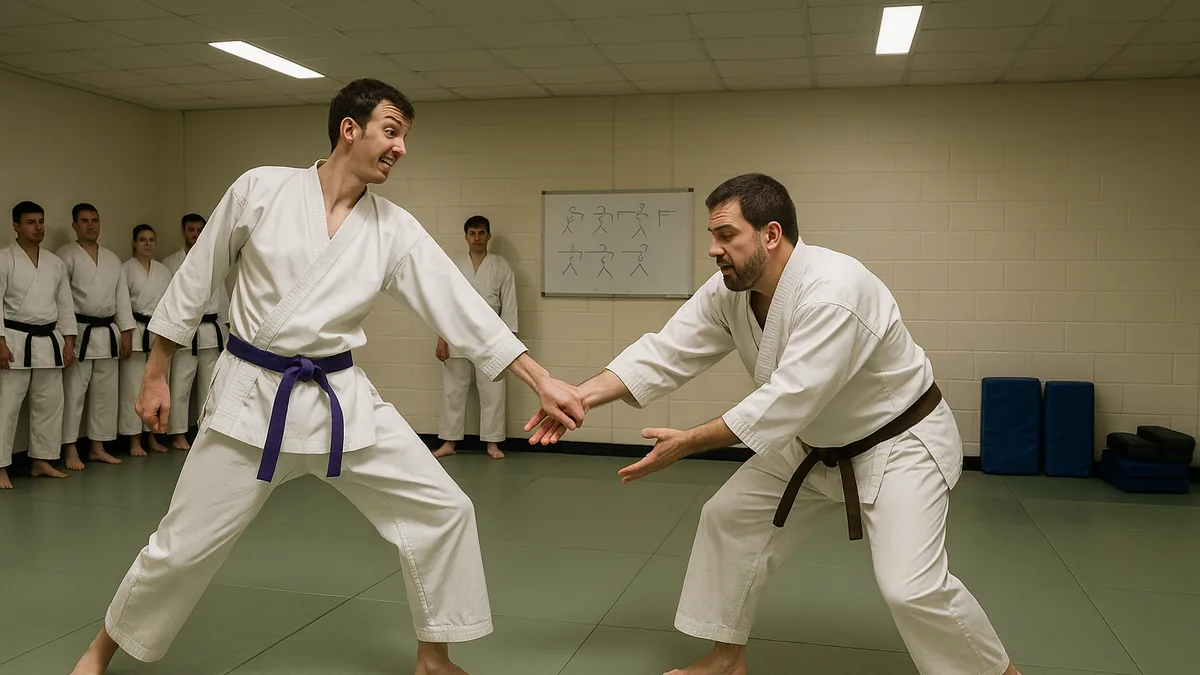
Most karateka who practise bunkai genuinely believe they are developing practical application skills. The problem is that belief rarely gets tested against anything that would expose whether it is true. This guide pulls out the practical core: how to recognise cooperative bunkai for what it is, and what to do about it before your next class.
Why the Drill Works in the Dojo but Nowhere Else
The issue is not effort or intent. It is that most bunkai is built around a silent agreement between partners. The attacker knows what is coming and unconsciously adjusts - they hold the right angle, they commit at the right moment, they stay where they land. The defender performs the sequence. Everyone nods. Nothing has actually been tested.
As the full article puts it:
"You are rehearsing a demonstration, not developing a skill."
The fix is straightforward in principle, if uncomfortable in practice: break the script deliberately. Ask your partner to vary the timing, shift the angle slightly, or simply not cooperate with the grip or position the technique assumes. You are not trying to sabotage the drill - you are making the defender actually find the technique rather than just recall it. If the application only holds up when conditions are preset, it is choreography, not bunkai.
Three Tests That Reveal the Truth
A functional application needs to pass three checks, and most bunkai struggles with all of them.
- Does it work against a non-compliant partner who knows roughly what is coming but is not helping it along?
- Does it survive an imperfect entry - when your angle is slightly off, your timing is a fraction late, or your position is not exactly where you planned?
- Can it hold up under any real pressure, even light resistance rather than full resistance?
The first test alone quietens most rooms. Allow the attacker to pull back or redirect once contact is made, and applications that looked clean against a static partner stop working almost immediately. That single variable - a natural, instinctive response from the attacker - is enough to reveal whether the technique has genuine structure behind it.
The Culture That Rewards Polish Over Function
There is a structural reason why cooperative bunkai persists in most clubs. Teaching genuinely functional application work takes considerably more time, requires careful management of resistance, and produces sessions that look messier than a clean cooperative drill. Instructors working with mixed-ability groups have real practical constraints.
The grading and competition environment makes this worse. Panels tend to reward bunkai that is visually coherent and neatly executed. A rough, pressure-tested sequence with an awkward entry and a messy follow-up can score lower than a pristine but untested performance. When the incentive structure favours presentation, that is what practitioners naturally train towards - and many do not even realise they have made that trade-off.
Some instructors have simply never been shown the difference. They learned cooperative bunkai, it was never seriously challenged, and they teach it in good faith. That is a transmission problem, not a personal one.
Checklist for Your Next Class
Bring these to your next bunkai session and work through them honestly with a regular training partner.
- Test the entry first. Before drilling the full application, check whether you can actually get into position from a realistic, moving attack. Most bunkai fails here before anything else.
- Break the script. Ask your partner to vary one element - timing, angle, or response - within the drill. Note where the technique stops working.
- Watch for the freeze. If your partner stops moving after the initial technique, you have not tested anything meaningful. Build in what happens next.
- Add resistance in stages. Roughly 30%, then 50%, then 70%. You are not sparring - you are finding where the technique breaks down so you can fix it.
- Train it tired. Run the application at the end of a hard session. Techniques that depend on fine motor precision will degrade under fatigue; the ones built on solid structure and timing will survive.
- Be honest about what you are doing. Cooperative bunkai is not worthless - it develops other qualities. But know whether you are doing application work or a performance rehearsal. The two are not the same thing.
For the complete version, with every drill explained, read Why Most Bunkai Doesn't Work on Karate Lifestyle.
Join the conversation: X · Pinterest · Bluesky
More from Karate Lifestyle


Comments
Post a Comment