Why Your Kata Isn't Showing Up When You Spar
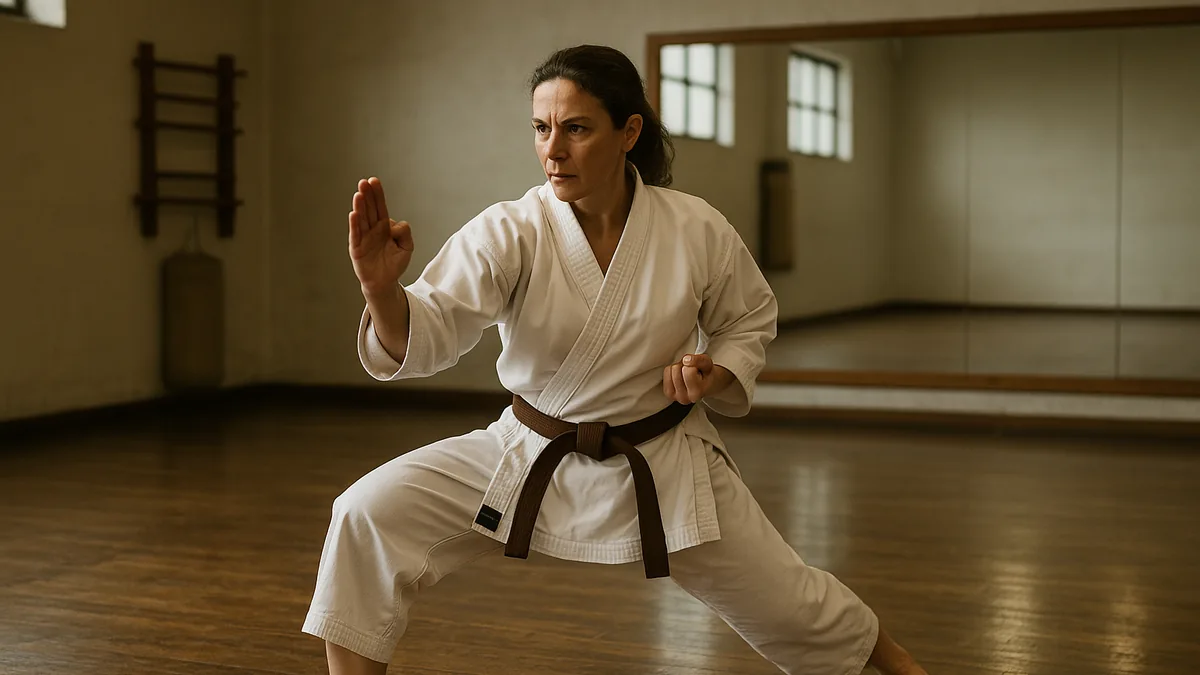
If you practise kata regularly and spar regularly but feel like the two exist in completely different universes, you are not alone. Most karateka experience this. The good news is that the disconnect is not inevitable - it is a training problem, and training problems have training solutions.
This piece is a practical companion to a longer article on the subject. The full piece covers the topic in much more depth, but here is what you can take to your next class.
The connection is physical, not visual
The most common reason karateka can't see how kata relates to sparring is that they are looking for the wrong thing. Kata does not look like sparring, and it was never meant to. What it does is build physical habits - weight transfer, hip drive, structural alignment - that fire automatically when you need them under pressure.
Students who rush through kata as a sequence to be completed tend to develop a disjointed sparring style. Students who slow down and actually feel what the body is doing before each technique fires tend to move with more coherence when it counts. The link is in the mechanics, not the choreography.
Bunkai is where the real work happens
Most dojo bunkai practice stays at the surface - this movement blocks, this movement strikes. That reading is not wrong, but it is incomplete.
When you look at kata sequences as responses to specific physical problems - a grab, a clinch, a failed technique, a bad position - they start to reveal far more than block-punch combinations. Joint locks, entries, takedowns, and control positions are all in there. As the article puts it:
"My instructor used to say that every kata contains at least three layers of meaning and most people never get past the first one."
The practical implication is straightforward. Take a short sequence from a kata you know well. Work out what physical problem it is actually solving. Then drill it with a partner who is genuinely resisting, not just feeding you the right attack at the right speed. Do that until the response starts to happen before you consciously decide to do it. That is the bridge most people are missing.
More kata does not automatically mean better sparring
Volume without understanding is just exercise. Plenty of karateka have accumulated enormous hours of solo kata practice and still freeze in sparring, because they have never made the conceptual connection between the two. Meanwhile, a student with a genuinely deep understanding of even one or two kata can move with a coherence that outranks students who know far more forms by name.
The sport versus traditional debate around this question is, in large part, a disagreement between people talking about different things. Competition-focused training and traditional training have different priorities, and both positions point at something real. What matters most is how your dojo treats the relationship between kata and kumite. If they are trained as connected disciplines, students experience them as connected. If they are treated as separate, the gap stays open.
Checklist for your next class
- Pick one sequence from a kata you already know well - three to five moves is enough
- Ask what problem it solves - not what it blocks or strikes, but what physical situation it is designed to handle
- Find a partner and drill that sequence with genuine resistance and varied attacks
- Slow your solo kata down - feel the weight transfer and hip movement before the technique fires, not after
- Notice your distance - when a technique feels cramped or reaching, the kata is giving you information about ma-ai
- Stop counting kata and start understanding them - one form trained deeply is worth more than ten performed on autopilot
For the complete version, with every drill explained, read Does Kata Actually Help Your Sparring? on Karate Lifestyle.
Join the conversation: Instagram · X · LinkedIn · Pinterest · Threads · Bluesky · YouTube
More from Karate Lifestyle


Comments
Post a Comment