What Beginners Actually Need From Kihon (And What Gets in the Way)
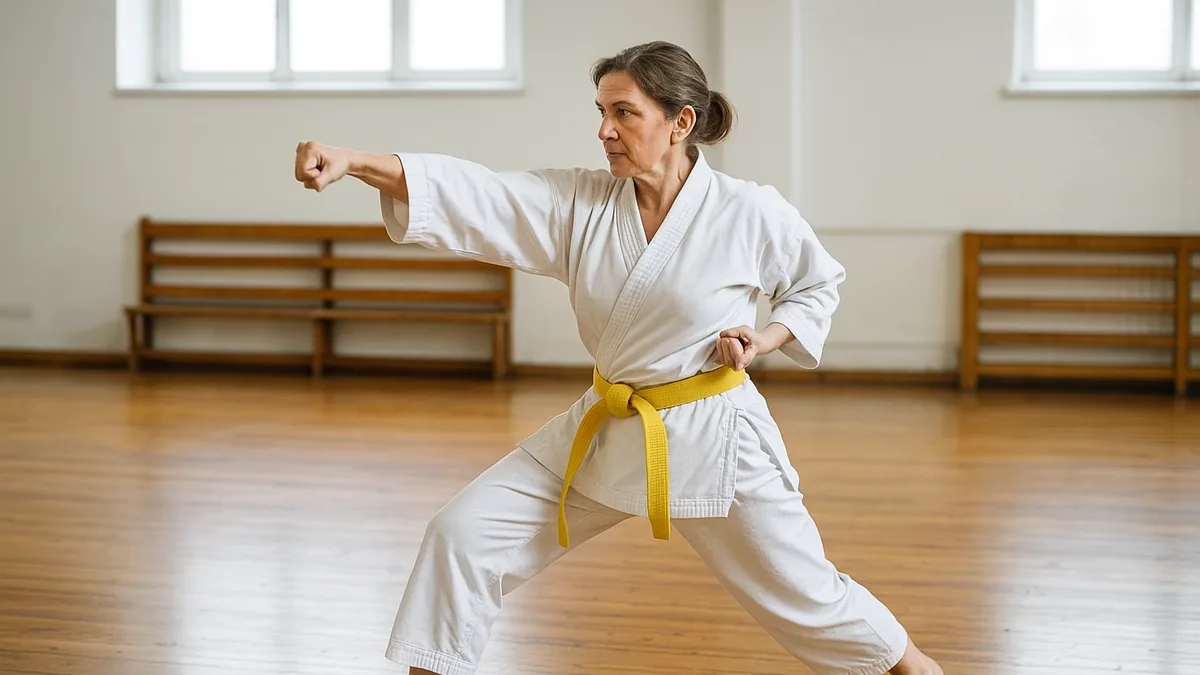
Most beginners treat kihon as something to get through rather than something to get from. Ten punches, move on. Ten blocks, move on. The repetitions happen, but the understanding doesn't always follow. That gap between doing and understanding is where improvement either happens or stalls.
The drills below - stationary and moving oi-zuki, age-uke and soto-uke, and mae geri - are the ones that matter most in the early stages. Here's what to pay attention to when you're training them.
The Hip Does the Work
This is the thing that takes longest to genuinely feel, and it sits underneath every drill in this list. The hip is the source of power in a punch, a block, and a kick. The arm, the hand, the foot - these are just where the power arrives, not where it comes from.
In stationary oi-zuki, this connection is easiest to isolate. Stand still, set up your stance, and throw the punch slowly. Ask yourself: does the hip move first, or does the shoulder? If the shoulder is leading, you're punching with your arm. It will look like a punch, but it won't carry any real structural weight behind it.
A useful check is to place a hand on your hip as you punch slowly. Feel whether the hip is initiating the movement or being dragged along after the arm has already gone. Once you can feel the hip driving the arm rather than following it, the punch changes noticeably - there's a solidity to it that isn't there when you're just throwing your arm forward.
"There's a difference between doing a hundred punches and doing a hundred punches while thinking about hip connection."
The hikite - the hand pulling back to the hip - is part of this same mechanic. It isn't a tidy finishing gesture. It's an active pull that contributes to the rotation. Drill it that way.
When You Add Movement, the Problems Multiply
Moving oi-zuki in zenkutsu-dachi is where beginners find out how much of their stationary technique was still relying on their arm. The step adds complexity, and the most common error appears almost immediately: the punch lands before the foot does.
This happens because the arm is faster than the body. The brain defaults to what's quickest, so the punch fires early and the step follows. The result is an arm moving through space with no body mass arriving behind it - the timing undermines the whole point of stepping through.
The correction is to deliberately hold the punch back until you feel the front foot about to make contact. Foot and fist together. When the timing is right, the whole body weight arrives in the technique. It's a noticeably different feeling from punching early - there's a completeness to it.
Stay low through the step, too. Students tend to rise as they move, which disrupts the centre of gravity and makes the timing harder to find.
Blocks Are Not Shields
Age-uke and soto-uke are frequently drilled passively - the arm moves into position and sits there. That's not blocking; that's parking your arm in someone's way and hoping for the best.
The forearm rotation in age-uke is what actually deflects an incoming technique. Without it, you're raising your arm. With it, you're redirecting force. The rotation should feel something like wringing a towel - there's a distinct sensation in the forearm when it's happening correctly.
Soto-uke works differently in direction but the same principle applies: the power comes from the elbow driving across, supported by the core and back, not from the hand or the bicep doing the work alone. In both cases, hikite pulls back simultaneously. Every block, every time.
Mae Geri: Snap, Not Push
A front kick that feels like you're pushing your leg into something is using muscle rather than mechanics. A properly executed mae geri feels like a whip - the knee extends sharply and then snaps back along the same path.
The chamber matters. The knee drives forward first; the foot follows as the knee extends. The retraction is just as important as the extension, and it's what beginners most commonly drop. They focus on getting the kick out and then let the leg fall rather than pulling it back. Drill the retraction as a deliberate movement until it becomes automatic.
If you're stumbling forward after the kick lands, the weight transfer isn't right. A good mae geri leaves you balanced and ready - not committed forward with nowhere to go.
On progression: correct mechanics at 60% speed is more productive than full speed with ingrained errors. Speed is the last thing to add, not the first.
Checklist for Your Next Class
- Stationary oi-zuki - feel the hip move before the shoulder; place a hand on your hip to check
- Hikite - pull hard and fast to the hip; treat it as half the technique, not an afterthought
- Moving oi-zuki - foot and fist land at the same moment; if the punch arrives early, hold it back deliberately
- Age-uke - feel the forearm rotation; without it, you're just raising your arm
- Soto-uke - power from the elbow and core, not the hand
- Mae geri - chamber the knee first, snap back along the same path, land in balance
- Speed - drill slowly with correct mechanics before adding pace
For the complete version, with every drill explained, read Kihon Training Drills for Beginners on Karate Lifestyle.
Join the conversation: Instagram · X · Pinterest · Bluesky · YouTube
More from Karate Lifestyle


Comments
Post a Comment