Why Your Reactions Aren't Getting Faster (And What to Actually Do About It)
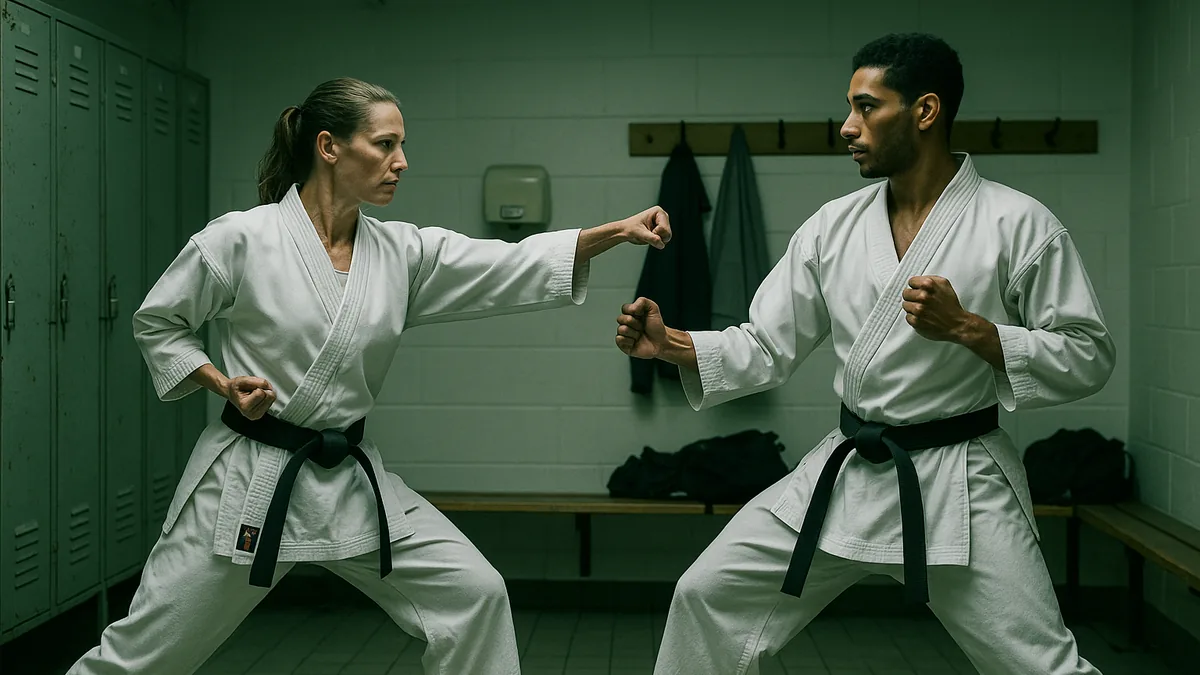
Most karateka who feel slow in kumite respond by pushing harder in training - more reps, faster drilling, longer sessions. It rarely helps, because the problem is almost never raw speed. If you've plateaued in sparring and can't work out why, this guide is for you.
The Real Reason You're Late
The most common mistake is watching the technique instead of the person throwing it. By the time your eyes register a fist moving toward you, your brain has processed it, and your body has begun to respond, the attack has already arrived. You cannot outrun that sequence by trying to move faster - the delay happens before movement even starts.
What experienced practitioners do differently is read the body before the attack begins. Weight shifts, shoulder raises, changes in posture - these signals appear in the preparation phase, not during the technique itself. Reacting to those cues gives you a genuine head start. Reacting to the technique means you are always catching up.
"Beginners react to what is happening. Experienced practitioners react to what is about to happen."
That shift - from watching the strike to reading the person - is where most of the real improvement lives.
The Decision-Making Problem
Even when you spot the cue early, hesitation can still cost you. Having too many possible responses available creates a delay before you commit to any of them. The more options you are weighing, the slower the response - this is a well-established principle, not an opinion. A practitioner with a large technique library but no automatic routing is still choosing under pressure, and that choice takes time.
The fix is to narrow the options deliberately in training. Drilling a single response to a single stimulus, repeatedly, until it requires no conscious decision, removes that delay. It feels overly simple, but that is exactly the point. Variety in drilling builds adaptability; repetition of a single pairing builds automaticity. Both matter, but most people do far too much of the former and not enough of the latter.
When the Problem Is Confidence, Not Speed
Some slow reactions are not a training problem at all. If a block is unreliable, a practitioner will hesitate before committing to it. If a counter doesn't land cleanly in practice, the body will hold back before throwing it in sparring. That hesitation looks like slow reactions from the outside, but no amount of reaction drilling will resolve it.
If you've been working on reactions for months without improvement, it's worth asking whether the underlying technique is actually trustworthy. A technique you don't believe in will always produce a pause before commitment. Fixing the technique removes the hesitation, and reactions often improve without any additional reaction-specific work.
A Short Checklist for Your Next Session
Take these into training and be honest with yourself about what you actually observe.
- Watch the torso, not the hands. In your next round of sparring, consciously shift your focus to your partner's chest and shoulders. Notice whether your read improves.
- Pick one stimulus-response pairing and repeat it. One attack, one response. Ten clean reps before you add any variation. Resist the urge to mix it up early.
- Ask your partner to introduce broken rhythm. If your pad work or partner drills always follow a pattern, your brain has stopped genuinely reacting. Ask for randomness and fakes.
- Record a round of sparring. Watch it back with one question: what were you looking at when you were late? Look for patterns - most people find they're watching the same thing every time.
- Check whether hesitation has a technique cause. If you're pausing before a specific block or counter, ask whether you actually trust it in practice. If not, that's where the work is.
- Prioritise frequency over volume. Short, focused sessions several times a week will do more for reaction training than one long session. Keep the stimulus sharp and the sessions brief.
For the complete version, with every drill explained, read How to Fix Slow Reactions in Kumite: What Actually Causes Them and How to Train Out of It on Karate Lifestyle.
Join the conversation: X · LinkedIn · Pinterest · Bluesky
More from Karate Lifestyle


Comments
Post a Comment