Why Your Attacks Keep Failing (It's Not Your Technique)
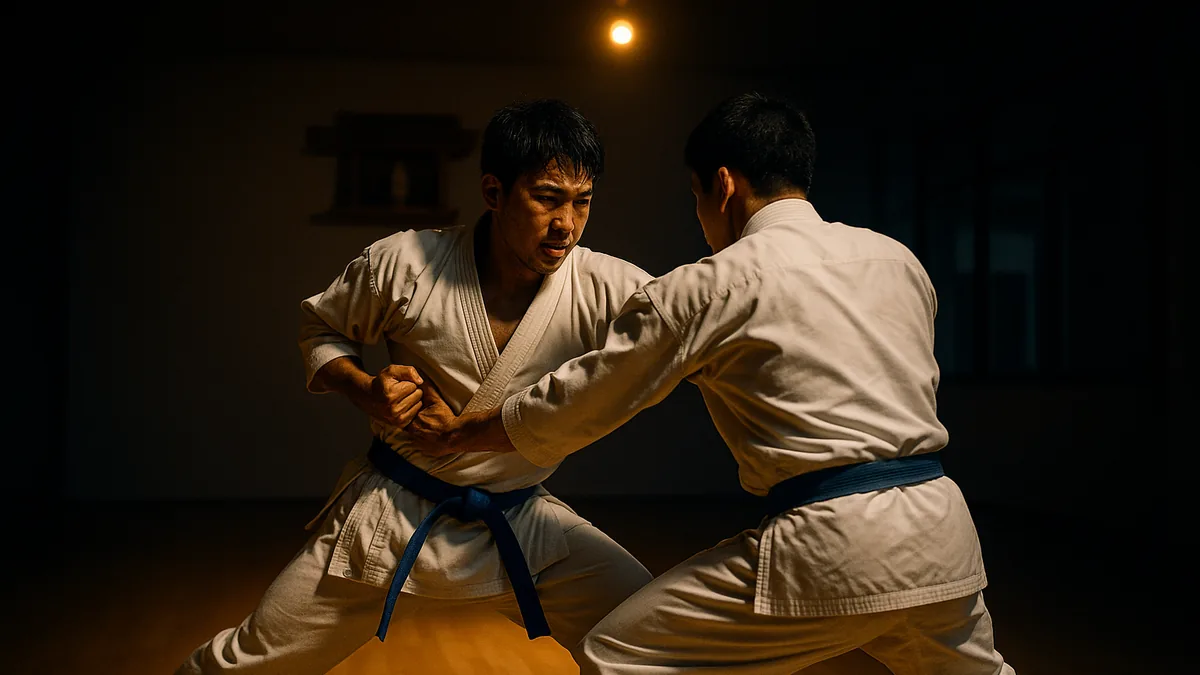
Most karateka at intermediate kyu grade have the same frustrating experience in sparring: the technique feels right, the timing seems reasonable, and the attack still doesn't land cleanly. The instinct is to go back to the bag and refine the punch. That instinct is usually wrong.
The issue, more often than not, is positional. Specifically, it is about centre control - and it is one of the most consistently undertrained skills at club level, not because nobody talks about it, but because footwork drills feel unrewarding compared to working combinations.
This guide gives you a practical way to think about it before your next session.
What Centre Control Actually Is
Forget the idea that centre control means standing in the middle of the dojo. That is not it. It is entirely about your position relative to your opponent - whether you have a direct, unobstructed line to their target areas while they are denied the same line to yours.
When you have it, your attacks travel the shortest route. When you do not, even a technically sound technique arrives at the wrong angle, with reduced power, and is far easier to deal with.
The physical feeling is worth learning to recognise. Being in the centre feels settled - mobile in any direction without needing to reorganise first. Being out of it feels like urgency, a low-level tension, a sense that you need to sort your feet out before you can do anything useful. A lot of beginners assume that second feeling is just what kumite feels like. It is not. It is a signal.
"The partner who has centre control is not necessarily faster or stronger. But every time you try to attack, you are already off-balance."
The Habit That Gives It Away
The most common way intermediate students lose the centre is by chasing a moving opponent. The opponent shuffles to the side, and the student pivots to keep them in front - stepping directly into the opponent's strongest line in the process.
The correction sounds small but changes everything: instead of following the target, you move to reclaim the angle. You step to re-establish the geometry rather than spinning to face wherever they went. Students who make this adjustment often describe it as the moment kumite started to make sense.
The other thing worth knowing is that build affects how you apply this. Taller practitioners can sometimes maintain the angle with less lateral movement because their reach creates the advantage for them. Shorter or heavier practitioners need to be more deliberate about using footwork to create that same geometry - the principle is identical, but the execution requires more active management.
Drills That Build It Faster Than Sparring Alone
Free sparring will not ingrain centre control on its own. There is too much happening for most students to isolate footwork as a variable, and without isolation, bad habits just get reinforced at speed.
Three constrained drills make a real difference:
- The angle drill - footwork only, no techniques. One person moves, the other works solely to maintain the centre angle. Two or three minutes of this makes it immediately obvious who is chasing and who is controlling.
- Restricted sparring - one partner can only move forward and back; the other has full movement. The mobile partner has to use lateral movement with genuine purpose rather than shuffling aimlessly.
- The pressure line drill - one person defends a line on the floor and cannot retreat over it. They have to use positioning to hold the centre without falling back. The discomfort this creates is the point.
Short and regular beats occasional and intensive. Five minutes at the end of every kumite session will do more than a one-off focus session every few weeks.
Checklist for Your Next Class
- Before sparring: remind yourself that centre control is about your angle to your opponent, not where you are in the room.
- During warm-up footwork: practise moving laterally to reclaim position rather than pivoting to face a moving partner.
- In sparring: when an attack fails to convert, ask yourself where your feet were - not what was wrong with the technique.
- Notice the feeling: if you feel urgency or slight imbalance, recognise it as a positional signal rather than just nerves or fatigue.
- After sparring: ask a training partner or your instructor whether you are chasing the target when they move.
- In drilling: request or suggest at least one of the constrained footwork drills - even five minutes of the angle drill will show you something useful.
For the complete version, with every drill explained, read Controlling the Centre in Kumite: What It Means and Why Most Practitioners Ignore It on Karate Lifestyle.
Join the conversation: X · LinkedIn · Pinterest · Bluesky
More from Karate Lifestyle


Comments
Post a Comment