Why Structured Kumite Drills Should Dominate Your Training Time
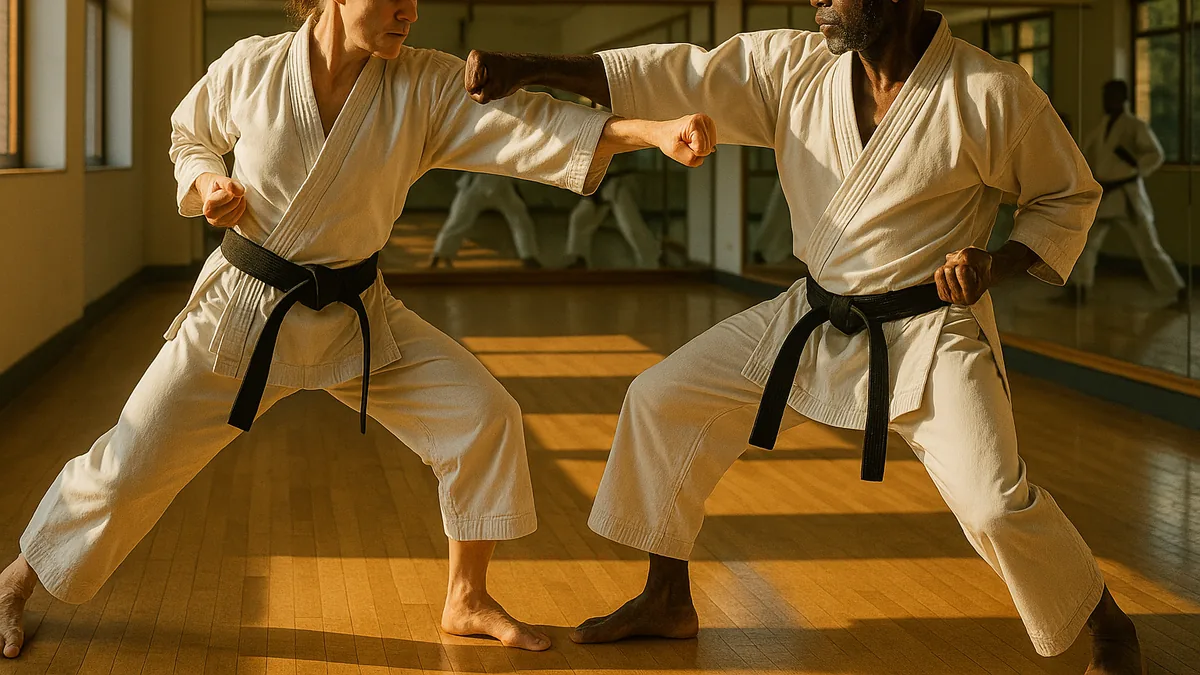
If you feel like you are going round in circles in your kumite - making the same errors week after week, never quite breaking through - there is a good chance the problem is not your technique. It is how you are spending your training time.
Most practitioners below black belt treat jiyu-kumite as the main event and everything else as warm-up. The argument here is that this is the wrong way around. Structured, constrained drills should be taking up the majority of your kumite training time, and free sparring should be the smaller portion where you test what those drills have built.
Here is why that matters, and what you can take into your next session.
Free Sparring Is a Test, Not a Teacher
When you step into a free round with no constraints, you naturally gravitate towards what already works for you. Your favourite distance, your strongest technique, your most comfortable timing. That feels productive, but it is mostly just performance.
The deeper issue is that free sparring actively lets you hide from your weaknesses. If you cannot counter off a failed attack, you simply stop attacking in free sparring - no one forces you to confront it. If pressure makes you freeze, you stay on the outside and pick your moments. You are neither getting better nor worse at those specific problems. You are just working around them.
"Free sparring is primarily a performance context. Structured drills, by forcing you into unfamiliar configurations, are where the deeper learning takes place - even if your performance looks less impressive in the moment."
Constrained drills remove the escape routes. They put you in the uncomfortable positions and make you work through them rather than around them.
What the Drills Actually Do
Three drills are worth understanding in detail.
Single-Technique Counter Flow trains the block and counter as one connected movement rather than two separate actions. When it is working correctly, the energy of the incoming technique redirects into your counter rather than being absorbed by your body. You feel it through the forearm. Most students block, reset, then counter - two distinct moments. The goal is one exhale, one movement. It feels rushed at first. It is not rushing; it is connecting.
Restricted Zone Sparring exposes distance management problems almost immediately. Mark out a small area and stay in it. The moment you cannot step back to reset your range, your default evasion disappears and you are forced to find other solutions - small angles, weight shifts, lateral movement. Students who rely on backward stepping suddenly have to find a different way to work. That is the point.
One-Attack, One-Counter, Freeze is the one students most want to skip, and the one they most need to do properly. After each exchange, both partners stop completely and assess where they are - guard, weight, distance, position. The pause is not a break in the drill. It is the drill. Skipping the freeze turns it into slow free sparring and removes the reflective moment where you actually notice what you did.
How Experience Changes the Way You Use Drills
Beginners doing these drills are focused on mechanics - hands, stance, target. That is appropriate. But as you progress, the drills should start to feel different rather than just look cleaner.
At intermediate level, the mechanics quieten down enough that you can begin to feel the drill - sensing rhythm, reading your partner's weight before they move, noticing the moment before the attack rather than just reacting to it.
Senior practitioners often do these drills slower than beginners, not faster. They are not trying to demonstrate speed. They are searching for micro-details: the tiny shift in weight that telegraphs an attack, the small hesitation that opens a counter. Speed, at that level, is less interesting than precision.
If you are below black belt and you find yourself racing through these drills to make them look impressive, slow down. You are probably performing rather than learning.
Checklist for Your Next Session
Take this into the dojo with you.
- Before free sparring: spend at least as much time on constrained drills as you plan to spend on jiyu-kumite
- In Single-Technique Counter Flow: aim for one exhale across the block and counter - not two separate breaths
- In Restricted Zone Sparring: when you feel the urge to throw wild techniques to create space, slow your breathing first
- In One-Attack, One-Counter: do not skip the freeze - talk out loud about what you felt in your guard, weight and position
- After any drill: give yourself a moment to discuss what you noticed with your partner; the conversation is part of the training
- Check your ratio: if you are spending more time in free sparring than in structured drills, consider flipping it
For the complete version, with every drill explained, read Pressure Testing Your Kumite: Why Controlled Sparring Drills Beat Free-Fighting for Most Practitioners on Karate Lifestyle.
Join the conversation: X · LinkedIn · Pinterest · Bluesky
More from Karate Lifestyle


Comments
Post a Comment