Which Karate Gi Is Actually Worth Your Money?
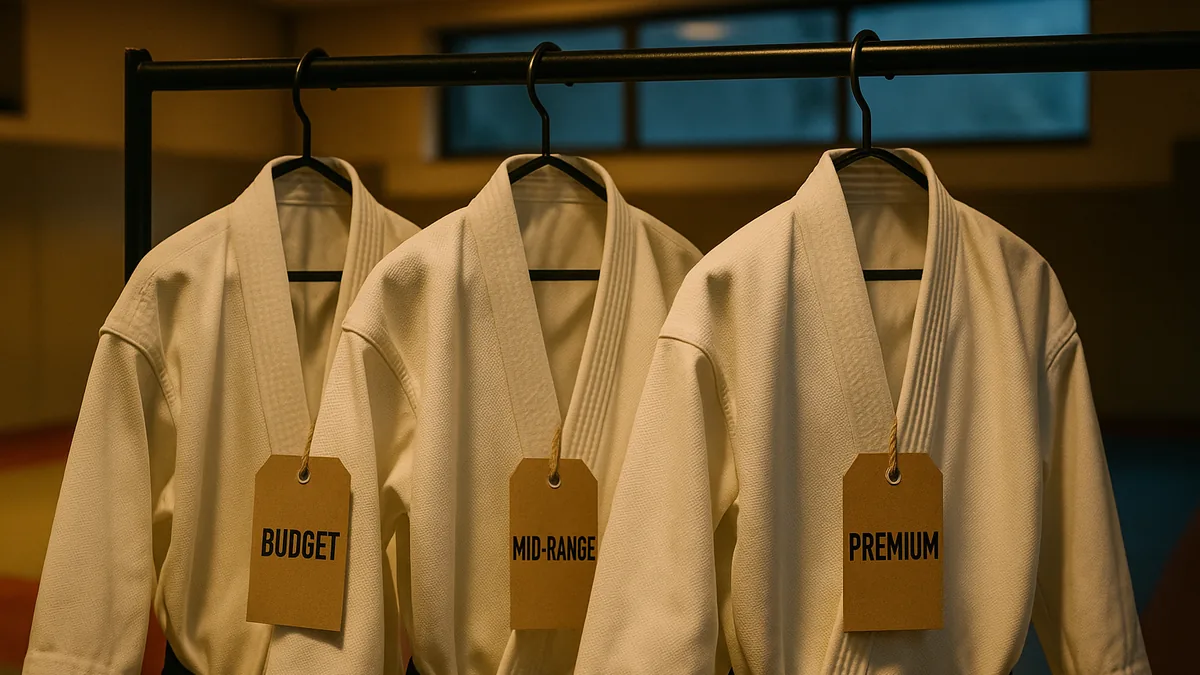
Choosing a gi feels straightforward until you have bought the wrong one twice. Most students either default to the cheapest option available or assume the most expensive must be best. Neither approach is particularly useful. What actually matters is matching the gi to where you are in your training - and understanding what you are genuinely paying for at each price point.
What Happens When You Buy Cheap
Budget gis - anything below roughly £25 to £30 - are typically made from a lightweight polyester-cotton blend, around 65% polyester and 35% cotton, at about 6oz fabric weight. They feel acceptable out of the bag. The problems emerge once regular washing and training get involved.
The failure points are consistent and predictable:
- Collar stitching starts to separate after repeated washing
- Shoulder seams pull apart under any kind of partner work or throwing
- Drawstrings shrink unevenly and become a genuine nuisance to tie
- The fabric loses its body - it goes limp and stops holding a clean shape
That last point is worth pausing on. A gi that has lost its structure does not just look untidy - it stops responding to your movement correctly. When you drive through a clean gyaku-zuki, you want the gi to react as your hips turn through. A worn-out gi simply hangs there. It is a subtle thing, but over hundreds of repetitions it matters.
"The gi is not a neutral object."
For a beginner in their first few weeks, a budget gi is perfectly reasonable. For anyone training consistently past that point, it becomes a false economy.
The Mid-Range Sweet Spot
For most students training more than once a week, gis in the £40 to £80 range represent the most sensible investment. The construction quality at this price point is meaningfully better - higher cotton content, denser weave, and double or triple stitching at the stress points where cheaper gis fail first.
A well-made mid-range gi sits correctly on the body. The jacket does not ride up during kicking combinations. The fabric holds its shape through the wash. Students who make the switch from budget to mid-range often notice quite quickly that their technique looks cleaner in the mirror - not because their karate has suddenly improved, but because the gi is no longer working against them.
One common mistake at this stage, particularly for parents buying for younger students: do not buy a size too large on the basis that they will grow into it. An oversized gi actively interferes with development. The student cannot feel clearly where their limbs are in space, and the instructor cannot see the technique accurately enough to correct it. Buy the correct size now and replace it when they grow. Always use the centimetre measurement rather than the size number, since the same number can represent different heights across different brands.
When a Premium Gi Makes Sense
Premium gis from established manufacturers sit in the £100 to £200-plus range, and for most club students training two or three times a week, they are not a necessity. Once you are training four or more sessions a week, competing, or working towards dan grade, the difference becomes tangible.
Heavier kata gis - typically 8oz to 12oz and above - are built specifically to produce the characteristic snap of the fabric during explosive technique. That sound is not just satisfying; it provides genuine physical feedback that the movement has been executed correctly. The gi is responding to your technique rather than simply following it.
The longevity argument is also worth taking seriously. A premium gi from a quality manufacturer, properly cared for, can remain in good condition for ten to twenty years. When you calculate cost per session across a five-year training period, it frequently works out cheaper than replacing budget gis every six months.
If you are training once a week at a recreational level, a premium gi is probably not where your money should go. Extra instruction will do more for your karate.
Checklist for Your Next Class
Bring this to your next session and be honest with yourself:
- Check your collar and sleeve seams - are they holding, or starting to pull away from the fabric?
- Look at the fabric itself - does it still have body and hold a clean line, or has it gone limp?
- Assess the fit - is the gi sitting correctly, or riding up and shifting during combinations?
- Consider your training frequency - more than once a week consistently means a mid-range gi is worth the investment
- If you compete or train four-plus sessions weekly - ask yourself whether a premium gi is now the right tool for the level you are working at
- If you are buying for a junior student - measure in centimetres and buy the size that fits now, not the size for next year
For the complete version, with every drill explained, read Do Cheap Karate Gi Fall Apart? Budget vs Mid-Range vs Premium Brands Compared on Karate Lifestyle.
Join the conversation: X · LinkedIn · Pinterest · Bluesky
More from Karate Lifestyle


Comments
Post a Comment