What Your Kata Syllabus Is Actually Teaching You (And Where It Came From)
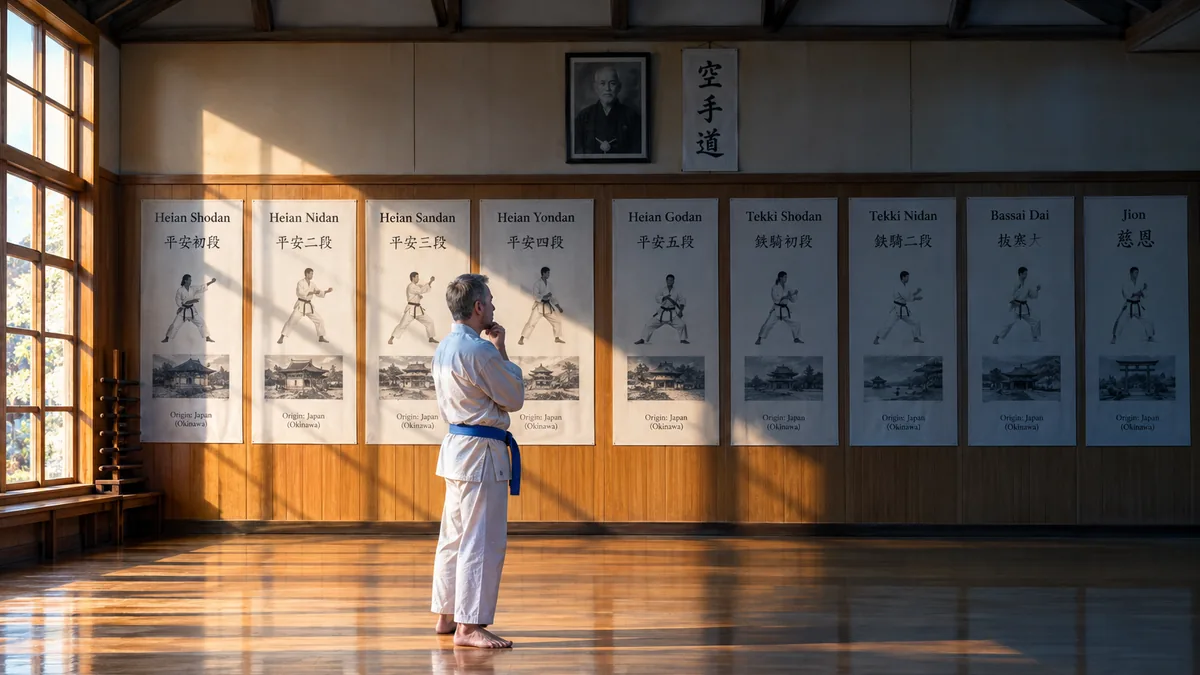
Most Shotokan practitioners can list the kata on their syllabus. Far fewer know who created them, when, or why - and that gap quietly undermines how well they train. This guide pulls out the practical points from our full article on the Shotokan kata list, so you can take something useful to your next session.
The Syllabus Is Not What You Probably Think It Is
The 26-kata JKA curriculum was codified from the 1950s onward, largely through the work of senior instructors after Funakoshi's time. Funakoshi's own published record lists only 15 of those kata (setting aside the Taikyoku group). That means more than a third of the forms practised today in JKA-affiliated dojos were added after his published work.
This is not a criticism of the syllabus - it is genuinely useful to know. When you hear authenticity arguments in the dojo or online, they almost always rest on the assumption that the current 26-kata list represents Funakoshi's vision. It does not, quite. It represents the vision of the senior instructors he trained, which is a different but equally legitimate thing.
Funakoshi himself wrote that a practitioner should focus on around 19 kata and train in them exclusively. The irony is that the style bearing his name now teaches considerably more than that.
The Heian Kata Are a Curriculum, Not a Warm-Up
The five Heian were not created by Funakoshi. They were developed by Itosu Anko in 1905, drawing from two older forms - Kusanku and Chiang Nan - specifically to give schoolchildren a structured entry point into karate. Funakoshi renamed them from Pinan to Heian when he brought karate to Japan.
Understanding that origin matters practically. These forms were designed as a progressive system, not five separate exercises. As the full article puts it:
"The Heian kata are not five separate things. They are a progressive curriculum for developing a specific set of body mechanics: hip rotation, weight transfer, transition between stances, and the relationship between blocking and counterattacking."
If your Heian kata feel comfortable, you are almost certainly not performing them with enough precision and intent. Heian Shodan establishes the foundations. By Heian Godan, you are dealing with jumping techniques, simultaneous block-and-strike combinations, and complex directional changes. That progression is deliberate, and it rewards being treated seriously at every grade.
Two Technical Points That Change Everything
In the Tekki series, the hips must lead - not the feet.
Tekki's lateral movement pattern exposes weaknesses that forward-and-back training can hide for years. If your hips are passive when you move sideways, the techniques have no structural foundation regardless of how tidy your arm positions look. Many instructors cue this as pushing the floor away rather than stepping sideways, because that framing keeps the hips driving the movement.
In intermediate and advanced kata, fast and slow are structural - not decorative.
The contrast between controlled, deliberate sections and explosive fast sequences is one of the defining features of kata like Bassai Dai and Kanku Dai. When that contrast collapses into a uniform medium pace - which is the most common mistake at intermediate level - the kata loses its architecture entirely. The slow sections build tension and precision; the fast sections discharge that accumulated focus. Getting that contrast right is what separates a technically correct performance from a genuinely good one.
A connected point: Yoshitaka Funakoshi, Gichin's son, shaped modern Shotokan significantly - introducing longer and deeper stances and side kicks, and studying under Kenwa Mabuni, the founder of Shito-ryu. The Shotokan you practise today reflects his influence as much as his father's.
Checklist for Your Next Class
- Heian kata - pick one and perform it slowly, focusing only on hip rotation and weight transfer between stances. Notice where the mechanics break down.
- Tekki Shodan - on every sideways movement, check whether your hips initiated it or your feet did. If the feet led, reset and repeat.
- Intermediate kata - identify the fast sections and the slow sections before you begin. Perform the slow sections at half your usual speed and see whether the quality holds.
- Any advanced kata you are working on - find the sections you rush through. Those are usually where the real work is.
- Authenticity arguments - next time someone insists a kata is or is not "true Shotokan", ask which reference point they are using: Funakoshi's 1935 published list, or the JKA's post-1950s codification. The answer changes the conversation.
For the complete version, with every drill explained, read Shotokan Kata List: Every Form in the Syllabus, Its Origin, and Why Funakoshi's Original Set Keeps Getting Debated on Karate Lifestyle.
Join the conversation: Facebook · X · LinkedIn · Pinterest · Threads · Bluesky
More from Karate Lifestyle


Comments
Post a Comment