What Kyokushin and Uechi-Ryu Actually Have in Common (And Why It Matters)
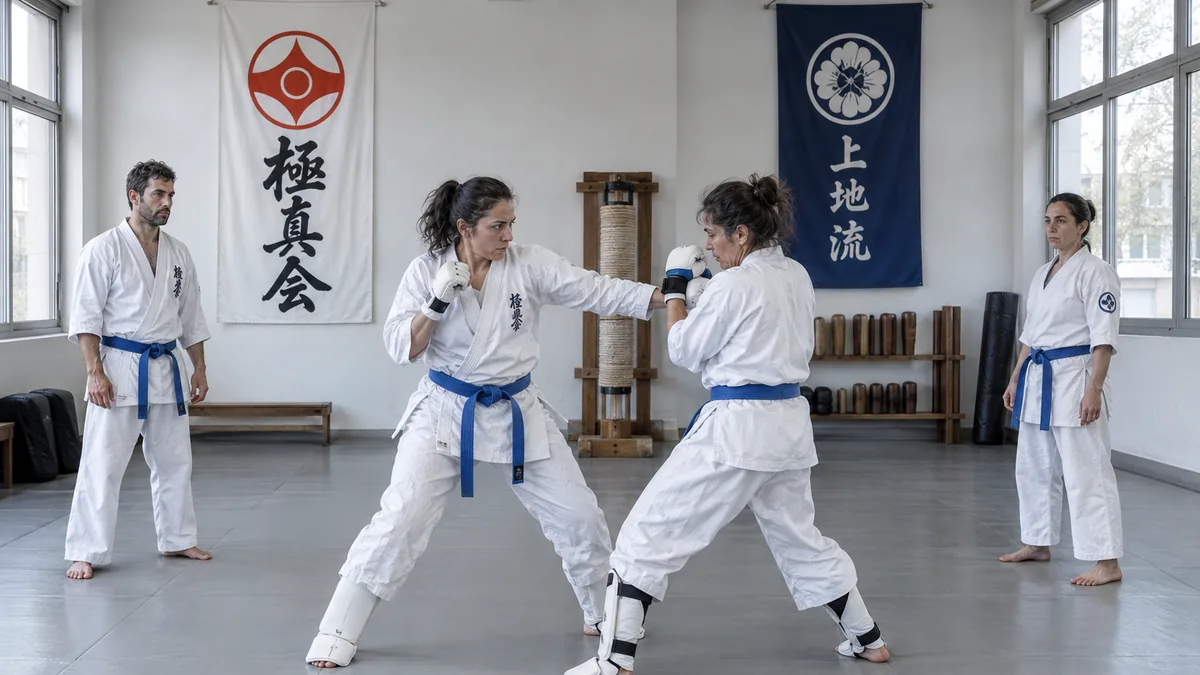
If you have ever watched a Kyokushin practitioner and an Uechi-Ryu practitioner spar together for the first time, you will notice something odd: they get on immediately. The work ethic matches. The tolerance for contact matches. Despite coming from completely different traditions with different kata, different stances, and different organisational histories, they recognise something in each other. This guide pulls out the practical reasons why, and what you can take from it into your own training.
Conditioning Is Not Separate From Technique
This is the point that catches most intermediate practitioners off guard. In both styles, the conditioning work is not preparation for technique - it is technique training. Uechi-Ryu's kote kitae forearm conditioning teaches you to receive force through a stable structure and breathe correctly under impact at the same time as it hardens the limbs. Kyokushin's partner drills and knockdown sparring do the same thing through volume and escalation.
The practical mistake is treating pad work, conditioning drills, and sparring as three separate boxes. When you do them with that mindset, you end up with a body that performs well in each box separately and loses coherence when the pressure becomes real. Both styles correct for this by making the pressure continuous and structural rather than occasional.
Uechi-Ryu's signature techniques - the one-knuckle punch, the thumb strike, the toe kick - cannot function as intended without years of dedicated conditioning first. The conditioning is a prerequisite, not an add-on. Kyokushin's body and leg work makes the same demand: if your core has not been built to absorb impact, the tournament format will expose it immediately.
The Flinch Response Is Trainable
Both styles are built around a specific outcome that is easy to overlook because it looks like personality: the absence of flinching. Practitioners from both traditions tend not to lose structure at the moment of contact. They do not pull back when something lands. This is not a character trait. It is a product of systematic, progressive exposure to real contact from early in training.
The mechanism differs between the two styles. Kyokushin builds this through cumulative sparring volume - you spar enough, hard enough, often enough that contact becomes ordinary. Uechi-Ryu builds it partly through sanchin kata and the shime process, in which a senior practitioner uses deliberate strikes and pushes during the kata to expose any weakness in structure, breathing, or tension. The shime approach has an advantage for beginners: it gives them a clear framework they can feel the feedback from straight away, rather than requiring a training hall full of experienced sparring partners.
"The toughness is not about being willing to get hurt. It is about not being distracted by getting hurt."
That distinction matters practically. A practitioner who has learned to ignore discomfort is different from one who has learned to work through it without losing focus or structure. The second one is what both styles are actually producing.
Where the Habits Diverge - and Why Cross-Training Works Anyway
The two styles do create different habits, and it is worth knowing which ones before you cross-train. Kyokushin's knockdown competition rules prohibit hand strikes to the head, which produces excellent body fighters but also produces some identifiable patterns: not moving the head defensively, holding the guard over legal targets rather than in front of the face, and finding comfortable distances that would be punishable by a skilled puncher.
Uechi-Ryu's close-range emphasis and sanchin stance suit infighting and compact exchanges. The range preferences of both styles actually align fairly well in practice, even though the specific techniques do not. Put a Kyokushin fighter and an Uechi-Ryu fighter together and the distance they both prefer tends to be similar; what they do at that distance is where the vocabularies differ.
Body conditioning transfers between the two styles almost immediately when cross-training. Range management and the specific technical habits take longer to adjust, because the competition formats have shaped each style's practitioners in ways that are not always obvious until you are actually working together.
Checklist for Your Next Class
- Test your conditioning during technique work, not after it. If you are doing kihon or kata without any structural testing, you do not know whether your technique holds under pressure.
- Ask a senior to check your structure mid-kata. If your style includes a shime equivalent, use it. If it does not, have a partner apply light resistance during basics and notice where you collapse.
- Watch how you react to feints. Economy of reaction is a marker of genuine composure under pressure. If you are moving to everything, the composure is not there yet.
- Notice where you hold your guard during sparring. Is it protecting the legal targets in your competition format, or protecting your face? Both have their logic; knowing which you are doing is the starting point.
- Be patient with conditioning timelines. Structural adaptation - real composure under impact, genuine stability when force comes in - takes years. Styles that shortcut this produce practitioners who perform well in controlled conditions and struggle when those conditions change.
- If you cross-train with a contact-oriented style, expect the body conditioning to transfer quickly and the range habits to take longer. Plan your adjustment time accordingly.
For the complete version, with every drill explained, read Kyokushin vs Uechi-Ryu: Why Two Full-Body-Contact Traditions With Completely Different Origins Produce Surprisingly Similar Fighters on Karate Lifestyle.
Join the conversation: Facebook · X · LinkedIn · Pinterest · Threads · Bluesky
More from Karate Lifestyle


Comments
Post a Comment