What Board Breaking Actually Tests (And How to Use It Properly)
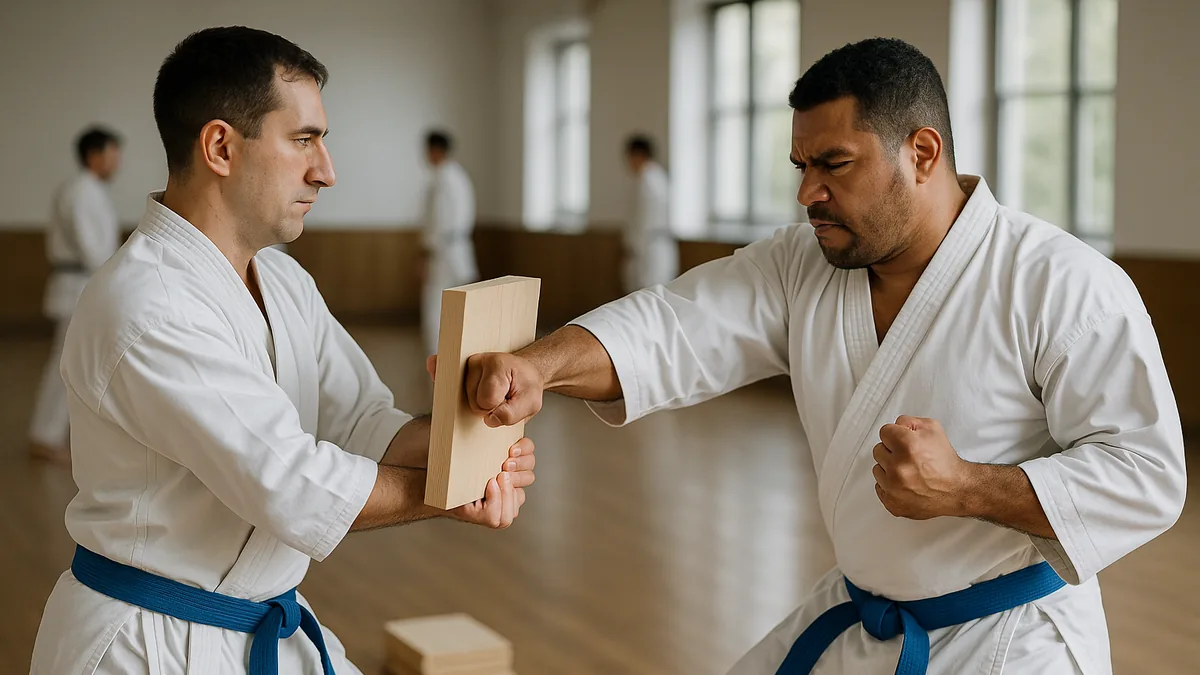
Most karateka who struggle with board breaking assume the problem is physical. It rarely is. The issue is almost always technical - and more specifically, it is usually a single correctable error in where the mind is aimed before the strike lands. Getting this right matters whether you are a student preparing for a grading or an instructor designing a breaking curriculum that actually develops technique.
This guide pulls out the practical essentials so you can apply them at your next session.
The Focus Point Error That Explains Most Failed Breaks
When a break fails, the instinct is to blame power, board thickness, or nerves. In most cases, the real culprit is simpler: the practitioner is aiming at the surface of the board rather than past it.
When your mental target is the board's surface, that is where your strike peaks. The movement stops at contact instead of accelerating through it. Shift your focus point to several inches beyond the far side of the board and the board stops being a destination - it becomes an obstacle your technique passes through. This single adjustment resolves more failed breaks than any change in equipment or conditioning.
As the full article puts it:
"The board does not fix technique. The board reveals it."
The same logic applies to kime. That sharp full-body contraction at the end of the technique is what transfers force efficiently through the complete power chain - from the lower body, through the core, and into the upper body at the point of impact. Without it, you are pushing rather than striking, and pushing does not break boards regardless of how strong you are.
Matching the Board to the Purpose
Reusable boards and wooden boards are not interchangeable. They serve genuinely different functions, and using them interchangeably is one reason practitioners do not get as much from tameshiwari training as they could.
Reusable boards are conditioning tools. Their job is to build the habit of committing through the target under repetition. Because their resistance is consistent - there is no grain to exploit, no variation between one board and the next - they give you an honest measure of whether the technique is correct. A wrong technique does not break them. A right technique does. That consistency is a real coaching advantage, and the fact that they reset immediately means you can train volume without budget problems.
Wood is a diagnostic tool. The feedback you get from a clean pine break is qualitatively different from what a reusable board provides. Specifically, wood reveals structural problems - particularly around wrist alignment - that plastic can conceal. A practitioner can develop reasonable breaking technique on reusable boards while carrying poor wrist alignment, and not notice until they move to wood. Under real impact load, that misalignment becomes apparent immediately. Poor alignment is not just inefficient; it is a genuine injury risk.
The two types work best in combination: use reusable boards for regular conditioning sessions to groove the motor pattern, and wood for diagnostic work and grading to confirm that the structure holds under real conditions.
What to Check Before You Blame the Equipment
If your breaking is inconsistent, run through these before changing anything about your boards or your training volume:
- Focus point - is your mental target the board's surface, or several inches past it?
- Kime - is there a sharp contraction at the end of the technique, or are you pushing through contact?
- Wrist alignment - does your structure stay correct under impact, or does it collapse at contact?
- Hip engagement - is the lower body driving the technique, or is the power coming only from the arm?
- Flinching - are you pulling back fractionally before contact? High-volume work on reusable boards is the remedy here, not willpower.
Checklist for Your Next Session
- Set your focus point several inches past the far side of the board before every attempt
- If you are drilling for volume and commitment, use a reusable board and repeat until the follow-through is automatic
- If you are checking structure and alignment, use wood and pay attention to what the feedback tells you - not just whether it breaks, but how the impact travels back through your hand and wrist
- Check wrist alignment consciously on every repetition, not just when something goes wrong
- Do not mix conditioning sessions with diagnostic sessions - decide the purpose before you start
- If a break fails, correct the focus point first before changing anything else
For the complete version, with every drill explained, read Breaking Boards for Karate: Reusable vs Wood, and What Actually Improves Your Technique on Karate Lifestyle.
Join the conversation: X · LinkedIn · Pinterest · Bluesky
More from Karate Lifestyle


Comments
Post a Comment