Two Styles, Two Answers: What Kyokushin and Wado-Ryu Reveal About Your Training
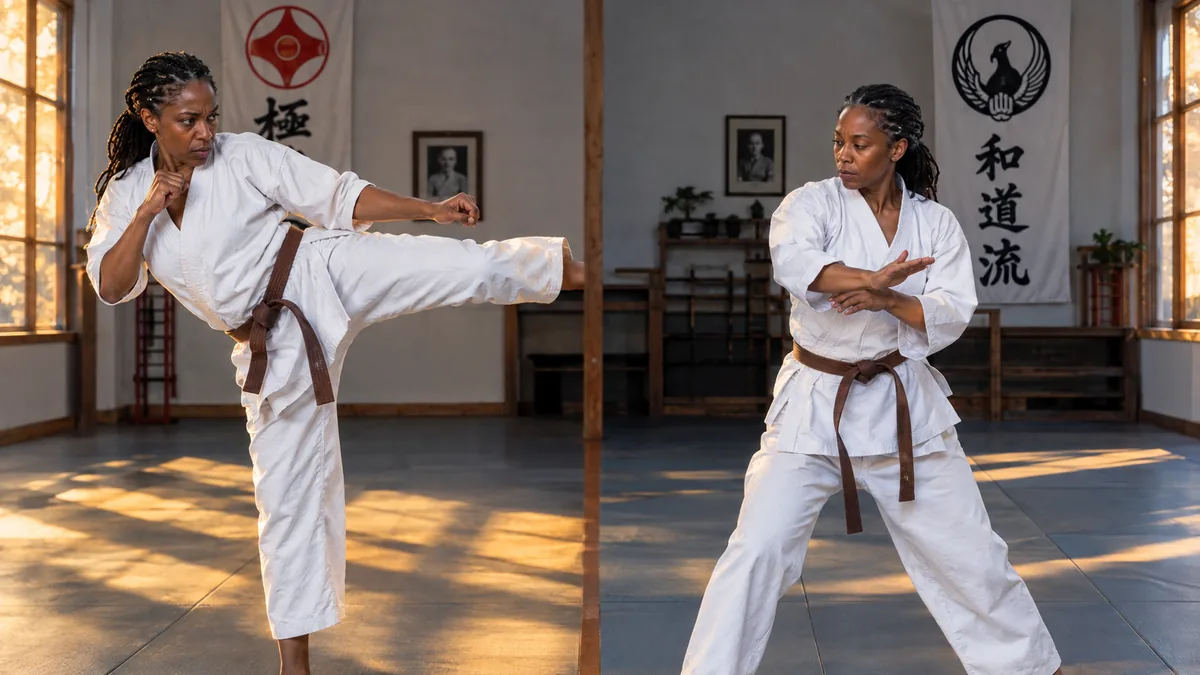
Most karateka spend years training one system without stopping to ask what that system is actually building in them. Kyokushin and Wado-Ryu make that question impossible to avoid, because they sit at genuinely opposite ends of what karate training can look like. Putting them side by side is not an exercise in style comparison for its own sake - it is a useful lens for any practitioner who wants an honest picture of their own development.
The Central Question Each Style Answers Differently
Kyokushin is built around a clear premise: when contact arrives, you need to be able to absorb it and keep working. Every element of the training system - the conditioning drills, the full-contact sparring, the competition format - flows from that starting point. The body hardening work (makiwara, knuckle push-ups, shin conditioning) is not a fitness add-on. It is the technical foundation, because the style demands a body capable of both delivering and receiving real force without breaking down.
Wado-Ryu starts from a different place entirely. Its approach to body mechanics - tai sabaki, the displacement and redirection of incoming force - is not about building tolerance to impact. It is about ensuring the impact does not connect cleanly in the first place. The defence and the counter are not two actions performed in sequence; they are one continuous motion, which is why beginners learning it often feel they are doing nothing. The footwork moves the body off the attack line while the counter is already forming. When the timing is internalised, it becomes efficient in a way that is difficult to appreciate from the outside.
As the full article puts it:
"Kyokushin says: be hard enough that it does not stop you. Wado says: be precise enough that it does not land."
Neither answer is wrong. They are solving different problems.
What Each Format Is Actually Testing
Kyokushin's knockdown competition ruleset is worth understanding because it shapes fighters in specific ways - including some that do not transfer cleanly outside the format. Hand strikes to the head are prohibited in traditional knockdown competition, which pushes fighters toward body attacks and leg kicks requiring genuine structural power. That pressure-testing is real and valuable. But it also means fighters can develop gaps in defending against hand attacks to the head, simply because the format does not require them to deal with that threat regularly. Acknowledging this honestly is more useful than ignoring it.
Wado-Ryu treats sparring as one tool among several rather than the definitive test. The paired drilling work - kihon kumite and the structured kata sequences - develops specific timing and entry skills that free sparring at full speed does not reliably teach on its own. This is not a lowering of standards; it is a different methodology for building precision. The jujutsu roots of the style also mean Wado retains throws, joint locks, and closer-range awareness that most pure striking systems have largely set aside, giving its self-defence applications a different texture.
Where Cross-Training Awareness Pays Off
The practical value of understanding this distinction is not that you should switch styles. It is that knowing what your current training is optimising for lets you identify what it is not developing.
A Kyokushin practitioner who has never experienced a well-timed tai sabaki entry will be genuinely surprised by it - not because they lack ability, but because their training has not required them to deal with that kind of angular, redirecting movement. A Wado practitioner who has never had to keep working after absorbing a full-power body shot has a different kind of gap. Both are real. Neither makes the practitioner a fraud in their own system. But spotting the gap is the first step to addressing it.
Senior practitioners across both styles tend to move away from asking "which style is better?" and toward asking "better for what?" That shift in framing is worth making earlier rather than later.
Checklist for Your Next Class
- Identify what your sparring format is testing - and what it is not. Every ruleset selects for certain skills and de-selects others.
- If you train Kyokushin, treat the conditioning work as technical training, not just fitness preparation. It is building the physical foundation the style requires.
- If you train Wado, focus your tai sabaki practice on the footwork first. The hands follow the body - if the displacement is right, the counter arrives naturally.
- If your format excludes certain attack types, make sure you are supplementing with work that addresses those gaps, particularly in a self-defence context.
- Ask yourself honestly: is your training building toughness and forward pressure, precision and redirection, or some combination? Knowing the answer tells you where to look for what is missing.
- Consider structured drilling and free sparring as complementary, not competing. Each builds something the other does not reliably teach on its own.
For the complete version, with every drill explained, read Kyokushin vs Wado-Ryu: Why the Two Styles Represent Opposite Ends of What Karate Training Can Look Like on Karate Lifestyle.
Join the conversation: Facebook · X · LinkedIn · Pinterest · Threads · Bluesky
More from Karate Lifestyle


Comments
Post a Comment