Two Okinawan Styles, Two Different Bets: Shorin-Ryu and Uechi-Ryu Compared
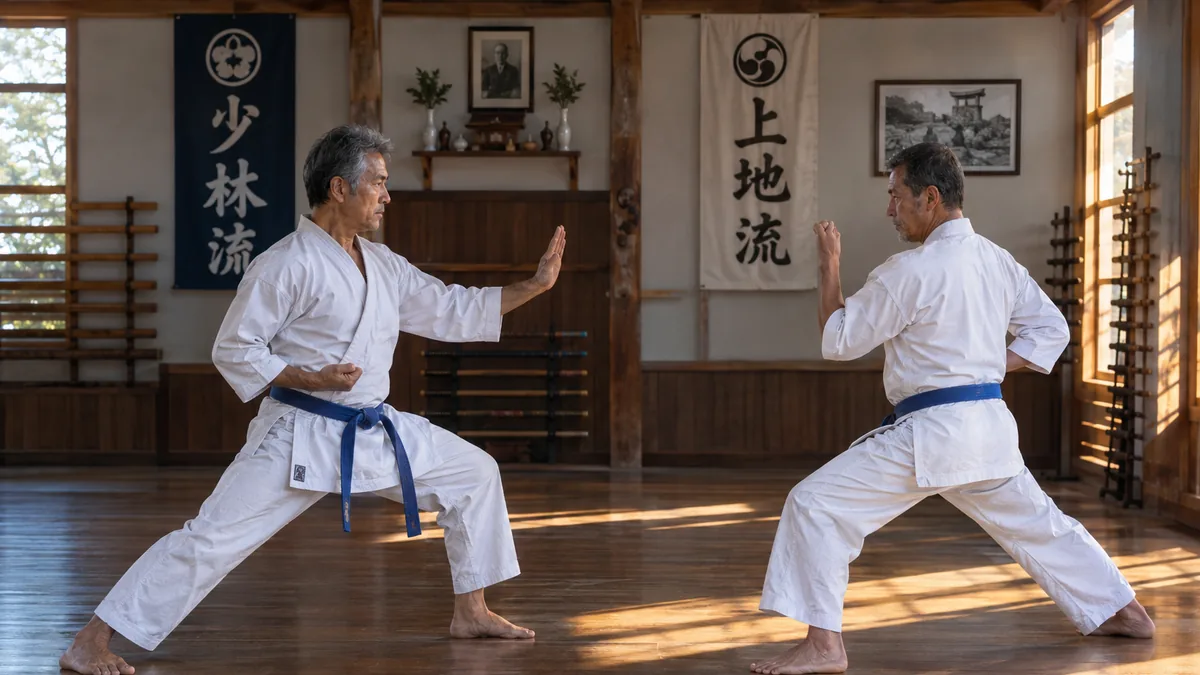
If you train in Okinawan karate, you have probably noticed that not all styles are simply variations on a theme. Shorin-Ryu and Uechi-Ryu are a clear example. They share an island and a rough century of parallel development, but they come from entirely separate cultural and historical roots - and those roots produce practitioners who move differently, train differently, and think about fighting differently. Understanding why that is the case matters before you try to compare them, cross-train between them, or simply deepen your grasp of whichever one you already do.
The Logic Each Style Is Built On
Shorin-Ryu grew from Okinawa's Shuri-te tradition, shaped by the practical demands of people who needed fast, efficient striking and the ability to move well under pressure. The style's upright, mobile stance and sharp, snappy techniques are not arbitrary - they reflect a tactical position that prizes speed and angular movement over structural mass.
Uechi-Ryu has a completely different origin. Its founder brought a southern Chinese system back to Okinawa, one built around iron body conditioning, close-range durability, and the deliberate development of physical toughness as a fighting asset. These are not minor differences in emphasis. They represent genuinely different answers to the question of what makes a body effective in a fight.
Shorin-Ryu bets on not being in front of the strike when it lands. Uechi-Ryu bets on being able to absorb that strike and keep functioning. Both positions are coherent. Neither is naive. But they produce very different training cultures and very different practitioners.
What Each Style Actually Demands of You
In Shorin-Ryu, the central quality you are developing is speed through relaxation. Most beginners grip too hard, brace too early, and drive the shoulder before the hip. Telling someone to relax is useless advice under pressure - what actually works is drilling the snap-and-release timing until unnecessary tension stops being the default. As the full article puts it:
"You will feel it when it happens: the technique suddenly feels almost effortless and lands with more impact than the tense version ever did."
In Uechi-Ryu, the foundation is Sanchin kata - a short, slow, intensely demanding form focused on structural integrity under sustained muscular engagement. Instructors test this mid-form by pushing, pulling, and striking the practitioner, a practice called shime testing. Sanchin is not a warm-up. It is the structural core of the entire system, and the principles it builds run through everything else the style does. The conditioning work - partner forearm and body drills known as kotekitae - is equally non-negotiable. A version of Uechi-Ryu that removes the conditioning has changed what the style is actually for.
Where Cross-Training Goes Wrong
Practitioners who move between these styles tend to make predictable mistakes, and most of them come from carrying one style's muscle memory into the other's training.
Coming from Shorin-Ryu into Uechi-Ryu:
- Rushing through Sanchin - the slowness is the point, not a sign the kata is easy
- Treating conditioning drills as supplementary rather than central to the system
- Trying to use Shorin-Ryu's mobile stance in Uechi-Ryu sparring, where a rooted structure is required
Coming from Uechi-Ryu into Shorin-Ryu:
- Carrying sustained tension into techniques that need snap-and-release timing - the same engagement that protects you in Sanchin will slow your reverse punch
- Standing too flat-footed in faster-paced kumite where staying in motion is the whole defensive strategy
- Underestimating the application depth in Shorin-Ryu kata like Passai or Kushanku because they look less intense than Sanchin
Recognising which assumptions you are carrying is the first genuinely useful step.
Checklist for Your Next Class
Take these questions with you, whichever style you train:
- Shorin-Ryu practitioners: In your last technique, where did the tension live? Hip first, then the arm - or shoulder first?
- Uechi-Ryu practitioners: Are you treating Sanchin as a warm-up, or giving it the focused attention the rest of your training depends on?
- Both: Do you know which question your style is answering about fighting - evasion or absorption?
- Cross-trainers: Before your next session in the other style, name one assumption from your home system you are likely to carry in by default
- Both: Is your dojo's version of the style keeping the load-bearing elements intact - conditioning in Uechi-Ryu, mobile footwork in Shorin-Ryu - or have those been quietly reduced over time?
For the complete version, with every drill explained, read Shorin-Ryu vs Uechi-Ryu: How Two Okinawan Styles With Completely Different Roots Ended Up Sharing the Same Island and Almost Nothing Else on Karate Lifestyle.
Join the conversation: Facebook · X · LinkedIn · Pinterest · Threads · Bluesky
More from Karate Lifestyle


Comments
Post a Comment