Two Okinawan Styles, Almost Opposite Principles: What Cross-Training Reveals
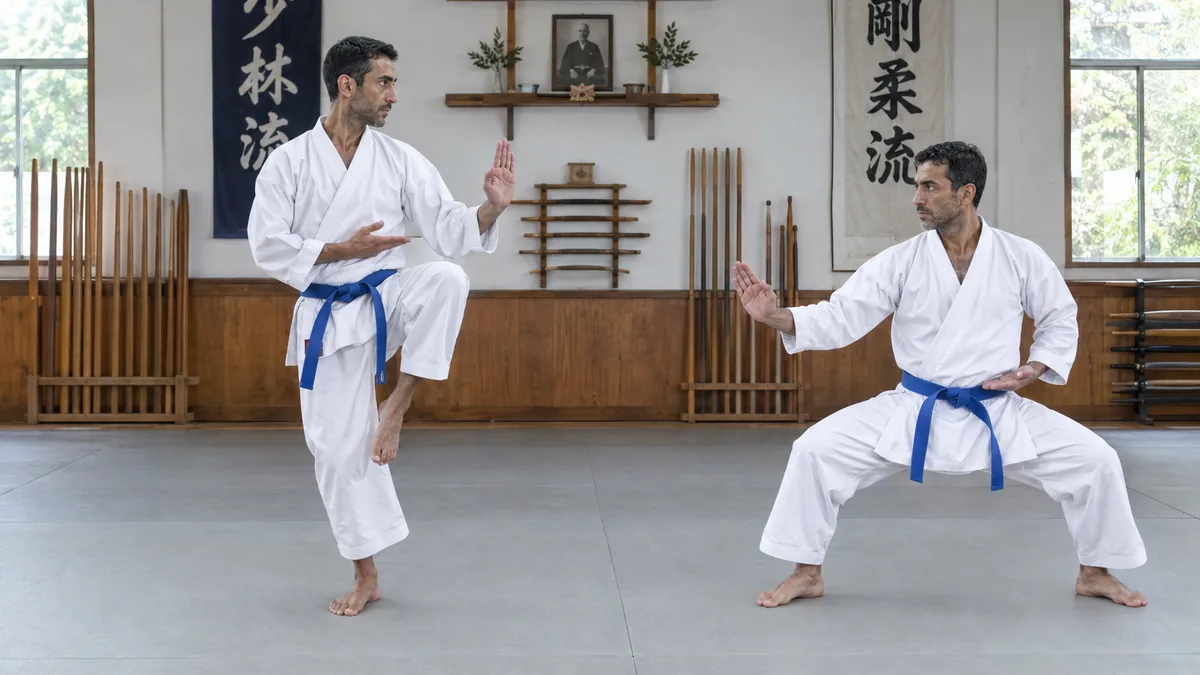
If you have ever stepped into a class from the other Okinawan tradition and felt immediately lost, you are not imagining it. Shorin-Ryu and Goju-Ryu share the same island and overlap in kata, yet the way each style asks you to use your body is almost inverted. This guide pulls out the practical points worth bringing to your next session - whether you cross-train, or simply want to understand why your own style makes the structural choices it does.
Speed and Power Are Built Into the Structure, Not Added on Top
The most common misreading practitioners bring when moving between these two styles is treating speed and power as qualities of effort rather than structural principles.
In Shorin-Ryu, the high, narrow stances are not a beginner convenience - they exist to make fast footwork and weight transfer possible. The style does not load up before striking. Movement and strike are often a single event. If you arrive from Shotokan or Goju-Ryu carrying deep stances and pre-loaded tension, you are directly working against what the style is trying to do. The correction is simple but uncomfortable: stay light underfoot, release the strike rather than drive it, and if your heels feel heavy you have already gone wrong.
Goju-Ryu takes the opposite position. Its power is generated from the inside out through ibuki breathing - a forceful, coordinated contraction of the abdomen, hips and full body that arrives slightly before the technique lands, not after it. If the breath follows the strike, the point of the technique has been missed entirely. Most beginners confuse this with gripping everything hard all the time, which produces slow, stiff movement and eliminates the soft half of the style completely. The correction is the same principle as good karate anywhere: stay loose during movement, contract at the moment of impact only.
Kata Are Not Interchangeable Documents
Both styles treat kata as the main vehicle for transmitting technical knowledge, but the kata themselves reflect the split in principles almost exactly.
Shorin-Ryu kata tend to be longer, more mobile sequences. The execution should feel light - weight shifts are decisive but not heavy, and combinations flow without resetting between techniques. Goju-Ryu kata are shorter on average but considerably denser. Sanchin, the foundational kata of the style, covers very little ground and can take years to perform correctly. It is primarily a breathing and body-conditioning exercise, designed to build internal qualities the practitioner feels rather than to look impressive from the outside.
Applying the wrong interpretive lens to either produces technique that looks approximately right but feels hollow. A Shorin-Ryu practitioner will tend to rush Goju-Ryu transitions and lose the breathing entirely. A Goju-Ryu practitioner will over-root in Shorin-Ryu kata and lose the lightness that gives the style its character. Both errors come from the same place: the body defaults to what it already knows.
"The contrast makes visible what your primary style does that you've stopped noticing."
The Sparring Logic Differs Completely
In jiyu-kumite, each style operates on a different strategic premise.
Shorin-Ryu works by managing distance and timing. The practitioner controls the entry window - slipping or redirecting rather than absorbing, and firing on the opponent's preparation rather than waiting for the attack to arrive. Getting caught at mid-range and standing still is the worst place to be.
Goju-Ryu works by collapsing that distance. Once inside punching range, short powerful strikes, receiving techniques and grip-based work become decisive. A Goju-Ryu practitioner is not trying to stay safe through distance - they are trying to get close enough that their structure and breath-driven power are the dominant factor. The two approaches are not just different tactics; they are different answers to the question of what makes a situation manageable.
Checklist for Your Next Class
Bring these points with you and test them against what you actually feel in practice:
- Check your stance height. Are you as light underfoot as the style requires, or are you carrying tension from a different system?
- Track where your breath lands. Does it arrive with the technique or after it? In Goju-Ryu especially, after is wrong.
- Notice your kata transitions. Are you rushing through them to get to the next technique, or are you giving each position its correct weight and duration?
- Ask what your kata is actually for. Is it a mobility and combination exercise, or an internal conditioning tool? The answer should change how you perform it.
- In sparring, identify your default range. Are you managing distance, or closing it? Is that a conscious choice or just habit?
- If you cross-train, slow down. The body fights itself when switching between these two styles. Working at reduced speed while staying conscious of the new principles is more useful than drilling at full pace with the wrong defaults.
For the complete version, with every drill explained, read Shorin-Ryu vs Goju-Ryu: How the Two Dominant Okinawan Traditions Split from the Same Island and Ended Up Teaching Almost Opposite Principles on Karate Lifestyle.
Join the conversation: Facebook · X · LinkedIn · Pinterest · Threads · Bluesky
More from Karate Lifestyle


Comments
Post a Comment