Training Frequency in Karate: Work Smarter, Not Just More
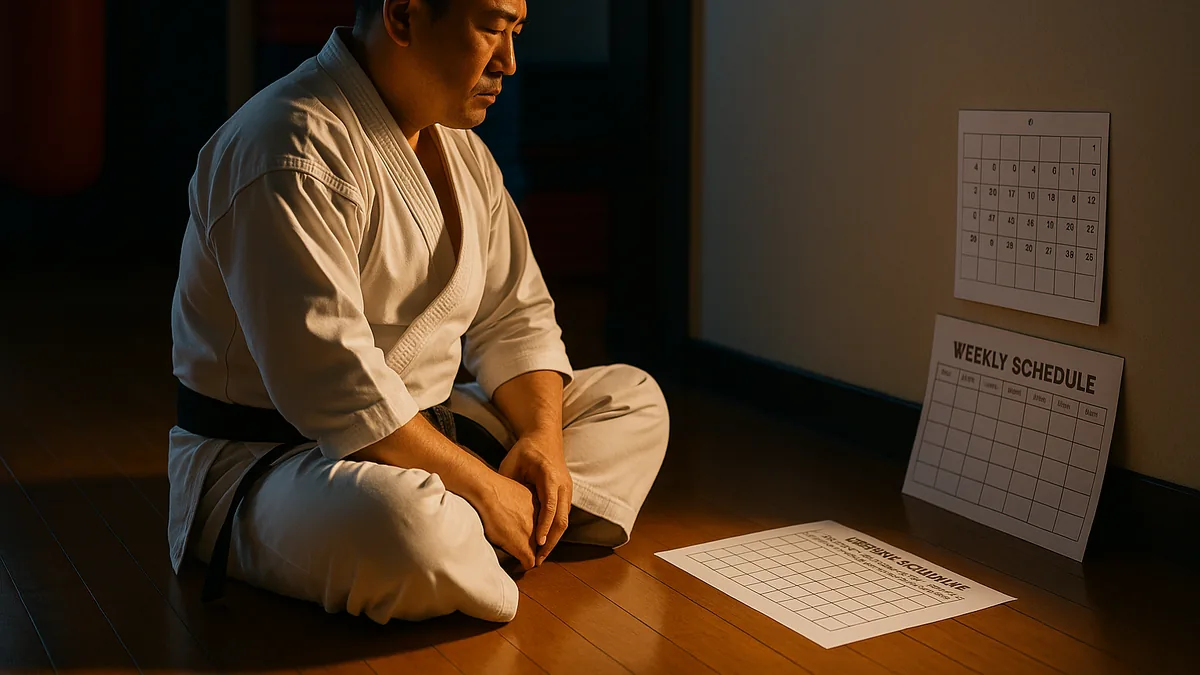
Most karate practitioners at some point ask themselves whether they are doing enough. The answer is rarely as simple as adding another session. Frequency matters, but it sits alongside intensity, recovery, and purpose - and getting the balance wrong in either direction will hold you back.
This guide pulls out the practical points so you can apply them before your next class.
More Sessions Does Not Mean Faster Progress
There is a common phase, often around the intermediate grades, where enthusiasm tips into overtraining. More floor time feels like the obvious route to improvement, but the relationship between volume and progress is not linear.
"A focused 90-minute session three times a week will outperform six half-hearted sessions every single time."
Physical recovery is the obvious reason - muscles repair and strengthen during rest, not during the session that taxed them. But the cognitive side is just as important. Motor skill consolidation, the process that turns an unfamiliar movement into a reliable one, happens during the rest periods between sessions rather than during practice itself. Rest is not lost training time; it is when the learning settles.
If you have ever drilled a combination until it felt sharp, then tried to add one more thing and watched it all unravel, that is exactly this process in action.
Structure Your Training Week Deliberately
Not every session should look the same. If you are training four days a week, a sensible split might be two high-intensity sessions - sparring, hard kihon, conditioning - one slow technical session, and one lighter day for solo work, flexibility, or breathing.
The technical day is the one people skip, and it is the one that does the most to build a lasting foundation. Generating power correctly, understanding how breathing connects to technique - none of that can be absorbed when you are pushing hard. You need the pace slow enough to actually feel what is happening.
Practitioners who plateau at intermediate level often train hard every single session without variation. Those who keep developing tend to be deliberate about when to push and when to absorb.
Your Optimal Frequency Depends on Your Situation
Goals, age, and life circumstances all shift the right answer. Preparing for a grading? A temporary increase in sessions over the preceding six to eight weeks makes sense, followed by a taper. Competing in kumite? Your conditioning demands differ from someone focused on kata performance. No specific goal right now? Three solid sessions a week and a focus on fundamentals will serve you well.
Age is worth naming directly. A younger practitioner with strong recovery capacity can handle five sessions a week without issue. A practitioner in their mid-forties with a physical job and family commitments may find that three focused sessions is genuinely the right answer for their situation - not a compromise forced by circumstance, but the actual optimal frequency given how recovery capacity changes over time.
Applying a competitive athlete's high-frequency schedule to someone training after work three nights a week is a category error. Those models assume physical preparation, coaching support, and life structure that most recreational practitioners simply do not have.
Bridging the Gap and Knowing When to Pull Back
If dojo access is limited, solo training - kata, shadow sparring, flexibility, conditioning - serves a genuine purpose. It is not a replacement for mat time with partners and a coach, but it provides repetition and consolidation that supports what you do in the dojo. Two dojo sessions plus two solo sessions is meaningfully different from two sessions and nothing else.
Knowing when you are doing too much is equally important. Technique that feels mechanical rather than sharp, sessions you are dreading rather than looking forward to, minor injuries that are not clearing between classes, and progress that has stalled despite the hours - these are signals to reduce load, not push through.
Checklist: Take This to Your Next Class
- Count your sessions this week - are you in the three to five day range, or outside it in either direction?
- Check your intensity spread - is every session hard, or are you varying the load across the week?
- Identify your technical day - do you have one, and are you actually doing it?
- Name your current goal - grading, competition, general development - and ask whether your frequency matches it
- Assess your recovery - are you arriving at sessions with some energy in reserve, or already running on empty?
- If access is limited, plan your solo sessions - what specifically will you work on, and when?
- Watch for overtraining signals - dreading sessions and stalling progress are reasons to rest, not push harder
For the complete version, with every drill explained, read How Many Days a Week Should You Train Karate? on Karate Lifestyle.
Join the conversation: X · LinkedIn · Pinterest · Bluesky
More from Karate Lifestyle


Comments
Post a Comment