Training Alone? Here's How to Come Back Sharper, Not Just Fitter
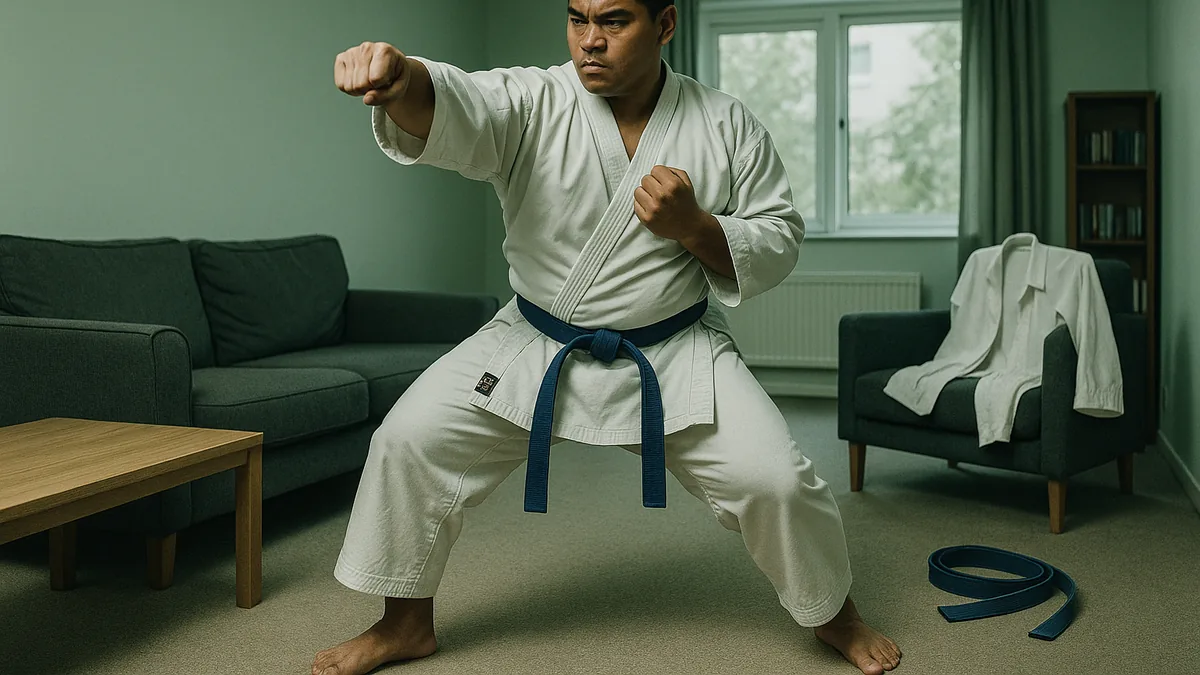
Most karateka who lose club access for a while do the same thing: they keep up the press-ups and the running, and let the actual karate go quiet. Fitness comes back quickly when you return. Technical precision does not. If you want to come back sharper rather than just less unfit, you need to treat solo training as its own discipline - not a holding pattern.
This guide pulls out the practical core of what works, so you can take it straight into your next solo session.
Shadow Karate Needs a Moving Opponent
There is a common version of shadow karate that involves throwing a combination, pausing, throwing another combination, and pausing again. That is not shadow karate - it is drilling with an imaginary audience.
For shadow karate to be worth your time, the opponent in your head has to be doing something. They move, they close distance, they respond to what you throw. Your job is to react, not to perform. That means your footwork stays live, your guard adjusts, and you sometimes abort a technique because the opening has gone. If your shadow rounds look polished and sequential, you are probably performing rather than problem-solving.
Set a round on a timer. Start moving immediately. Let your imaginary opponent dictate some of what happens. Include moments where your attack does not land and you have to reset. That is where the real practice is.
Slow Kata Is Where the Detail Lives
Kata is probably the most underused solo training tool available, even among experienced practitioners. Running it at roughly 20% of normal speed - not as a performance, but as an examination - reveals things that full-speed momentum simply hides.
At that pace, you will find where your balance actually goes during transitions (most people have no idea), where you are gripping or bracing with tension you do not need, and where your breathing stalls. These are not beginner problems. They are the details that senior practitioners are still working on, and they are nearly impossible to feel when momentum is carrying you through.
The most common mistake when trying slow kata is slowing down the techniques but keeping the transitions fast. The transitions are precisely where the useful information is. Slow everything.
Once you know the kata well, try running it with a specific application in mind for each sequence - not a vague idea of blocking and punching, but a concrete situation. The kata will feel different, and movements that seemed arbitrary will start to carry weight.
Kihon Without Feedback Is Mostly Wasted Effort
The problem with drilling basics alone is that repetition without a reference standard tends to reinforce whatever you are already doing, including the errors. You need something that shows you what you cannot feel.
A wall works well. Stand close enough that a fully extended punch would bring your knuckles to within a couple of inches of the surface. Drill your stepping punch along the line. You are not striking the wall - you are using it as a fixed reference. A drifting punch or a flaring elbow becomes visible against that surface in a way it simply is not in open space.
For the reverse punch specifically, try isolating the hip snap without the arm at all. Just the hip movement, in your front stance. This is a practical way to learn where the power in that technique actually originates - and to notice when your shoulder is doing the work your hip should be doing.
Work at medium pace until the mechanics feel right. Adding speed before the pattern is clean just makes the errors faster.
Recording Yourself: The One Tool That Pays Off Most
"The practitioners who use solo periods well are the ones who treat it as a different kind of training rather than an inferior substitute."
Video is the closest thing to an instructor's eye that solo training offers. Record a kata or a kihon sequence, then - and this part matters - watch it back the following day, when you are no longer inside the movement.
You will see things that surprise you. Angles you assumed were correct. Timing that felt sharp but looks hesitant. That distance between what you feel and what is actually happening is exactly the gap that solo training is trying to close.
Your Solo Session Checklist Take this to your next training session at home:
- Shadow karate: Set a round timer. Make your imaginary opponent move and respond. React rather than perform. Include aborted attacks and resets.
- Slow kata: Choose one kata. Run it at 20% speed. Check balance in transitions, unnecessary tension, and where breathing breaks. Slow the transitions, not just the techniques.
- Bunkai focus: Run the same kata again with a specific application in mind for at least one sequence.
- Wall kihon: Use a wall as a reference for your stepping punch. Watch for drift and elbow flare.
- Hip isolation: Practise the hip snap of your reverse punch without the arm. Feel where the movement originates.
- Record and review: Film one sequence per session. Watch it back the next day, not immediately afterwards.
- Honest assessment: Kumite qualities need a partner. Use solo time to go deeper on kata and kihon mechanics rather than trying to replicate what a dojo provides.
For the complete version, with every drill explained, read How to Train Alone When You Have No Club Access on Karate Lifestyle.
Join the conversation: X · LinkedIn · Pinterest · Bluesky
More from Karate Lifestyle


Comments
Post a Comment