Train Less, Progress More: Building a Karate Schedule Around Real Life
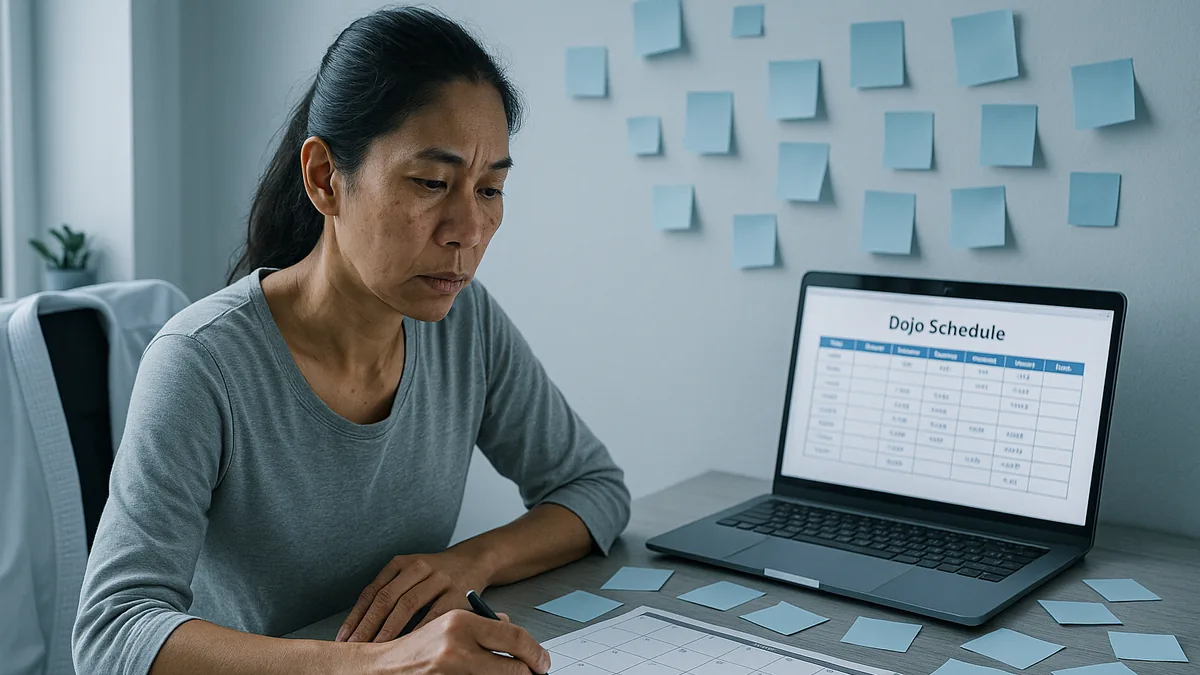
Most karate practitioners have done it at least once. A great class, a surge of motivation, a six-day training plan written out on Sunday evening - and then real life arrives by Wednesday. The schedule collapses, the guilt sets in, and weeks later you are starting from scratch again.
The problem is not commitment. It is planning for a life you do not actually have.
This guide pulls out the practical core of what sustainable karate training looks like for people with jobs, families, and finite energy. Read it before you write your next training schedule.
Start With Your Real Week, Not Your Ideal One
Before you plan a single session, spend a fortnight tracking what your week actually looks like. Every fixed commitment, every genuinely depleted evening, every commute. Be honest about the nights where you are running on empty by 7pm - those are not training slots, no matter what your schedule says.
This matters for a specific reason: mental fatigue impairs motor skill performance and decision-making even when your capacity for maximum force output stays largely intact. Training on an exhausted brain is not neutral. It actively works against you, reinforcing poor movement patterns and blunting the quality of decision-making that good kumite and kata both demand.
What you are looking for is not the maximum number of available slots. You are looking for the slots where you can train with genuine focus. For most people juggling full lives, that is two to four sessions per week. That is enough - if you use them well.
What Goes Into Those Sessions Matters More Than How Many You Do
"The practitioner who trains three focused sessions a week for two years will always outpace the one who trains six days a week for two months, burns out, and starts over."
Once you know how many focused sessions you genuinely have, the next question is what fills them. A common mistake is gravitating toward techniques you are already comfortable with. The strong-side combination feels good. The weak-side work is uncomfortable. So the weak side stays weak.
Research on expert performers consistently shows the opposite approach: they spend the majority of their practice time on what they are worst at, not what they are best at. That principle applies directly to karate training.
If you are working with two sessions a week, here is how to use them:
- Session one: fundamentals. Kihon, stance, basic combinations. This is not beginner work - it is the foundation that drifts for everyone over time, regardless of grade. Technique always drifts. Come back to it.
- Session two: your weakest area. Not your favourite. The thing you would rather skip. If your kata is losing you marks at gradings, that is session two. If your kumite timing is unreliable, that is session two. This requires honesty.
If a third session is available, use it to pressure-test what you have been drilling - harder combinations, sparring, working under fatigue. A fourth, if you have it, works well as lighter active recovery: slower drilling, half-pace kata, noticing rather than grinding.
Build in a floating session with no fixed content - one slot each week where you address whatever your other sessions exposed. If Tuesday's kihon work revealed a problem with your hip position, that is what Thursday's floating session is for. This is where experienced practitioners self-coach, and where real progress tends to accelerate.
How to Handle the Weeks When It Falls Apart
A schedule that only works when life cooperates was never going to last. Flexibility is not a compromise - it is what keeps practitioners training through years of disruption rather than repeatedly restarting.
Have a short-format option ready before you need it. Something you can do in 20 to 30 minutes at home - kihon in a hallway, kata in a living room, slow shadow work on hip mechanics and timing. This is not a replacement for dojo training. It is maintenance. And maintenance is what stops you losing ground during the weeks when everything else takes priority.
The rule that experienced practitioners tend to follow is straightforward: never miss twice. One missed session is life. Two missed sessions is a pattern. The research on habit formation supports this - missing a single instance of a behaviour does not materially disrupt the habit itself. So if you miss a session, the only job you have is making sure the next one happens. Not a longer session to compensate. Not a harder one. Just the next one, as planned.
Before Your Next Class: A Quick Checklist
- Track two real weeks before planning anything - identify focus-capable slots, not just available time
- Assign session one to fundamentals - kihon and stance work, regardless of your grade
- Assign session two to your weakest area - be honest about what that actually is
- Set up a short home session option now, before you need it - two or three things you can do with no equipment
- Build one floating session into your week with no fixed content, based on what your other sessions reveal
- Apply the never-miss-twice rule - one missed session is fine; make sure the next one happens as planned
For the complete version, with every drill explained, read How to Build a Karate Training Schedule That Actually Fits Your Life on Karate Lifestyle.
Join the conversation: X · LinkedIn · Pinterest · Bluesky
More from Karate Lifestyle


Comments
Post a Comment