Shorin-Ryu and Shotokan: What Each Style Kept That the Other Let Go
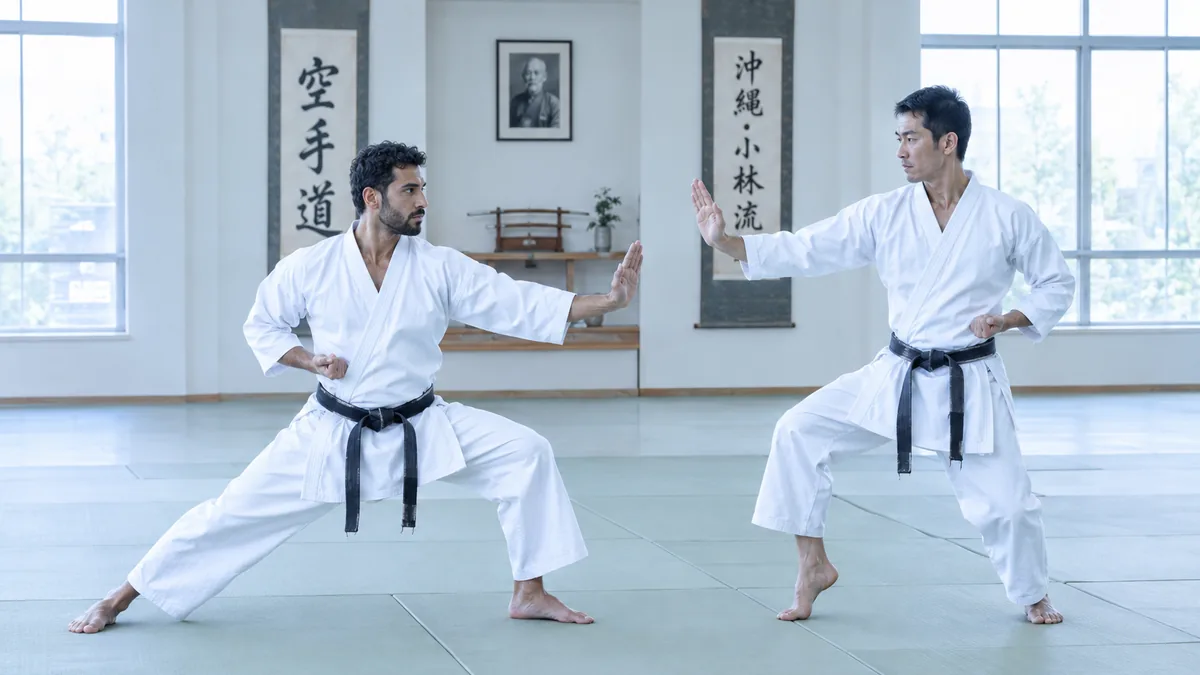
If you have spent years in one of these styles and then seriously encountered the other, you will know the feeling: something in the other tradition exposes a gap you did not know you had. That is not a coincidence. Shotokan and Shorin-Ryu share a lineage, but they made genuinely different choices about what to develop and what to let fade. Understanding those choices makes you a better practitioner of whichever style you train.
Stance Height Is a Philosophy, Not a Difficulty Setting
The first thing a Shotokan practitioner notices in a Shorin-Ryu dojo is how high the stances are. The instinct is to read this as less demanding, or less developed. That reading is wrong.
Shorin-Ryu's shorter, higher stances are a deliberate choice to keep the body mobile and capable of continuous movement. Weight transfer happens quickly. There is no dead point between techniques where everything stops to load up for the next action. Many Okinawan instructors describe this as keeping the body alive throughout a sequence, rather than pausing to fire and then pausing again.
The trade-off is real: you move faster and reposition more easily, but individual techniques carry less structural weight behind them. Speed, angle, and timing do more of the work.
Shotokan's deep zenkutsu-dachi operates on a different logic entirely. The stance is primarily a teaching tool. When a beginner drops into a proper deep stance and throws a gyaku-zuki correctly, they feel the power chain running from the back foot through the hip and out through the fist. When it goes wrong, the deep stance makes the disconnection impossible to hide. A shallow stance lets a beginner throw an arm-punch that looks passable. A deep stance does not allow that cheat. This is why Shotokan works so well as a group teaching system - faults are visible and correctable from across a dojo.
What the Kata Divergence Actually Reveals
Funakoshi renamed and modified kata when he brought karate to Japan. Studying the Okinawan versions of Passai, Kusanku, and Naihanchi alongside their Shotokan equivalents - Bassai, Kanku-Dai, and Tekki - shows you interpretation choices that are otherwise invisible. The Okinawan versions retain movement patterns that the Shotokan adaptations modified, in some cases substantially.
Naihanchi is a clear example. Shotokan's Tekki series uses kiba-dachi and moves laterally along a single line. Shorin-Ryu versions use a narrower stance with different weight distribution, and many Okinawan instructors argue that close-range applications become harder to see once the stance changes. You do not have to accept that argument to notice the structural difference is real.
Hangetsu is worth particular attention. It is one of the few Shotokan kata that retains the slow, breathed, tension-driven quality of its Okinawan source, Seisan. The approach is closer in character to Goju-Ryu's Sanchin than to standard Shotokan kihon. Training it seriously, with proper attention to the prescribed breathing, is a reminder that the Okinawan substrate never fully disappeared - even in the most Japanese-feeling of the major styles.
How the Difference Shows Up in Sparring
In jiyu-kumite, the styles produce recognisably different fighters. Shorin-Ryu's mobile, natural movement tends to produce practitioners who are harder to read and faster to reposition. Shotokan's committed structure tends to produce practitioners with more stopping power when they land. Neither is universally better.
The common mistake for Shotokan practitioners crossing into Shorin-Ryu sparring is trying to plant and fire the way they were trained. In a context where the other person is already moving, that approach makes you slow and predictable. The adjustment is learning to treat movement itself as the primary weapon, with technique as secondary.
"Over time, practitioners who have spent years in one style and then seriously study the other often report the same thing: the other style shows them what they had stopped seeing in their own."
This is not an argument for cross-training as a lifestyle. It is an observation that each tradition genuinely preserved something valuable - and that knowing what the other style developed is one of the most honest ways to assess your own gaps.
Checklist for Your Next Class
- If you train Shotokan: notice whether your movement between techniques is alive or mechanical. Shorin-Ryu's continuous flow exposes this.
- If you train Shorin-Ryu: pick one technique and ask whether your whole body is behind it, or mainly your arm. Shotokan's power-chain emphasis is worth borrowing here.
- Either style: look up the Okinawan version of one kata you know well. Note at least one movement that differs and consider what interpretation it might reflect.
- Hangetsu / Seisan practitioners: train the opening sequence with the prescribed breathing and tension rather than standard kihon timing. The difference is instructive.
- Before sparring: ask yourself whether your default is to commit to position or to stay mobile - and whether that default is a choice or just a habit.
For the complete version, with every drill explained, read Shorin-Ryu vs Shotokan: How the Okinawan Parent Style and Its Japanese Descendant Diverged and What Each Preserved That the Other Lost on Karate Lifestyle.
Join the conversation: Facebook · X · LinkedIn · Pinterest · Threads · Bluesky
More from Karate Lifestyle


Comments
Post a Comment