Picking a Karate Style: What Actually Matters Before You Commit
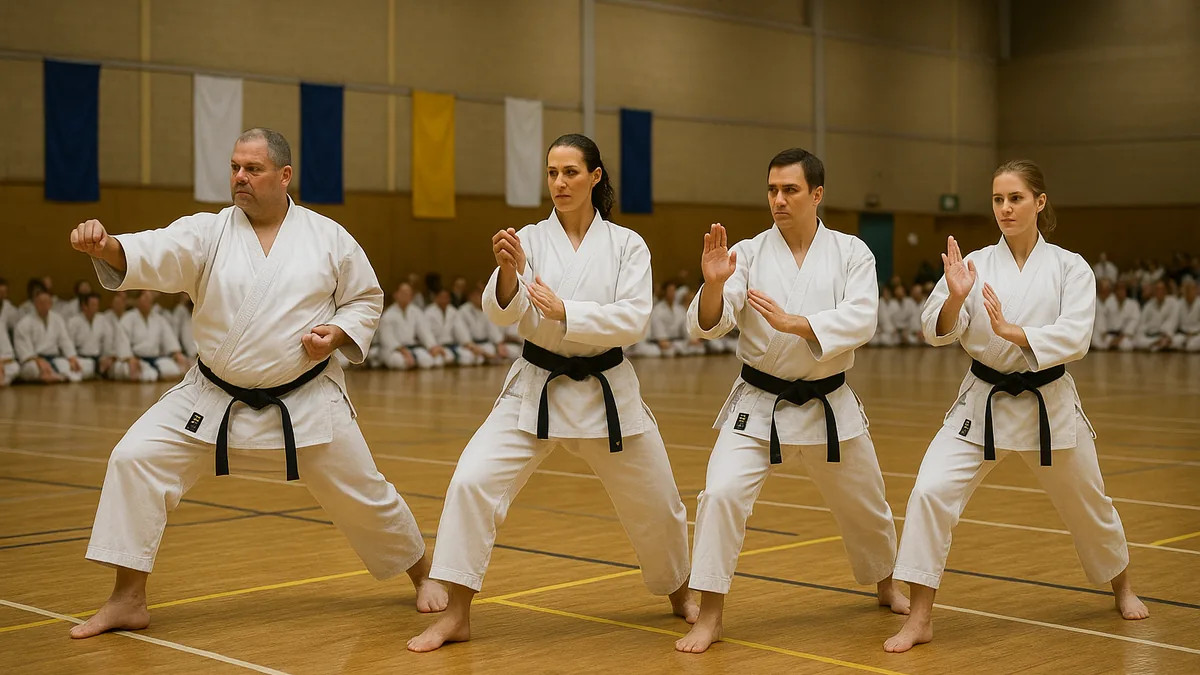
If you have been training for a year or two, you have probably started noticing that karate does not look the same everywhere. A visiting club arrives for a joint session and suddenly everything feels slightly foreign - different timing, different distances, different priorities. That is not confusion you should brush off. It is the beginning of actually understanding what you are doing.
This guide breaks down what separates the four main Japanese styles, where each one tends to produce its best and worst results, and what to look for when you are choosing a dojo. The full article goes into much more depth, but this should give you something useful to take to your next class.
How Each Style Approaches the Fundamentals
Shotokan builds around linear power and precise mechanics. The wide, low stances you see beginners struggling with are not meant to be fighting positions - they are training tools for developing hip drive and structural connection. The problem is that not every instructor makes that distinction clear, and students can spend years reinforcing habits that will eventually need correcting.
Goju-Ryu works close. Where Shotokan is about generating power over distance, Goju-Ryu is about generating it from almost no distance at all. The kata in Goju-Ryu are not a grading formality - they are the entire technical curriculum. Practitioners who dig into the applications tend to be noticeably more effective in sparring than those who treat kata as a solo performance.
Wado-Ryu carries a strong jujutsu influence alongside its karate lineage, and that shows up most clearly in its emphasis on body evasion rather than direct blocking. The idea is to move offline and counter in a single motion rather than absorbing an attack and responding afterwards. In practice, this requires reading an attack earlier than feels comfortable:
"The movement has to start before you are certain the attack is coming."
That is a genuinely difficult skill to develop, and it is why Wado-Ryu rewards patience more than most styles.
Shito-Ryu draws from two distinct Okinawan lineages and has the broadest kata syllabus of the four - over sixty kata depending on the association. That breadth is genuinely valuable if your instructor connects the principles across the material. If they simply teach you more sequences without linking them, the breadth works against you.
What the Style Cannot Tell You
Here is the honest part: the style name on the door tells you less than you might hope. The instructor and the dojo culture will shape your karate far more than the syllabus. A knowledgeable Shito-Ryu instructor who connects principles across the style's wide catalogue will develop you further than a Shotokan instructor who runs through basics without explaining why they work.
This is especially relevant when you are choosing a dojo for the first time, or considering a switch. Watch a class before you commit. Do not just assess the instructor's credentials - watch how the students who have been there for two or three years actually move. That is what the training produces.
Practitioners who have spent a serious amount of time in one style - ten years or more - tend to stop dismissing the others. From that vantage point, the differences look less like competing philosophies and more like the same principles expressed through different physical languages.
Which Style Might Suit You
There are genuine differences in emphasis worth knowing about before you walk through a door:
- Shotokan suits beginners who want a structured, clearly defined path. The grading system is well-organised and the basics are taught systematically. Watch out for dojos where free sparring is an afterthought.
- Goju-Ryu suits practitioners who want to understand close-range application and are willing to invest seriously in kata study. It is also worth exploring if you have trained Shotokan for a few years and want to see familiar kata from a different angle.
- Wado-Ryu suits practitioners who are drawn to timing and evasion over raw power, and who are willing to spend time developing sensitivity rather than just strength. It will frustrate anyone who wants to hit things hard immediately.
- Shito-Ryu suits practitioners who want the broadest technical foundation - but only if the instructor is genuinely connecting principles across the syllabus rather than just adding more kata to the pile.
Checklist for Your Next Class
- Watch how your instructor explains stances. Are they described as fixed positions or as training tools? The answer matters.
- Ask about bunkai. Whatever style you train, if kata applications are never discussed, you are only getting part of the curriculum.
- Notice your timing in sparring. Are you reacting to techniques or reading intentions? Most practitioners react. Working on reading earlier is useful regardless of style.
- Train with someone from a different style when you get the chance. Even a single session will show you things about your own movement that in-style training alone may not reveal.
- Go back to basics deliberately. Whatever your grade, the gap between competent technique and genuinely good technique almost always lives in the details of the fundamentals - hip connection, weight transfer, kime timing.
- If you are choosing a dojo, visit first. Watch a class. The students tell you more than the branding does.
For the complete version, with every drill explained, read Karate Styles Compared: Shotokan, Goju, Wado and Shito-Ryu on Karate Lifestyle.
Join the conversation: X · LinkedIn · Bluesky
More from Karate Lifestyle


Comments
Post a Comment