Makiwara Training: What It Actually Teaches and Whether You Need It
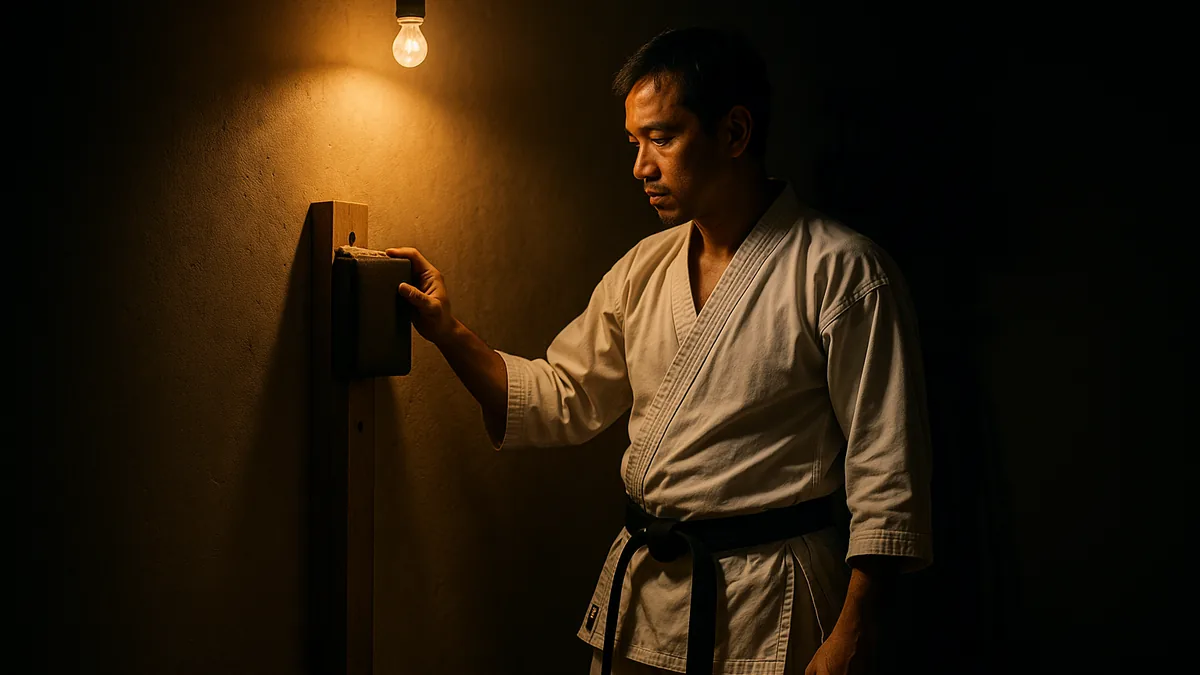
Most karateka who pick up a makiwara for the first time assume it is about toughening the knuckles. That assumption is understandable, but it misses the point. The board's real job is to tell you the truth about your technique the moment you make contact - and it does so without mercy.
This guide covers what the makiwara is actually for, the mistakes that undermine it, who genuinely needs one, and what you can use instead if it is not right for your training.
What the Board Is Really Measuring
A heavy bag forgives a lot. It moves, absorbs, and lets you get away with sloppy alignment. The makiwara does none of that. A wrist out of line, an elbow tracking badly, a hip that is not driving the technique - you will feel every one of these the instant you make contact.
"The board does not lie. That is the core value."
Effective striking in karate depends on a sequential kinetic chain working in order: back leg, knee, hip, shoulder, elbow, wrist. The makiwara is a diagnostic tool for that chain. Any break in the sequence registers immediately as a jarring, scattered feeling rather than a clean, sharp return through the body. When everything is right, you know it. When it is not, you know that too.
Knuckle conditioning does happen with regular practice, but experienced practitioners tend to regard it as a side effect rather than the goal. The primary lesson is commitment - driving through the board with your whole structure aligned and moving together, without pulling back or flinching at the last moment.
The Most Common Mistake
Most beginners approach the makiwara the same way they throw technique in the air: at speed, expecting the board to confirm what they already think they are doing. That is the wrong approach.
The recommendation from experienced instructors is to start at around 60% speed, press through the board rather than smashing it, and pay close attention to what is happening in the hand, wrist, and forearm on contact. Bouncing off at full power gives you something, but it is not the primary lesson.
Bad habits are also well documented with makiwara training: overextending the elbow for extra reach, locking out the shoulder, tilting the torso forward instead of driving from the hips. The board will accept all of these if you let it. An instructor will not. Experienced supervision from the first session is not optional - it is essential.
Do You Actually Need One?
It depends on what you are training for.
If your focus is sport karate or competition kumite, the makiwara is probably not your highest priority. Focus mitts, a heavy bag, and good partner drilling will develop striking power and accuracy effectively, with lower injury risk. There is no shortage of fast, powerful competition strikers who have never touched a makiwara.
If you are training traditional kata and bunkai seriously - particularly in Okinawan styles - the makiwara is harder to replace. It sits within the hojo undo system of supplementary training precisely because it develops the short, penetrating contact quality that kata application demands. Practitioners who have gone deeper into kata after years of sport karate are often the ones who come back to the makiwara and understand for the first time why their seniors always insisted on it.
Alternatives Worth Knowing
If the makiwara is not right for your situation, the alternatives are genuinely better than they used to be:
- Focus mitts with a skilled partner - the most underrated tool for developing real striking quality, with the added challenge of a moving target
- Wall-mounted pad targets - more forgiving than a makiwara but less so than a bag; useful for accuracy and commitment without significant joint stress
- Resistance band striking drills - good for reinforcing hip-to-hand connection and the mechanics of power transfer, though not a substitute for contact training
- Heavy bag, short-range focus - can approximate some of the makiwara's lessons if you are deliberate about positioning and do not use the bag's movement as feedback
None of these are identical to the makiwara. But none of them require months of knuckle adaptation or carry the same wrist strain risk from early technical errors.
Checklist for Your Next Class
- Ask your instructor whether makiwara work fits your current stage of training and style
- If you try it, start at around 60% speed and focus on pressing through the board, not hitting it
- Get experienced eyes on your first sessions - bad habits embed quickly and the board will not correct them for you
- Check the kinetic chain: ankle, knee, hip, shoulder, elbow, wrist - any break will show up on contact
- Do not neglect partner work alongside any makiwara practice; solo equipment training does not replace kumite
- If sport karate is your focus, invest time in mitt work and partner drilling before considering the makiwara
For the complete version, with every drill explained, read Do You Need a Makiwara? An Honest Assessment for Modern Karateka on Karate Lifestyle.
Join the conversation: X · LinkedIn · Pinterest · Bluesky
More from Karate Lifestyle


Comments
Post a Comment