Kyokushin Kata: Why Fewer Forms Demands More From You
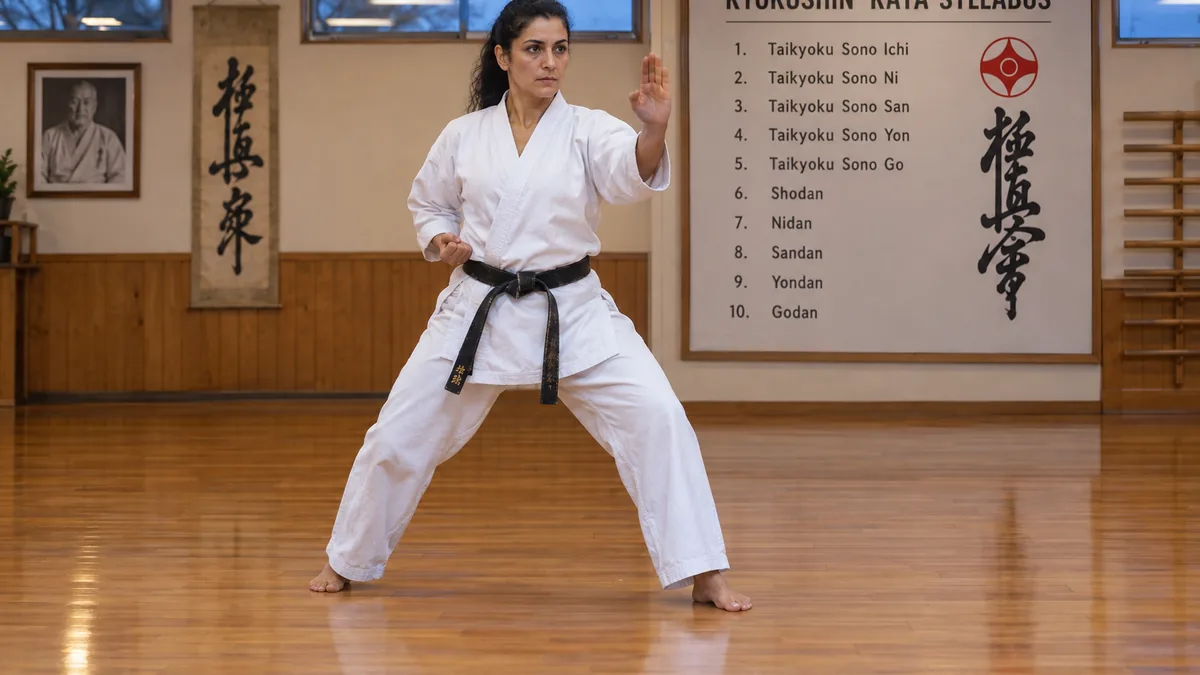
If someone from a Shotokan or Shito-ryu dojo has ever raised an eyebrow at how few kata Kyokushin practitioners know, you have probably felt the urge to defend the syllabus without being entirely sure how. The full article on KarateLifestyle.uk makes that case thoroughly. This companion guide pulls out the practical points you can take straight to your next training session.
The Philosophy Behind the Small Syllabus
Kyokushin's approach to kata is not a gap in the system. It is the system. Mas Oyama was not interested in cataloguing forms - he was interested in what held up under real pressure. When your regular training includes full-power body strikes in kumite, your tolerance for techniques that do not connect to genuine striking mechanics drops quickly. That standard shaped which kata stayed in the syllabus and which did not.
The logic is straightforward: a practitioner who genuinely understands five kata is more capable than one who can walk through twenty without real comprehension. Kyokushin has stayed consistent on this, and it shows in how grading expectations are structured. Breadth is not the measure. Depth is.
What Each Part of the Syllabus Is Actually Testing
The Taikyoku series is where most people underestimate what is being asked of them. The techniques are simple enough that attention drifts to getting through them rather than refining them. The real work in these kata is in the transitions - what happens between techniques, whether posture holds, and whether each movement connects to the next or just follows it. If you are building sloppy habits in transitions here, you are carrying them forward into everything else.
The Pinan series deserves more serious attention than it typically receives at lower grades. One example: the age-uke that appears throughout these kata is often trained as a rising block, passively deflecting an incoming strike upward. Many instructors read it differently - as a committed strike to the underside of an attacking arm, driven by the hip. Train it that way and the body mechanics shift entirely. The technique becomes rooted rather than reactive. That kind of interpretive work is available throughout the Pinan series if you go looking for it.
Sanchin is tested in Kyokushin by an instructor striking the practitioner's body during performance - not to cause harm, but to verify that the tension and structural alignment being demonstrated are genuine rather than cosmetic.
"You cannot fake a properly rooted Sanchin when someone is checking your body alignment with a strike to the ribs."
Tensho, which Oyama regarded as one of the most important forms in the syllabus, is frequently rushed. The circular hand techniques look simple and practitioners tend to move through them to reach the next posture. Senior practitioners do the opposite - slowing those techniques down and maintaining tension through the full arc is where the kata's value actually lives.
The Ura Kata as a Diagnostic Tool
Every standard form in the Kyokushin syllabus has an Ura version - performed moving in the opposite direction. This is not a novelty variation. It is a genuine test of whether you have understood a kata or simply memorised it.
If your Ura performance is noticeably weaker than your standard version, that gap is telling you something specific: you have learned a route, not a kata. The spatial awareness, the structural habits, the timing - if those are genuinely embedded, direction should not matter much. If it does matter, that is where your training attention belongs.
A Checklist for Your Next Class
- In Taikyoku and Pinan kata, pay deliberate attention to the moments between techniques rather than the techniques themselves
- When training age-uke, experiment with your instructor's interpretation of it as a committed strike rather than a passive block - notice whether your hip engagement changes
- If you have not been tested on Sanchin with strikes to check your structure, ask a senior to do it - and be honest about what the result tells you
- Slow your Tensho hand techniques down significantly and maintain tension through the full arc of each movement
- Run the Ura version of any kata you consider yourself competent in and compare the quality honestly
- If you are at a higher grade and treating Sanchin and Tensho as warm-up formalities, consider reversing that priority for a training cycle
For the complete version, with every drill explained, read Kyokushin Kata List: Every Form in the Syllabus, Its Origin, and Why Kyokushin Kept So Few Compared to Other Styles on Karate Lifestyle.
Join the conversation: Facebook · Instagram · X · LinkedIn · Pinterest · Threads · Bluesky
More from Karate Lifestyle


Comments
Post a Comment