Karate Shoes: When They Help, When They Don't, and How to Decide
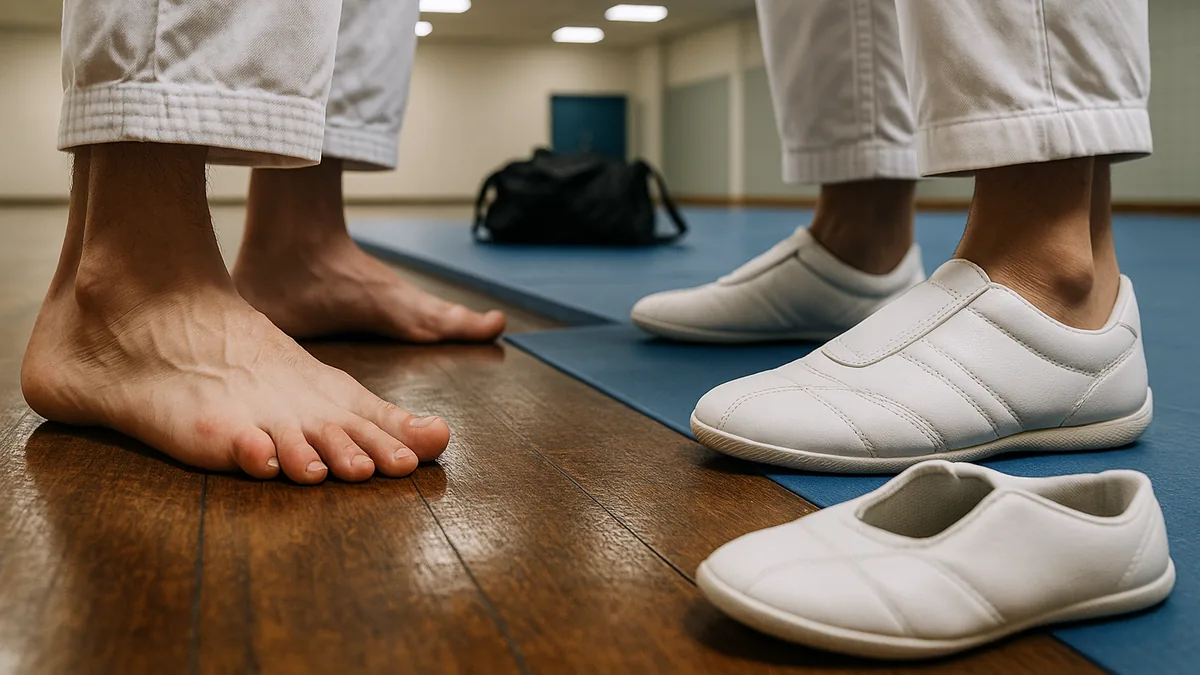
Footwear in karate tends to provoke strong opinions, usually based on habit rather than clear thinking. Some practitioners never train in anything other than bare feet; others pull on shoes without really asking whether they're helping. The honest position sits somewhere in the middle, and it comes down to one question: what problem are you actually trying to solve?
What You Lose When You Cover Your Feet
On a properly maintained wooden dojo floor, bare feet give you something no shoe can replicate: direct, unfiltered contact with the surface beneath you. That contact is not just about comfort - it is part of how correct technique is built. When you drive off the back leg in a reverse punch, the foot anchors the movement. The tactile information coming up through the sole of your foot tells you whether your stance is loaded correctly, whether your pivot is working, and whether your hip rotation is generating real power or just going through the motions.
When you cover that feedback with a shoe, even a good one, some of that information disappears. The sole compensates. And if the sole is compensating, you may never notice that your technique has a gap in it. Instructors frequently observe this with students who have trained for extended periods in shoes - their pivoting mechanics on a bare wooden floor reveal habits that the footwear had been quietly masking.
This is not an argument against shoes in every context. It is an argument for knowing what you are giving up when you wear them.
When Shoes Are the Right Call
There are genuine situations where bare feet become a liability rather than an asset.
Outdoor demonstrations, school gym floors, concrete community halls - surfaces that are rough, unswept, or simply unforgiving on repeated impact - are exactly the conditions where a proper karate shoe earns its place. On a surface you cannot control, bare feet introduce hesitation and risk. A thin-soled shoe designed for martial arts lets you move without that concern.
The emphasis on thin-soled matters. A martial arts-specific shoe with a flexible or split sole keeps you close to the floor. You still feel what is beneath you. That is an entirely different proposition from a cross-trainer or running shoe, which disconnects you from the surface almost completely and actively works against correct pivoting technique. If you are going to train in shoes, the type of shoe is not a minor detail.
There is also a hygiene consideration that rarely comes up in these conversations. With a significant proportion of the UK population affected by athlete's foot at any given time, training barefoot at unfamiliar venues carries a genuine infection risk. Lightweight shoes are a practical way to manage that, particularly when you are away from your regular dojo.
"The mistake is treating shoes as either always necessary or always wrong. They're a tool. Use them when the situation calls for it."
On the competition side, the picture is straightforward for WKF events: standard kumite and kata competition is conducted barefoot on the tatami, and the current WKF Kumite Competition Rules make no provision for competitor footwear. If WKF competition is part of your training, you should be doing the bulk of your preparation barefoot. Some non-WKF and local formats are different, so check the rules for your specific event - and then train in whatever you will compete in.
Checking Your Own Foot Mechanics
If you do train in shoes regularly, it is worth periodically removing them on a good wooden floor and paying attention to what changes. Not to prove a point, but as a diagnostic. Do your pivots feel different? Does your stance feel less stable? Are you suddenly more aware of where your weight is sitting?
If the answer to any of those is yes, the shoe was doing something for you that your foot mechanics were not. That is useful information, and the right response is to work on the underlying technique rather than keeping the shoe on permanently.
A Checklist for Your Next Class
- What surface am I training on? Maintained wooden floor: go barefoot if you can. Hard, rough, or variable surface: a proper karate shoe is reasonable.
- What type of shoe am I wearing? Thin, flexible or split sole: appropriate. Thick cushioned sole or running shoe: leave it at home.
- Am I training for WKF competition? If yes, train barefoot - that is the competition condition.
- Have I checked my pivoting mechanics barefoot recently? If not, take one session without shoes and see what comes up.
- Are my feet uncomfortable after training? Work out whether the cause is the surface, your technique, or your training load before treating footwear as the solution.
- Am I training at an unfamiliar venue? Consider lightweight shoes for hygiene reasons, particularly in shared changing areas.
For the complete version, with every drill explained, read Do Karate Shoes Actually Help? Grip, Protection, and Performance Compared on Karate Lifestyle.
Join the conversation: X · LinkedIn · Bluesky
More from Karate Lifestyle


Comments
Post a Comment