Hip Rotation in Karate: Getting Past the Positions and Into the Movement
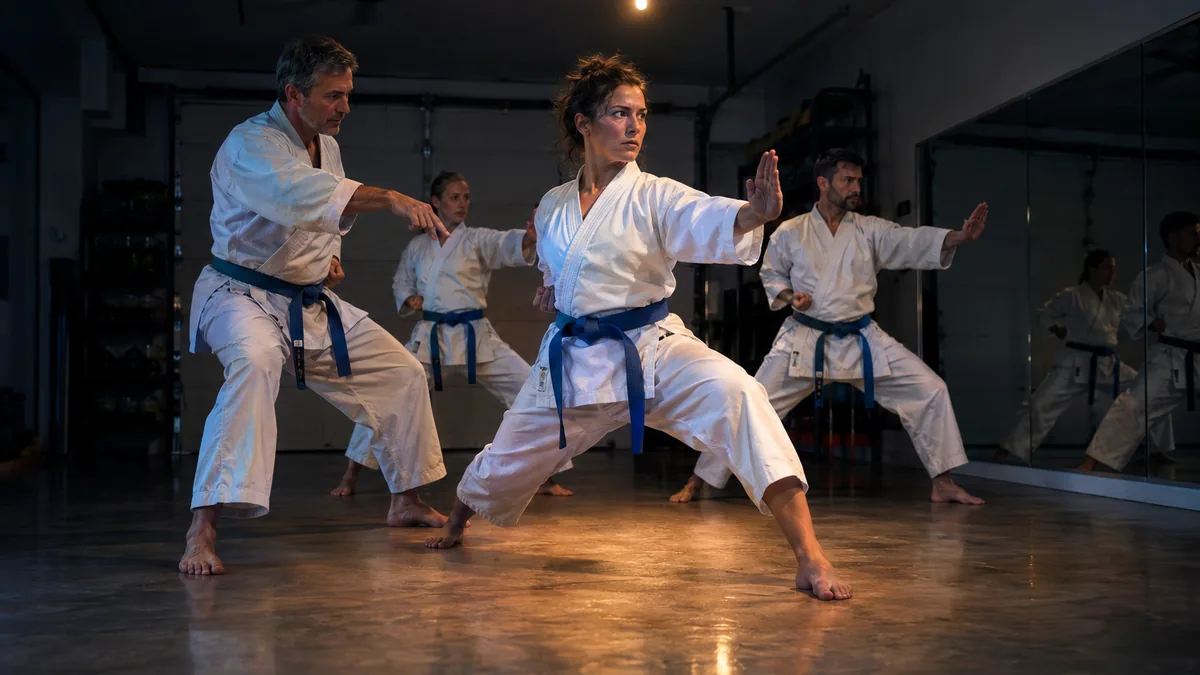
Most arguments about hip rotation in kihon sound like disagreements about tradition. They are actually disagreements about mechanics - and once you understand that, a lot of instructor contradictions start to make sense.
This guide pulls out the practical essentials so you can apply them at your next session.
Positions or Phases? Getting the Framing Right
The first thing to sort out is what gyaku-hanmi and shomen actually are. Gyaku-hanmi places the hips rotated away from the punching side; shomen squares them to the front. The mistake most students make is treating these as fixed stances to punch from, rather than points along a rotational path.
In a well-executed gyaku-zuki, you are not holding gyaku-hanmi and then throwing a punch. You are driving through gyaku-hanmi toward shomen, and the rotation itself is what loads and releases the power. The position you see at kime is the end point of a movement, not the starting condition for it.
This is why copying the shape of an advanced practitioner's technique rarely produces the same result. The shape is a consequence of the mechanics, not a substitute for them.
Why the Hikite Does More Than You Think
If your gyaku-zuki lacks power and your first instinct is to rotate the hips further, stop and check the hikite first. The returning hand is what generates the rotational force that drives the punching side through. Pulling it back sharply and fully - not letting it drift lazily to the hip - creates the snap that the hips then transmit forward.
Kinematic research on straight punching confirms that power travels from the ankle upward through the knee, hip, trunk, shoulder and arm in sequence, with the fist arriving last. The arm is almost a passenger at the end of the chain. That means if the chain breaks earlier - at the hikite, at the trunk, at the hip - the fist cannot compensate.
When the sequencing is right, the punch feels compact and heavy. When the hips over-rotate past their useful range, the shoulder is pulled out of alignment and the technique loses structural integrity at the point of contact. You will feel this as looseness at kime rather than a solid, locked impact:
"Correct rotation feels like a door slamming shut rather than a door swinging open."
Grading vs Kumite: Different Priorities, Same Principle
The context you are training for changes what you should emphasise, though the underlying mechanics stay the same.
In kihon lines for grading in traditional UK associations, examiners expect to see clear hip engagement. A punch that arrives accurately and quickly but shows no visible hip contribution will be marked down. The hips need to be driving the technique, not just present in the background.
In jiyu-kumite and competition, the priority shifts. Full, committed rotation is appropriate for a finishing technique, but it costs you recovery time. Senior practitioners tend to use the minimum rotation needed to generate effective force, then reset immediately. The difference between a mid-grade and a senior competitor is often less about how hard they hit and more about how quickly the hips return to a neutral position ready for the next exchange.
Oi-zuki and gyaku-zuki also demand different hip actions. Oi-zuki is a forward drive, not a lateral snap - the hip on the punching side pushes ahead with the stepping leg. Over-rotating into shomen on oi-zuki tends to collapse the stance and turns the technique into a lunge. If your oi-zuki and gyaku-zuki look identical in terms of speed and hip action, the mechanics are not differentiated enough.
Checklist for Your Next Class
- Before drilling gyaku-zuki: focus on pulling the hikite back fully rather than adding more hip rotation
- Check your oi-zuki separately: the hip action should feel like a forward push, not a sideways snap
- Test for over-rotation: if the technique feels loose at the point of kime, reduce the range of rotation rather than adding more speed
- In kihon lines: make the hip movement visible and deliberate - examiners need to see it driving the technique
- In kumite practice: after each gyaku-zuki, note how quickly your hips reset; if recovery feels slow, you may be over-committing the rotation
- If an instructor cues contradict each other: ask yourself what each is optimising for - grading clarity, competition speed, or maximum single-impact force - rather than assuming one is simply wrong
For the complete version, with every drill explained, read Gyaku-Hanmi vs Shomen in Kihon: What the Hip Position Is Actually Doing and Why Instructors Disagree on How Much Rotation Is Correct on Karate Lifestyle.
Join the conversation: Facebook · Instagram · X · LinkedIn · Threads · Bluesky
More from Karate Lifestyle


Comments
Post a Comment