Focus Mitts or Thai Pads? How to Choose the Right Tool for Karate Training
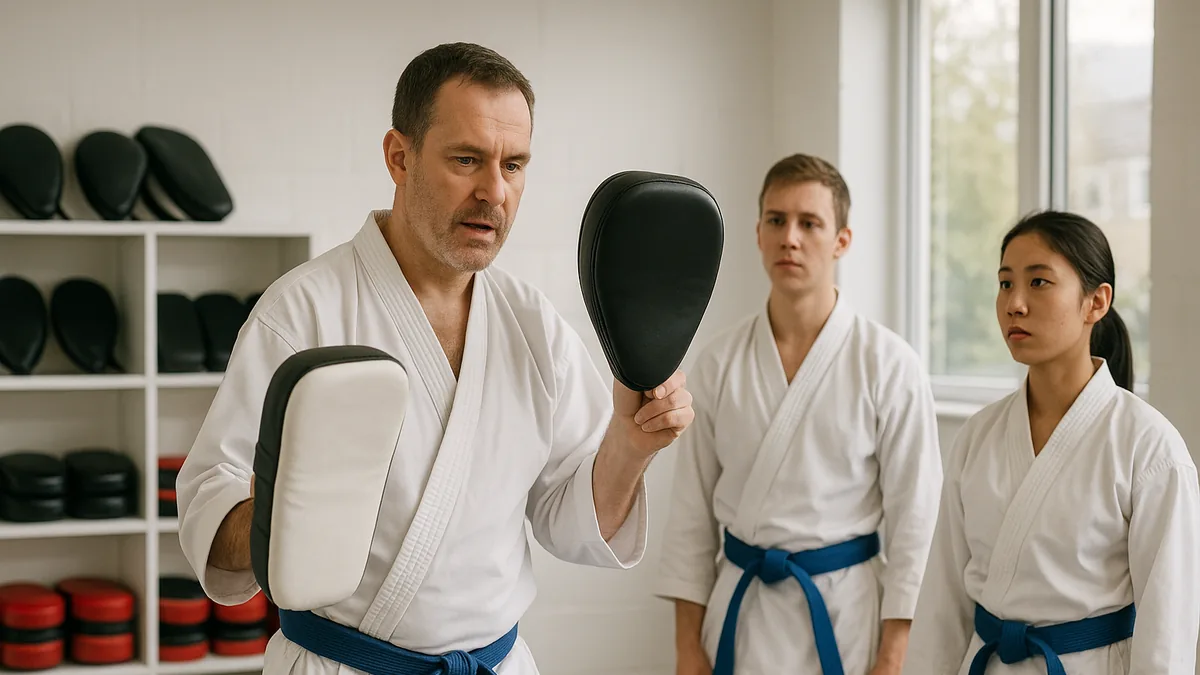
Most karate dojos that use pad work treat focus mitts and Thai pads as variations of the same thing. They are not. Each piece of equipment teaches something specific, and reaching for the wrong one - or using the right one badly - will quietly undermine your training without you realising it. Here is how to think about both.
What You Are Actually Training When You Pick Up a Pad
Focus mitts are not small heavy bags. The moment a student winds up to hit one hard, the drill has already gone wrong. What focus mitt work is actually for is sharpening the striker's eye: reading where the target is, reacting to movement, and committing cleanly without telegraphing. The holder is running the drill - presenting the target, pulling it away, shifting the angle - and the striker has to stay responsive.
When technique and timing come together correctly on a focus mitt, the feedback is unmistakable. You get a sharp snap rather than a dull thud, and the pad barely shifts because the energy transferred cleanly into it. That is kime made tangible. Many practitioners who have trained for years without quite grasping what kime means physically find that a few rounds of properly structured focus mitt work makes it suddenly obvious.
Thai pads work differently. They are built to absorb serious impact, and that forgiveness is both their strength and their limitation. A sloppy, arm-driven punch can still feel solid on a Thai pad because the pad soaks up the slack. For karate punching technique, that is a problem - the feedback is too generous. But for developing kick power, particularly the hip rotation that drives an effective mawashi-geri or the full commitment needed for ushiro-geri, Thai pads are genuinely difficult to replace. The resistance builds the kinetic chain in a way that kicking air simply cannot.
The Precision Gap Most Karate Students Have
Here is a pattern that comes up repeatedly: a student trains hard, develops reasonable power through bag work and pad rounds, then steps into jiyu-kumite and cannot land anything. Their timing is off. Their targeting is vague. They are strong but imprecise.
"Power without precision is sparring noise."
The scoring window in free sparring is brief. If you have trained almost exclusively for power, you will have the physical capacity to do damage but not the trained eye to find the opening and move into it at the right moment. Focus mitt work - done properly, with an active holder who is making the striker read the target - addresses that gap directly.
The opposite problem is also real. Students who have only ever drilled with controlled technique and no resistance often pull everything because they have never felt what it means to drive through a target. That reads as tentative technique to any experienced examiner or judge, even when the student believes they are simply showing control. Some Thai pad work, done properly, builds the commitment and follow-through that removes that hesitation.
How the Holder Changes Everything
The quality of pad work depends as much on the holder as on the striker. A holder who keeps pads flat and static is turning a dynamic drill into a punching-at-a-wall exercise. Focus mitt holders need to angle the target, vary the height, and move - making the striker earn the contact rather than simply swing forward.
With Thai pads, the common failure is a holder who absorbs kicks by drifting backwards. When that happens, the striker is learning to push rather than generate power from a rooted structure. Beyond the training effect, poor pad-holding technique also puts the holder's wrists and forearms at real risk if the pads are gripped or angled incorrectly under impact.
Holding pads well is a skill that takes time to develop. That is part of why focus mitts are the better starting point for most dojos - they are more intuitive to hold correctly, and the margin for error is smaller.
Your Checklist for the Next Class
- Before the session, decide what you are training - timing and precision, or power and commitment. Do not mix them without intention.
- If you are using focus mitts, stay active as a holder. Angle the target, vary the height, and move it between combinations.
- If you are using Thai pads, brace properly. Root your stance, engage your core, and absorb through structure - not by stepping back.
- Watch for the snap vs thud distinction on focus mitts. A thud means the energy pushed through rather than transferred cleanly.
- Check whether your students can land in sparring what they are hitting in pad work. If not, the gap is likely timing, not power - add more focus mitt work.
- Buy focus mitts first if you are equipping a dojo. Add Thai pads once someone can hold them correctly.
- Use the right tool for the session goal - not whichever pads are closest to hand.
For the complete version, with every drill explained, read Karate Focus Mitts vs Thai Pads: Which Are Worth Having for Karate Training? on Karate Lifestyle.
Join the conversation: X · LinkedIn · Pinterest · Bluesky
More from Karate Lifestyle


Comments
Post a Comment