Cold Water Immersion for Karate Recovery: What You Actually Need to Know
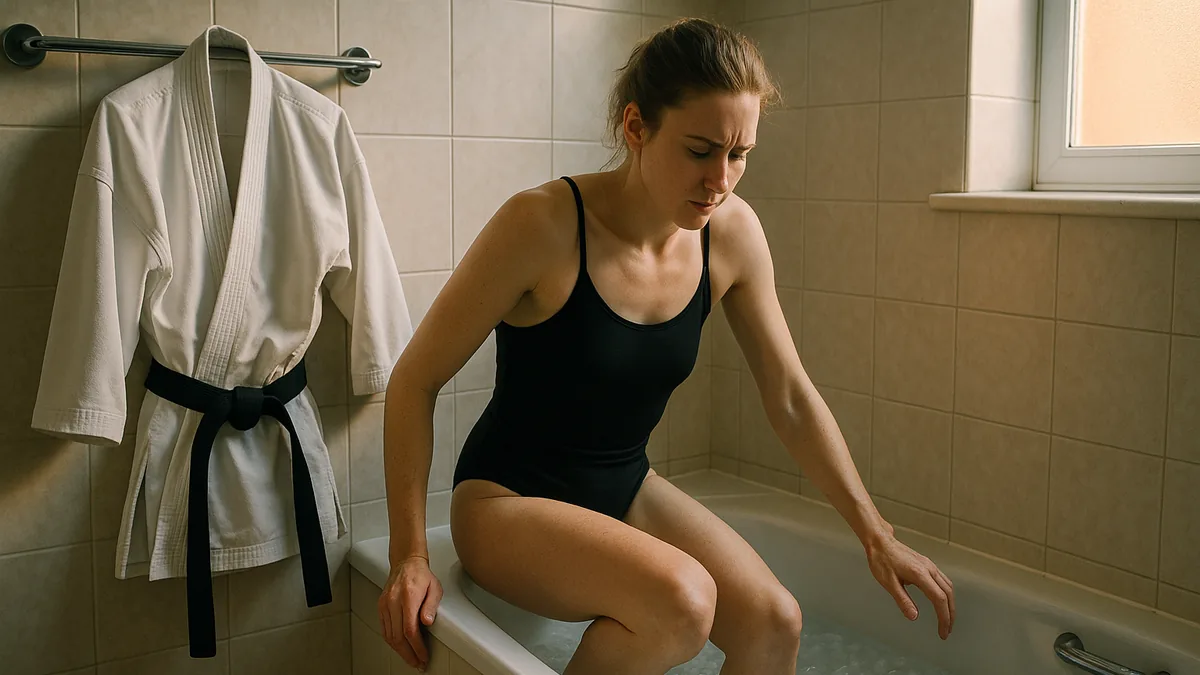
Recovery is one of those areas where karate practitioners either overthink everything or ignore it entirely. Cold water immersion sits right in the middle of that tension - there is decent evidence behind it, but the way most people use it undermines the point. This guide pulls out what actually matters so you can make a sensible decision before your next hard session.
Why Cold Exposure Is Worth Taking Seriously
After a heavy kumite session or a demanding gasshuku, the soreness and stiffness you feel is your body's inflammatory response doing its job. That process is necessary, but its early, most disruptive phase - the part that leaves you barely able to walk down stairs the next morning - can be moderated without stopping the underlying repair.
Cold water immersion works by lowering tissue temperature and triggering vasoconstriction, which helps reduce the initial inflammatory spike. The goal is not to switch off your body's recovery process. It is to take the edge off the acute phase so you can function and train again sooner.
For karate specifically, this matters because training is not evenly distributed. Camps, grading preparation, and high-intensity sparring blocks place demands that are genuinely different from a light technical session. The ability to bounce back between those harder blocks is what keeps your progress moving.
"The practitioners who recover fastest between sessions are not necessarily the fittest. They tend to be the ones who treat the hours after training as seriously as the training itself."
Getting the Protocol Right
The most common mistake is treating cold immersion as a test of mental toughness rather than as a measured intervention. Too cold, too long, with no clear rationale - and you either have a miserable experience or create a stress response that outweighs any benefit.
A 2025 network meta-analysis examining 55 randomised controlled trials found that medium-duration immersion at 10 to 15 minutes consistently outperformed both shorter and longer exposures for reducing delayed onset muscle soreness and improving neuromuscular recovery markers. The temperature range best supported by the evidence for soreness reduction is 10 to 15 degrees Celsius. Going colder or longer does not appear to add benefit and, beyond a point, becomes a stressor in its own right.
The first two minutes will feel like burning. This is a quirk of how your nervous system processes extreme cold - the same pathways that respond to painful heat are activated. If you breathe steadily and stay still, that burning sensation shifts into a deep ache and then towards numbness. That transition is when the vasoconstriction underlying the recovery effect is occurring. It is not a sign something is wrong - it is the point of the exercise.
One practical note: let your core temperature begin to drop naturally before getting in. If you are still radiating heat from exertion, your body is managing two competing demands at once.
When Not to Use It
This is where most people go wrong. Applying cold immersion after every session - regardless of what that session involved - is not supported by the evidence and may actively work against you.
Research has shown that cold water immersion can blunt resistance training-induced muscle fibre hypertrophy by reducing skeletal muscle protein anabolism and increasing catabolism. If you have just done a session designed to drive strength or technical adaptation, an ice bath may interfere with the signals your body needs to actually adapt. Save it for your hardest sessions - after intensive kumite, grading preparation at full intensity, or a training camp. After a light kata session or partner drills, leave it out.
Individual response also varies considerably. Some practitioners notice clear improvements in how quickly they return to full intensity. Others, particularly those who run cold naturally or who have circulation issues, may find it counterproductive. If you have any cardiovascular condition or history of heart problems, speak to your GP before starting - cold immersion triggers a physiological response that includes vasoconstriction and stress hormone release, and that response carries genuine risk for some people. Do not use it unsupervised when you are new to the practice.
If full immersion is not practical or does not suit you, contrast showers - alternating hot and cold - offer a more accessible option. Across multiple trials, contrast therapy modestly reduced muscle soreness in the 24 to 96 hour window after hard exercise. The effect is probably somewhat less potent than full immersion, but it is a reasonable alternative if the logistics of an ice bath do not work for your situation.
Quick Checklist for Your Next Hard Session
- Reserve cold immersion for your highest-intensity sessions only - kumite, grading prep, camps. Not after technical or light work.
- Aim for 10 to 15 degrees Celsius and 10 to 15 minutes. Colder and longer is not better.
- Wait until your core temperature starts to drop naturally before getting in.
- Breathe steadily through the first two minutes. The burning sensation shifts - wait for that.
- If you have any cardiovascular condition, speak to your GP first. Do not immerse alone when you are new to this.
- Track your response honestly over four to six weeks. Your experience may differ from your training partners - individual variation is real.
- No ice bath available? Contrast showers are a practical fallback with modest supporting evidence.
For the complete version, with every drill explained, read Cold Exposure and Ice Baths for Karate Recovery: Do They Actually Work? on Karate Lifestyle.
Join the conversation: X · LinkedIn · Pinterest · Bluesky
More from Karate Lifestyle


Comments
Post a Comment