Your Warm-Up Is Probably Costing You Before Class Even Starts
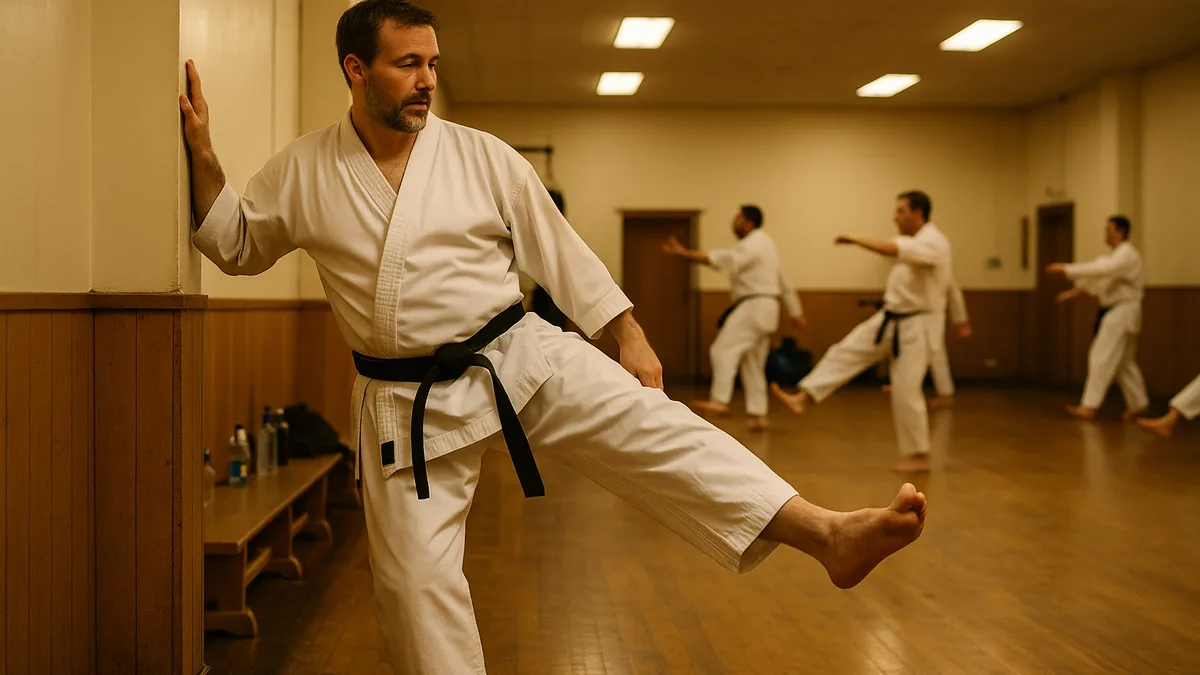
If you arrive at the dojo, do a couple of arm circles, touch your toes, and consider yourself ready - this is for you. The way most practitioners prepare for training actively works against them, and it is worth understanding why before your next session.
"The warm-up is not a formality. It is the first technical decision you make in every session, and most people get it wrong before class even starts."
Why Saving Static Stretching for After Class Actually Matters
Long static holds before training are still standard in many dojos. The problem is that research consistently shows pre-exercise static stretching reduces the muscle-tendon unit's capacity to store and return elastic energy - which is precisely what powers your kicks and fast combinations. A large meta-analysis drawing on over a hundred studies found measurable acute reductions in maximal strength from pre-exercise static stretching, with the negative effects being smallest when any single muscle group was held for under 45 seconds. A later review confirmed that static stretching reduced explosive lower-limb performance, while dynamic movement improved it.
The practical implication is straightforward: if long static holds make up most of your warm-up, you are likely starting class with less explosive capacity than you walked in with. Brief holds under 45 seconds, slotted into an otherwise active warm-up, are far less of a concern. Sustained static work is best placed after training, when tissue is warm and you are genuinely trying to make lasting flexibility gains.
Start With the Joints, Not the Big Movements
Before any dynamic sequences, spend two minutes on joint mobilisation. This matters especially if you train first thing in the morning or have spent the day at a desk. Slow ankle circles, full hip circles - done deliberately, not rushed - and wrist and shoulder rolls all help the joints move through their actual range before you ask them to handle load and speed.
The most common mistake here is going too fast. Slow the hip circles right down until you can feel the rotation coming from the hip joint itself rather than your lower back compensating. Sixty seconds of genuine ankle mobilisation does more than most people realise, given that the ankles underpin every stance and every kick.
The Dynamic Sequences Worth Building Your Warm-Up Around
Once the joints are moving freely, dynamic sequences raise muscle temperature, activate the relevant muscle groups, and prepare the nervous system for fast, coordinated effort - things a static-only approach simply does not do.
Leg swings - forward and lateral - should be controlled pendulum movements where the range builds naturally across 10 to 15 repetitions. Forcing height from the first rep misses the point entirely. Let the warmth earn the range.
Walking lunges with rotation earn their place in every karate warm-up because they address hip flexor loading, thoracic spine mobility, and balance through transitional movement - all at once. Step into the lunge, hold briefly at the bottom, and rotate your torso over the front leg. Most beginners rotate through the shoulders and leave the mid-back completely still; focus on moving the spine, not just the arms.
Inchworms - hinging at the hips, walking out to a plank, one controlled press-up, and back - develop the hip hinge pattern that mirrors the mechanics of driving a front kick or dropping into a structured low stance. If your lower back rounds to reach the floor, bend the knees slightly until the pattern improves.
High knees and lateral shuffles raise the heart rate and get the feet moving in ways that directly carry over to sparring footwork.
Finally, and this is the step most people skip: end every warm-up with slow, controlled versions of the kicks you are about to train. A few deliberate mae geri and mawashi geri at low intensity tell your body exactly what is coming. This is the bridge between preparation and training, and leaving it out is leaving something important on the table.
If You Only Have Five Minutes
A shortened warm-up is not ideal, but it is far better than nothing - provided you protect the right elements.
- Joint mobilisation (hips and shoulders as a minimum)
- Leg swings, both directions
- Walking lunges with rotation
- High knees and lateral shuffles
- Slow, controlled kicks on both sides
If something has to go, cut the inchworms. The leg swings and the controlled kicks at the end are non-negotiable regardless of time pressure.
Class Checklist Take this to your next session:
- Before anything else: ankle circles, hip circles, wrist and shoulder rolls - go slowly
- Leg swings: let the range build across the reps, do not force height early
- Walking lunges with rotation: feel the hip flexor load and the mid-back rotation, not just the shoulders
- Inchworms: hinge from the hips, not the waist
- High knees: stay forward on the balls of your feet, do not lean back
- End with kicks: mae geri and mawashi geri, slow and controlled, both sides
- Static stretching: save it for after class
- Time check: 10 minutes done well beats 20 minutes at half-pace
For the complete version, with every drill explained, read Warm-Up Routines for Karate Training on Karate Lifestyle.
Join the conversation: X · LinkedIn · Pinterest · Bluesky
More from Karate Lifestyle


Comments
Post a Comment