Your Kata Looks Fine. That's the Problem.
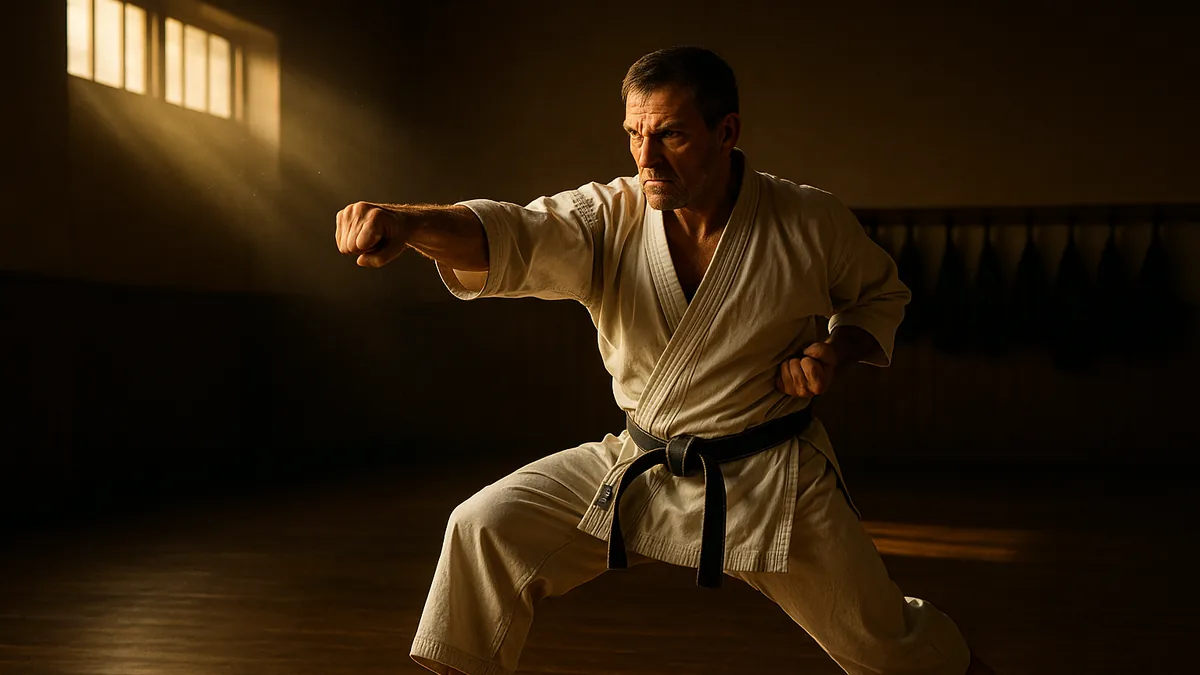
Most practitioners reach brown belt with kata that is, by most measures, correct. The sequence is right, the stances are solid, the turns land where they should. And yet something is missing - something instructors struggle to name and students struggle to fix.
The problem is not technical. It is the absence of a fight.
This guide pulls out the practical essentials for any intermediate or advanced practitioner whose kata feels hollow, and gives you something concrete to take to your next session.
What Intent Actually Requires
When an instructor tells you to "put more intent in," they are not asking you to tense harder or look angrier. They are asking you to have a specific opponent in your head at every single moment of the kata.
"Intent means you have a specific, visualised opponent at every moment of the kata."
Not a vague sense of someone. A person, at a distance, attacking from a direction. Each technique only makes sense if the threat behind it exists in your mind. A low block without a kick to deflect is just an arm movement. A turn without an attacker on the new line is just footwork.
A quick test: before your next run-through, ask yourself to describe the first three techniques as a fight scenario - not what the moves are called, but what is actually happening. If you can only describe the shapes, that is what you have been practising.
Kime and Breathing Are the Same Problem
Kime is probably the most misunderstood concept at intermediate level. The common version looks like this: tighten everything at the point of impact, hold it briefly, then relax. That is a pose, not kime.
Real kime is a sharp, total contraction at the precise moment of impact, followed by immediate relaxation. The whole structure fires at once and then releases. When it is correct, the technique feels like it originates from the floor rather than the arm. There is a snap of focused energy, and then it is gone.
The held-tension habit comes from early training, where instructors reasonably ask beginners to freeze so the form can be checked. The problem is that many practitioners never unlearn it. By brown belt, it is deeply ingrained and feels like the right thing.
Breathing is directly connected. The exhale needs to happen at the moment of kime - not before, not after. Breathing out before the technique means tension arrives early. Breathing out after means the mind has already moved on. The breath and the strike need to be the same event. A useful rhythm is to take the inhale during transitions and turns, so that every technique is an exhale. This also stops you holding your breath through combinations, which quietly drains your focus across a full kata.
Zanshin: The Half-Second Nobody Watches
Zanshin - remaining mind - is often understood as the composed stillness at the end of a kata. That is the smallest part of it.
In practice, zanshin means your attention never drops, even between techniques. The place where it collapses most visibly is on the turns. Watch any group working through a familiar kata and pay attention to the half-second before each turn. Most students mentally check out. The body goes slightly soft. The eyes lose focus. They are already thinking about the next sequence.
That gap is where the quality of the whole performance lives or dies. A student who maintains zanshin through every transition looks fundamentally different from one who doesn't, even if their individual techniques are technically identical. There is a quality of readiness that never disappears - and judges, instructors, and experienced observers will notice it within the first four counts.
Contrast Is the Marker of a Meaningful Kata
Mechanical kata has a consistent rhythm. Every technique takes roughly the same amount of time because the performer is managing the sequence, ticking through the counts at a comfortable pace. It is accurate, but it is even - and a real fight is not even.
Meaningful kata has contrast. Explosive techniques followed by loaded stillness. Fast transitions and deliberate moments of weight. Combinations that feel connected rather than sequential. The tempo is driven by the scenario, not by the performer's comfort level.
If your kata sounds like a metronome, you are managing the memory. If it sounds like something with urgency and pause and decision in it, you are performing a fight.
Checklist for Your Next Class
- Before you start: spend thirty seconds establishing the scenario - who is attacking, from where, with what
- On kime: aim for contraction and immediate release; if you are holding the end position, you are practising the wrong habit
- On breathing: exhale on the technique, not before or after; inhale during the turns and transitions
- On turns: keep your attention sharp in the half-second before each turn; that is where zanshin is tested
- Describe it: after your run-through, explain the first three techniques as a fight scenario; if you cannot, go back to the visualisation
- Listen to the rhythm: if your kata has a consistent tempo all the way through, work on introducing genuine contrast between explosive moments and stillness
For the complete version, with every drill explained, read How to Perform Kata With Intent on Karate Lifestyle.
Join the conversation: X · Pinterest · Bluesky
More from Karate Lifestyle


Comments
Post a Comment