Your Kata Already Contains a Complete Grappling Curriculum - Here's How to Find It
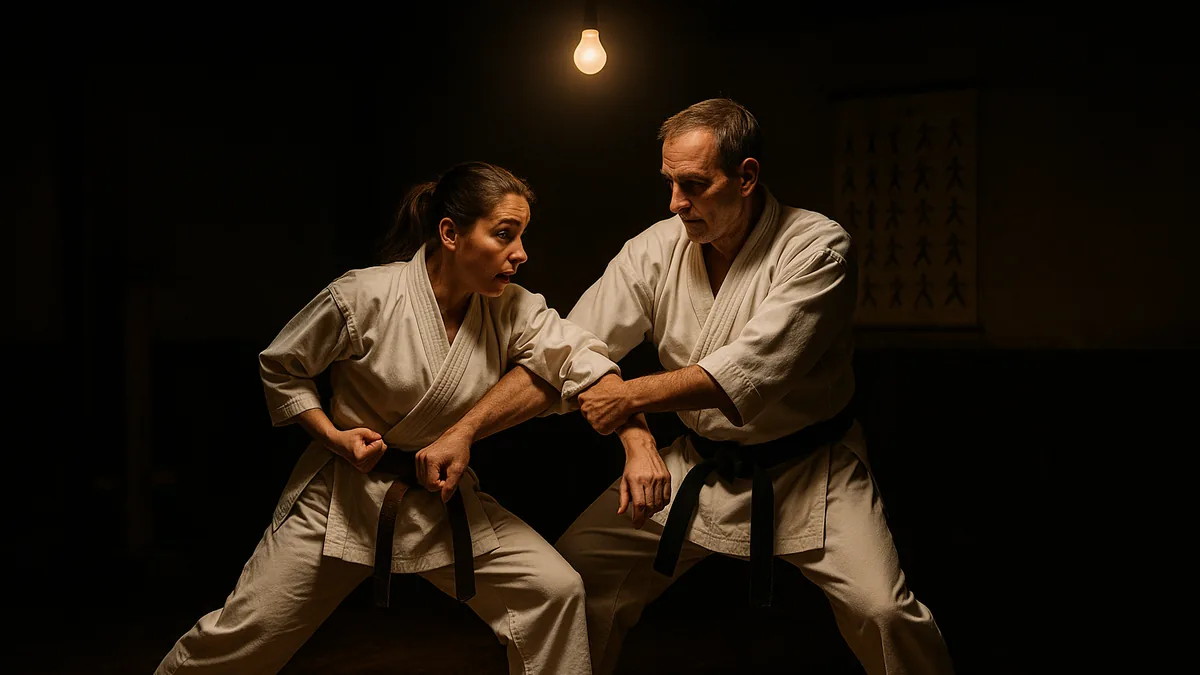
Most karate practitioners can perform their kata to a high technical standard and still be missing the actual fighting content encoded within the movements. That is not a criticism - it reflects the training environment most of us work in, where kata are drilled solo, bunkai is rehearsed with compliant partners, and sparring rules exclude the very techniques the kata are built around. Those three things rarely connect, and the gap is where the grappling curriculum disappears.
This guide is for practitioners at green belt and above who train kata regularly but have not yet explored what sits beneath the block-and-counter layer. If that is you, the good news is that nothing new needs to be added to your kata. The throws, joint locks and close-range controls are already there.
The Pulling Hand Changes Everything
The single most immediately useful adjustment you can make to your kata practice costs nothing and requires no new knowledge. It is simply this: every time your hikite hand pulls back, treat it as though it is gripping an opponent's limb.
Look through early karate texts and you will find that bunkai illustrations almost never show the hikite hand returning empty. It is grabbing, seizing or controlling something. When you perform hikite as a simple chamber, you lose the mechanical logic of the whole technique - the off-balancing, the exposure of a target, the setup for what follows. Drilling with a partner where you are actually pulling their arm while the other hand delivers its technique makes both functions clear at the same time.
This one adjustment tends to shift how practitioners read the rest of their kata almost immediately.
Large Arm Movements Are Probably Throw Entries
A reliable heuristic for finding the grappling content in kata: any large circular arm movement combined with a significant weight shift or step is worth examining as a potential throw or sweep entry rather than a block.
The gedan-barai in Heian Shodan is a worked example most practitioners can test straight away. As a beginner technique it reads as a low block. With partner work it develops further - the stepping action creates an angle, the arm movement controls and off-balances, and the hip rotation provides the throw. The mechanics are already in the movement. The question is only whether you recognise what they are for.
This is not a modern reinterpretation. Gichin Funakoshi documented nine throws derived directly from Shotokan kata and wrote explicitly that throwing and joint pressure techniques should be studied through basic kata. That material was present from the beginning.
Locks Live in the Transitions, Not the Positions
Most practitioners focus on the finished positions in kata - the stances, the completed techniques. The transitions between movements tend to be treated as neutral, as simply getting from one technique to the next. In practice, those transitions are frequently where the joint locks and controls are found.
The rotation happening between a high block and a reverse punch contains a potential armbar entry. Double-arm movements that look like simultaneous block-and-strike combinations often contain wrist lock mechanics that only become apparent when slowed right down and applied against a resisting partner. Whenever one hand pulls back toward the hip while the other extends or rotates across the centreline, there is a reasonable chance you are looking at a neck control or strangle.
The method for finding these is consistent: slow the transition, apply it against genuine resistance, and see what emerges. If it works under pressure, you have probably found something real.
"The test of any bunkai interpretation is whether it works under pressure."
Convoluted applications that require a cooperative partner across multiple scripted steps are not martial techniques - they are choreography. The content worth training is what functions when a partner is genuinely resisting.
Checklist for Your Next Class
Bring this to your next kata or bunkai session and work through it:
- Hikite first. In every technique you practise today, grip something with the pulling hand. Notice what changes.
- Find one large circular movement in the kata you are working on. Drill it with a partner as a throw entry, not a block, and feel the weight shift.
- Pick one transition between two techniques and slow it to about a quarter speed against a partner who is lightly resisting. Look for the lock or control in the movement between positions.
- Apply the pressure test. If your current bunkai interpretation only works when your partner throws a scripted attack, note it and keep looking.
- Spend time on Heian Shodan. Take just the first four movements and find at least two distinct interpretations of each one before moving on. It will take longer than expected.
- Check your throw awareness. Any movement in your kata that combines a step with a large arm action - does it contain kuzushi? Work it with a partner and find out.
For the complete version, with every drill explained, read Hidden Techniques in Kata on Karate Lifestyle.
Join the conversation: X · Pinterest · Bluesky
More from Karate Lifestyle


Comments
Post a Comment