Your First Kumite Session: What's Actually Being Tested
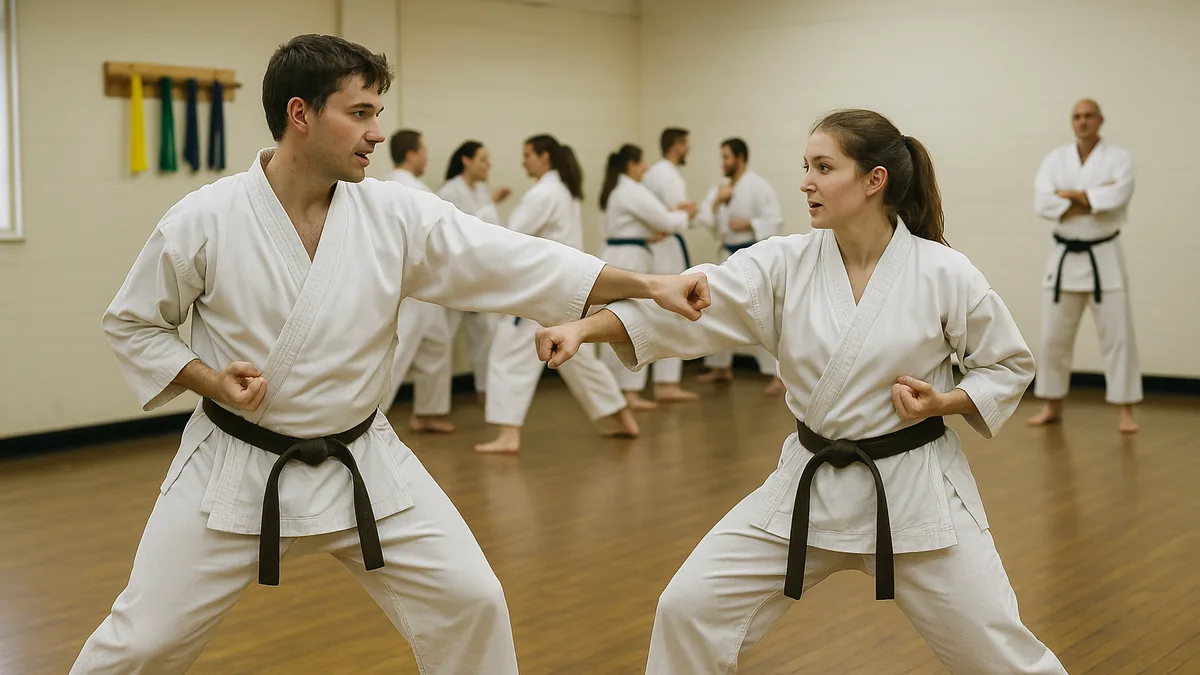
Most beginners arrive at their first kumite session having drilled their techniques until they feel solid. Then the bow happens, and everything they practised evaporates. If that sounds familiar, or if you are about to experience it for the first time, this guide is for you.
The good news: that blank, chaotic feeling is not a sign that you are behind. It is the starting point. What you do with it is what matters.
What You Are Actually Being Asked to Do
The first thing that hits you in a live sparring situation is not your partner's fist - it is the distance. Ma-ai that felt manageable in structured drills suddenly seems completely unreliable when someone is actively trying to score on you. Your partner is either too close or too far away, and your brain cannot decide which.
The second thing is your breath. You will hold it. Almost everyone does, and most people do not notice until several exchanges in, when they are suddenly gasping. This is not poor preparation - it is a recognised feature of the acute stress response. Under genuine pressure, muscle tension overrides normal breathing rhythm, and the result is that everything tightens: shoulders rise, movement slows, reactions narrow.
So here is the actual brief for your first session: your job is not to win. It is not even to score. It is to stay present. Keep your eyes on your partner. Keep moving. If you can do that, the session is a success regardless of what the score looks like.
Managing the Nerves (Not Eliminating Them)
Trying to get rid of pre-kumite nerves is the wrong goal. The nervousness is useful - it sharpens attention. What you want is to manage it, not switch it off.
The most practical version of this takes about ten seconds before you bow in. Take three genuinely slow breaths - not rushed, not shallow - and deliberately drop your shoulders. Sport psychology research supports slow-paced breathing as one of the simplest ways to reduce pre-performance anxiety and sharpen focus. It will not calm you down completely, but it gives you a small but real head start on not freezing when the match starts.
The other thing that helps is committing to movement the moment the bout begins. Do not stand still waiting to react. Shift your weight, adjust your angle, do something with your feet. Even small movement breaks the freeze response and gives your body something to do while your brain catches up.
What Your Instructor Is Watching For
This is where most beginners get it wrong, and it is not their fault - it is rarely explained clearly enough.
Your instructor is not watching to see if you score. They are watching to see whether you are applying what you have been taught. Under competition criteria, a valid scoring technique requires good form, vigorous application, awareness (zanshin), good timing, and correct distance. Those same criteria shape what coaches look for in supervised practice and grading.
In practical terms, that means four things:
- Kamae - are you maintaining a recognisable guard, or have you collapsed into a defensive hunch the moment pressure was applied?
- Controlled technique - are your attacks finishing with some semblance of form, or are they just flailing in the general direction?
- Awareness - are you watching your partner, or staring at the floor?
- Attitude - are you engaging, or backing into the corner hoping it stops?
That last one carries more weight than most beginners expect. A white belt who throws a technically imperfect gyaku-zuki with genuine intent will be viewed far more favourably than someone technically competent who refuses to engage. Kumite is a test of character as much as technique.
A Checklist for Your Next Class
Take this into your next session and keep it simple:
- Before bowing in: three slow breaths, shoulders down, eyes forward
- From the first moment: move your feet - do not wait for your brain to catch up
- On every attack: initiate from the hip, not the shoulder - the wind-up is what gets you countered
- After every exchange: return to kamae before doing anything else - reset and reassess
- On every technique: exhale - the kiai is part of the strike, not a byproduct of effort
- When you feel overwhelmed: move into the line of attack, not away from it
- Throughout: keep your eyes on your partner, not the floor
As the full article puts it:
"A mediocre technique at the right time beats a perfect technique half a second late, every single time."
At white belt, your understanding of kumite will feel like it is about executing techniques under pressure. That is fine - it is the right place to start. But the sooner you stop measuring success by the score and start treating each session as information, the faster everything else begins to make sense.
For the complete version, with every drill explained, read Kumite for Beginners: What to Expect on Karate Lifestyle.
More from Karate Lifestyle


Comments
Post a Comment