Why Your Stretching Isn't Transferring to Better Karate Technique
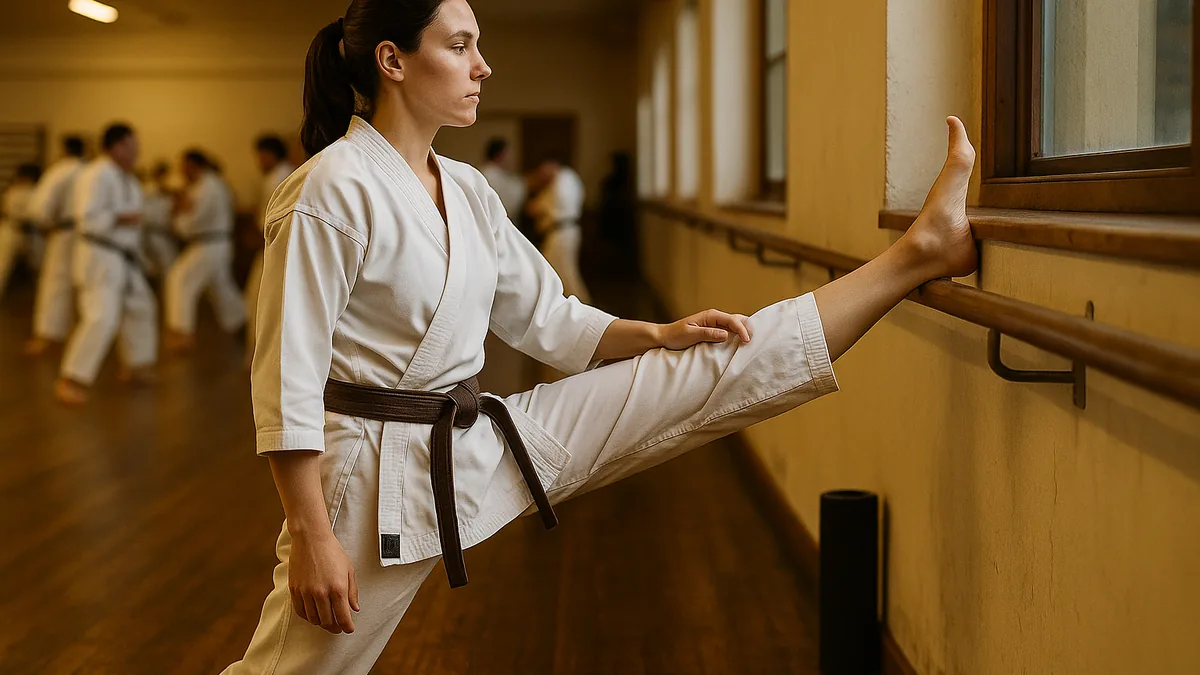
If you train alongside a desk job, you have probably noticed that the stretching you do before class does not seem to produce the range of motion you need when you are actually moving at speed. You can touch your toes in the warm-up and still feel your hip lock halfway through a mawashi-geri. That gap between what you can do slowly on the floor and what you can do under pressure is the real problem - and fixing it means being more deliberate about what you stretch, when, and why.
The Hip Work Most People Skip
Ask most karateka where their flexibility is limited and they will say hamstrings. In practice, the bigger limiters are usually the hip rotators and adductors - the deep muscles in the glute and inner thigh. Mawashi-geri, for example, requires the hip to move through flexion, abduction, and external rotation in sequence before the leg drives toward the target. If those ranges are not available, the kick either stays low or the upper body compensates with a lean that kills both power and balance.
The correction is not more forward folds. Pigeon pose variations, lateral lunge holds, and figure-four stretches get at the rotators and adductors far more directly. If you are currently spending most of your flexibility time on hamstring stretches and calling it hip work, you are probably treating the symptom rather than the cause.
There is also a postural dimension here. Tight hip flexors tilt the pelvis forward, which places the hamstrings in a lengthened and tense position. Stretching the hamstring alone will not resolve this - adding hip flexor work to the same session will often produce faster progress than extra time in a forward fold.
Dynamic Before, Static After
This one has clear evidence behind it and is worth having a firm position on: prolonged static stretching before training reduces force output and impairs explosive performance. Dynamic stretching - controlled leg swings, walking lunges, slow kicks to the top of your range - improves both mobility and muscle readiness going into activity. The two methods serve different purposes and using them in the wrong order costs you performance.
This does not mean static stretching is useless. It is genuinely effective for building range over time. But that work belongs after training, or in a dedicated session on a recovery day - not in the five minutes before you start throwing techniques.
"A mobile joint with no strength around it is an unstable joint."
That point matters because passive flexibility and active flexibility are not the same thing. The range you can reach slowly with a partner's help is typically larger than what you can produce under your own power at speed. In jiyu-kumite, only the active version is available to you. Building it requires slow controlled kicks with a hold at the top of range, and strength work through full range of motion - not just more time spent on the floor.
Thoracic Mobility: The One Nobody Mentions
Most karateka do not think about shoulder or thoracic flexibility until something starts feeling wrong in their punching or blocking. Restriction in the mid-back shows up as stiffness in gyaku-zuki, mechanical-looking age-uke, and a flatness in kata that should have rotational depth. The instinct is to stretch the shoulder - but the more useful target is the thoracic spine itself.
For anyone sitting at a desk for much of the day, this is directly relevant. Prolonged sitting is consistently linked to reduced thoracic mobility, which forces the shoulder complex to compensate. Thread-the-needle stretches, open book rotations, and thoracic extension over a foam roller will do more for your punching mechanics than arm circles will.
A Checklist for Your Next Class
- Before training: use dynamic work only - leg swings, walking lunges, slow controlled kicks. Keep any static holds short.
- Check your hip work: are you including rotation and abduction, or only forward flexion? Add a figure-four or lateral lunge hold to your routine.
- If your hamstrings feel chronically tight: spend time on hip flexors as well. The tilt may be the actual cause.
- After training or on recovery days: use longer static holds to build range over time. This is when that work belongs.
- Include thoracic mobility: one or two mid-back rotations per session if you sit for most of the day.
- Test your active range: kick slowly to the top of your range and hold it for two or three seconds. That height, under control, is your real working range - build from there.
- Pair flexibility with stability: kihon done with genuine attention to hip stability counts as functional flexibility training. Do not separate them entirely.
For the complete version, with every drill explained, read Flexibility for Karate: What Actually Matters on Karate Lifestyle.
Join the conversation: X · LinkedIn · Pinterest · Bluesky
More from Karate Lifestyle


Comments
Post a Comment