Why Your Core Training Isn't Helping Your Karate (And What To Do About It)
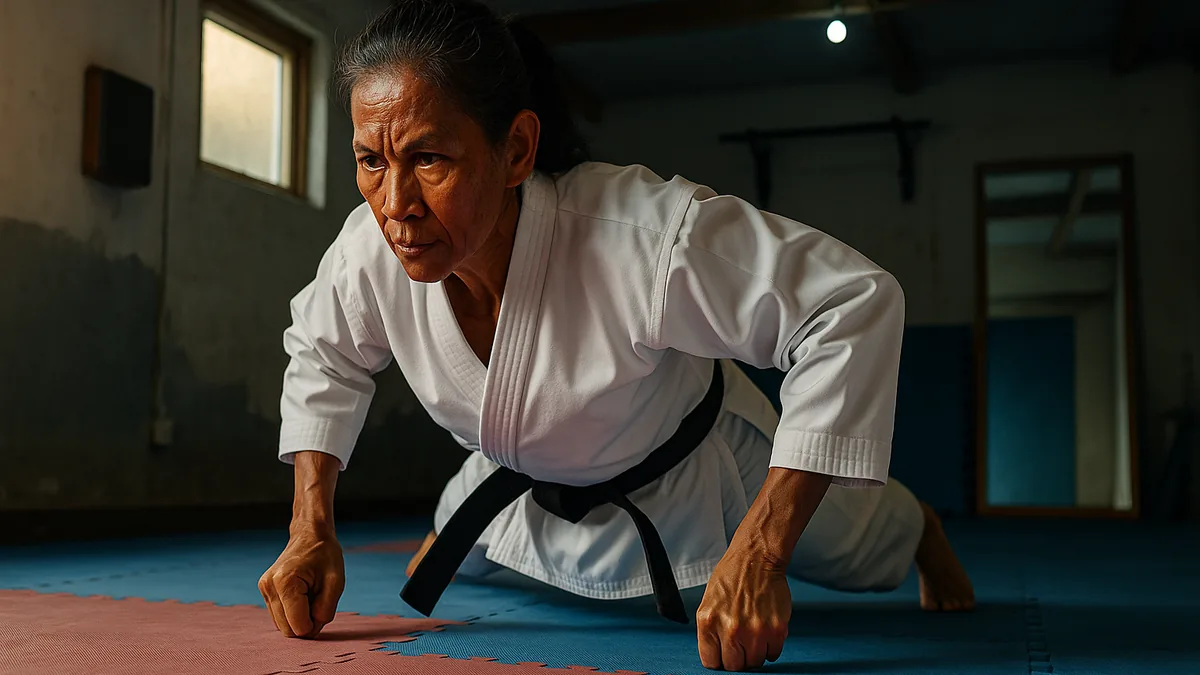
Most adult karate practitioners have done some form of core training. Planks, sit-ups, maybe some gym work. And yet the posture still collapses under pressure, the kicks still lack weight, and sparring still feels unstable the moment someone closes distance. The problem is not effort. It is that most core programmes develop only one quality when karate demands three: resisting rotation, generating rotation, and transferring force through the body. Train only one and the others remain weak links.
This guide pulls out the practical essentials so you can take something useful to your next session.
What Your Core Is Actually Doing When You Train
Every technique passes through your trunk. A reverse punch draws power from hip rotation, but that rotation only produces force if one side of your trunk is bracing while the other drives through. A mawashi-geri demands that your core controls the chamber on the way back, not just the extension on the way out. In sparring, staying rooted when someone presses you depends on your ability to resist being twisted off your centre.
The distinction that matters most is this one:
"You can initiate a kick with good speed yet have no weight behind it, because you are generating the technique but not bracing through it - the power leaks out the back door."
Generating force and transmitting force are separate qualities. A practitioner can have fast, technically tidy kicks that carry very little real impact because the trunk is not bracing through the movement. Addressing that requires deliberate, targeted training - not more repetitions of the same thing.
The Four Exercises Worth Your Time
Dead bug is the starting point, and it is consistently underestimated. The alternating limb pattern - extending opposite arm and leg while keeping the lower back pressed into the floor - replicates the anti-extension demand of throwing a combination. Most people can hold a static plank. Far fewer can maintain a neutral spine while extending a limb under load. Do it slowly, five seconds down and five seconds back, and treat the return as half the exercise rather than a rest.
Pallof press is where intermediate practitioners should spend the most time. Attaching a resistance band or cable at chest height and pressing both hands straight out while standing sideways to the anchor trains your obliques and deep trunk muscles to resist rotational pull. In jiyu-kumite, your opponent is constantly trying to disrupt your structure. Anti-rotational strength is what keeps you square. Most generic core programmes skip this entirely.
Rotational medicine ball slam shifts the focus from resisting movement to producing it. The critical thing to feel is where the throw begins: it should start from the back foot, travel through the hip, and only then involve the arms. If the arms are doing the work, the wrong movement pattern is being reinforced - one that will not transfer to a well-connected gyaku-zuki or any other rotational technique.
Single-leg Romanian deadlift surprises people when it appears in a core training context, but it may be the most directly relevant exercise for kick recovery. Standing on one leg and hinging at the hip loads the hamstring and posterior chain eccentrically while demanding trunk and hip stability to keep the pelvis level. That is precisely what pulling a kick back under control requires. Kick recovery is a core training problem as much as a flexibility one.
How Often and Who Needs This Most
There is a reasonable argument that high-quality, high-frequency kihon and kata practice builds core strength through technique alone. If you are on the mat five days a week with full attention to every movement, that argument has real merit.
For most adult practitioners training twice a week, it does not hold. Targeted core work closes the gap that reduced mat time creates. For anyone training past 40, it should be treated as a non-negotiable part of the programme rather than an optional extra.
The other thing worth stating plainly: gym-based core work and dojo practice need to be connected deliberately. Spending ten minutes on kihon immediately after core training, and paying attention to whether the stability you just worked on is showing up in your technique, is what makes the transfer happen.
Checklist for Your Next Class
- Before class, run through dead bug: slow, controlled, lower back pressed flat throughout
- At the Pallof press, brace from the feet up - not from the hands down
- In rotational work, check that the movement starts from the back foot before the arms do anything
- On single-leg RDL, keep the hips square as you hinge - twisting means you have exceeded your current control range
- During kihon, notice whether your trunk stays braced through each technique, not just at the point of impact
- After kicks, practise chambering back slowly at least a few reps per session to expose any instability in the recovery
- If your core work feels comfortable, it probably is not challenging the right qualities - adjust load or position before adding repetitions
For the complete version, with every drill explained, read Core Training for Karate on Karate Lifestyle.
Join the conversation: X · LinkedIn · Pinterest · Bluesky
More from Karate Lifestyle


Comments
Post a Comment