Why Your Breathing Is Costing You Power (And What to Do About It)
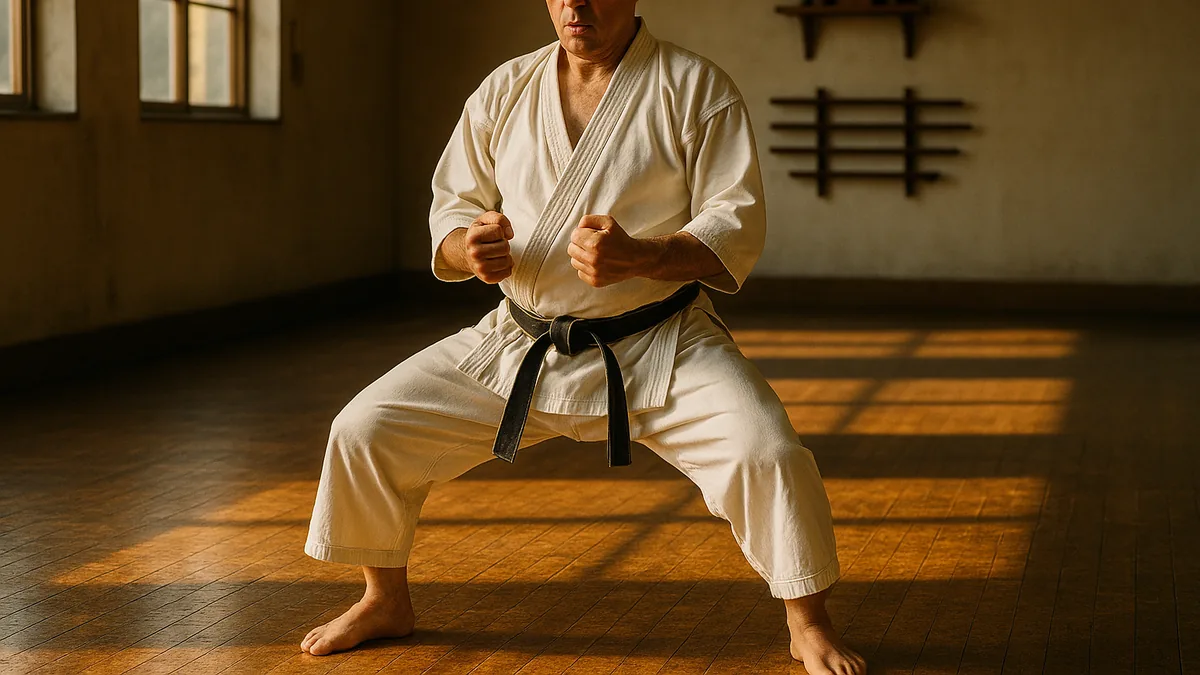
Most karateka who feel unexpectedly wrecked after kumite assume they need to get fitter. Often, that is the wrong diagnosis. The real culprit is breathing - not the absence of it, but the wrong pattern at the wrong moments. This guide pulls out the practical essentials so you can take something useful straight to your next class.
Why Breathing Is a Technical Skill, Not Just a Physical One
Breathing in karate is not background noise. It is part of the technique itself, and it affects your power, your timing, and how quickly you recover between exchanges. The reason this matters beyond simply staying aerobically comfortable is that a sharp exhalation at the moment of kime directly recruits the deep abdominal muscles - the ones that connect your upper body movement to your hips and legs. Without that exhalation, power leaks at the midsection regardless of how fast your arms are moving.
This is why two practitioners can have similar arm speed on a punch and produce noticeably different impact. The one breathing correctly is engaging the whole body. The other is just moving an arm.
The same principle applies to whole-body tension at the point of contact. Try throwing a punch while breathing in, then throw one with a controlled sharp exhale. You will feel the difference immediately - no explanation required.
What This Looks Like Across Kata and Kumite
In kata, the most common error is exhaling only at the two kiai points and breathing irregularly through everything else. Every technique with a clear endpoint needs its own exhalation - the kiai moments are simply the loudest in what should be a continuous rhythm. Inhale during transitions and preparatory movements; exhale on every strike, block, or kick that has kime. Holding one breath across a three-technique combination and then gasping is one of the most power-sapping habits you can have, and it is very common.
"Making the breathing audible to yourself changes kata performance more than almost any other single correction."
That is worth taking literally. Run a familiar kata at half speed and let your breath be heard. You will immediately identify where your breathing is out of sync with your technique - and that is where your timing problems are hiding.
In kumite, the first thirty seconds is where breathing tends to collapse most completely. The adrenaline response pushes you into rapid chest breathing, which is shallow, inefficient, and creates a tension feedback loop that makes the whole round harder than it needs to be. The practical fix: before you throw your first attack, take two or three deliberate abdominal breaths. Make that your opening priority. If you can hold controlled breathing through that initial burst, the rest of the round tends to settle on its own.
Between exchanges, use your guard position to reset. Exhale on every attack and every defensive movement - not just on combinations you consider significant. The rhythm to aim for is: exchange, reset, breathe, assess, repeat.
The Kiai Is Not a Shout
This is possibly the most misunderstood single element in karate for newer practitioners. A kiai is a concentrated abdominal exhalation - the sound it produces is a byproduct of the air being expelled with force, not something you generate in your throat.
When it is done correctly, you feel it in your core. The lower abdominal wall contracts sharply, the air is driven upward and out, and the sound that results is short and forceful. When students simply shout, the core does not engage, and the kiai contributes nothing to the technique it is supposed to punctuate.
A useful approach if you are struggling: forget about making a sound entirely. Contract your lower abdomen sharply - as if bracing for a punch to the stomach - and expel the air fast. The sound follows from correct mechanics. Once the breathing is right, the kiai stops feeling like something separate you have to produce and starts feeling like the natural endpoint of a strong exhalation.
A Checklist for Your Next Class
- Before you start - take two or three deliberate abdominal breaths to establish the pattern before training begins
- In kihon - assign a sharp exhalation to every technique; no technique should be executed on a held breath
- In kata - make your breathing audible to yourself; if you cannot hear it, you are probably not doing it
- At kiai points - focus on abdominal contraction and fast air expulsion, not on producing a sound
- In kumite - prioritise controlled breathing in the first thirty seconds before committing to an attack
- Between rounds - walk slowly and breathe abdominally; do not stand still or sit down
- After class - note any combinations where you caught yourself gasping; those are your targets for next session
For the complete version, with every drill explained, read Breathing in Karate: When and How on Karate Lifestyle.
Join the conversation: X · LinkedIn · Pinterest · Bluesky
More from Karate Lifestyle


Comments
Post a Comment