Why You Keep Getting Hit in Sparring (And It's Not Your Blocks)
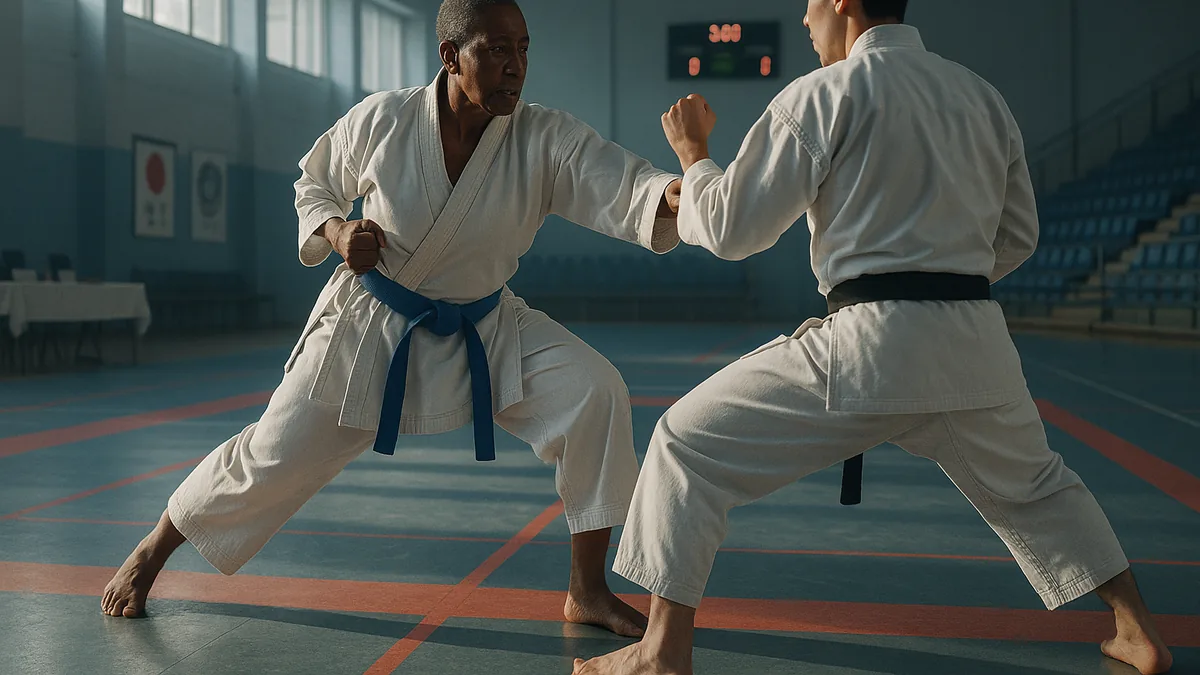
If you are stepping into jiyu-kumite and getting caught repeatedly, the instinct is to assume your blocks need to be sharper or faster. That instinct is wrong, and chasing it will keep you stuck. The problem almost always sits further back in the chain - in where you are standing, what you are watching, and how you are moving before anything is thrown at you.
This is a practical companion to the full article on sparring defence on KarateLifestyle.uk. Read this first to get your bearings, then go deeper with the main piece.
Distance Is Not a Setting, It's a Habit
Ma-ai - the fighting distance between you and your opponent - is not something you establish at the start of a round and then maintain passively. It shifts with every step either of you takes, and your job is to keep adjusting it continuously. The moment you treat your position as a home base to return to, you stop moving, and a still target is an easy target.
The danger zone that catches most beginners is a distance that feels cautious but is not. Far enough that nothing is happening yet, but close enough that one committed step from your opponent puts their technique on you. That gap is not safety - it is just a pause before the problem arrives.
A useful internal check: if someone attacked right now, would you have to scramble? If yes, your distance is already wrong.
Watch the Body, Not the Hands
"Getting hit less is not about faster hands. It is about being somewhere the punch was not aimed at in the first place."
Most beginners track the hands during an exchange because that is where the punch comes from. The correction experienced coaches apply is to shift your focus to the chest and hips instead. The body commits to an attack before the limb moves - the weight shifts, the shoulder drops, the hips begin to turn - and if you are watching the centre of mass with a soft, wide focus, you pick up those signals earlier than you would by tracking the fist.
This does not mean ignoring the hands entirely. It means letting your peripheral vision handle the limbs while your primary attention stays at the source. It feels unnatural at first, but it gives you the extra fraction of a second that makes evasion possible rather than reactive.
Shoulder tension makes this worse. When you sense an attack coming and your shoulders tighten, you freeze briefly - and that freeze, not the speed of the attack, is usually what gets you hit. Staying loose and keeping your weight slightly forward keeps all your movement options open.
The Diagonal Step: Move Off the Line
Stepping straight back when someone attacks keeps you on the same line the technique is travelling along. It might buy you a little time, but it does not change the geometry of the problem. Your opponent is still facing you squarely, still in structure, and still able to follow.
Stepping 45 degrees to the outside is a different matter entirely. When your opponent commits to a lunge punch and you move diagonally off the line, two things happen at once: you are no longer where the technique was aimed, and your opponent's weight is now forward with their back quarter turned toward you. The counter opportunity is already there - you do not have to create it.
This is not an advanced concept, but it does require decent footwork as a base. The diagonal step only works if you land in a stable position. Practise the movement on its own first, without any attack involved, until it stops feeling like a conscious decision. When you have to think about it, it is too slow.
Checklist for Your Next Class
- Before the round starts: remind yourself that distance is something you keep adjusting, not something you set once
- During exchanges: focus on your opponent's chest and hips, not their hands - let your peripheral vision handle the limbs
- When you feel an attack coming: check your shoulders are loose and your weight is slightly forward, not braced back
- Instead of moving straight back: practise stepping 45 degrees to the outside, even slowly, and notice where it puts you relative to your opponent
- After getting hit: ask yourself whether the problem was the block, or whether your positioning was already wrong before the attack started
- Overall priority: treat evasion as your first line of defence and blocking as the backup - not the other way around
For the complete version, with every drill explained, read How to Spar Without Getting Hit on Karate Lifestyle.
Join the conversation: LinkedIn · Pinterest · Bluesky
More from Karate Lifestyle


Comments
Post a Comment