Why Slowing Down Your Kihon Is the Fastest Route to Better Technique
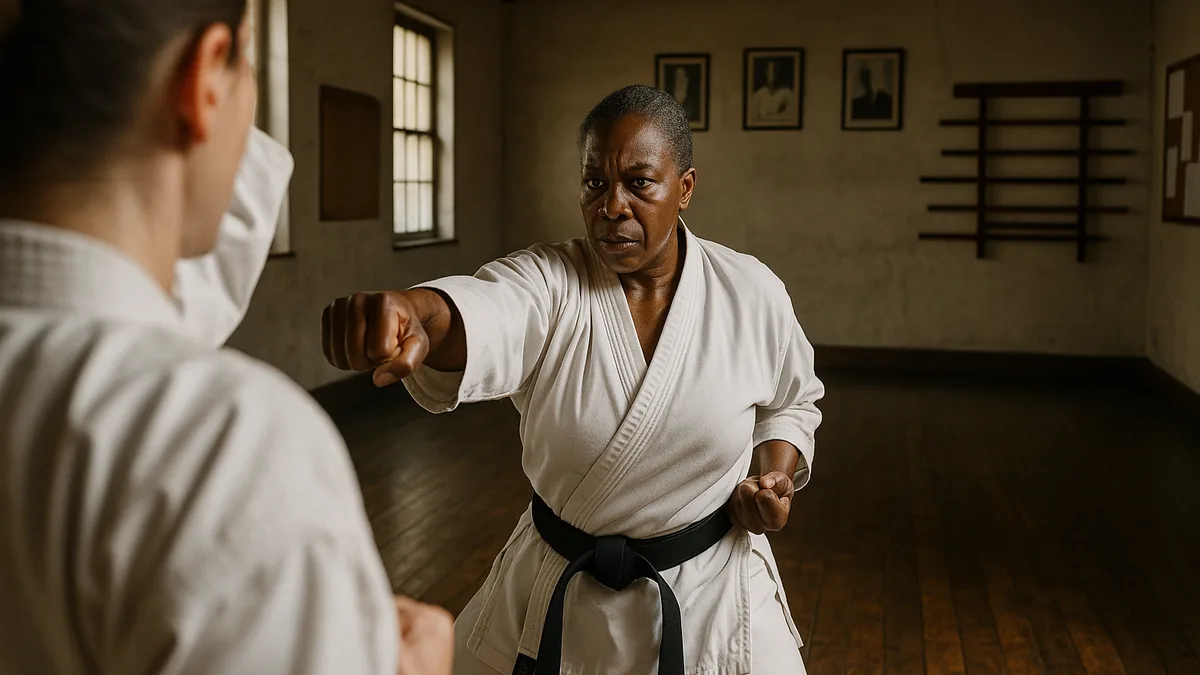
If you watch lower grades during kihon, you'll see the same thing in almost every dojo: arms snapping out as fast as possible, hips rushing through, the whole sequence treated as a race. The assumption is that practising fast builds speed. It doesn't - not reliably, and not correctly. What it builds is whatever pattern you already have, encoded more firmly than before.
Slow practice is where the actual neurological work happens. Here's what that means in practical terms, and how to make it part of your regular training.
Why Your Nervous System Needs the Slow Phase
Every technique you perform sends electrical signals through specific motor pathways. Repetition makes those pathways more efficient - but the key word is those. The pathways being reinforced are the ones being activated during practice. If your technique has an error and you drill it at full speed, the error is what gets encoded more deeply.
"Practise a technique incorrectly, repeatedly, and the circuitry supporting that incorrect pattern is the circuitry being reinforced."
Slow practice solves this by giving you the time to verify correctness before encoding it. At full speed, there is simply no opportunity for conscious adjustment - the movement is over before you can assess it. At one-quarter to one-third of your maximum speed, you can simultaneously monitor your weight transfer, hip rotation, shoulder position, hand path, breathing, and core engagement. That is not possible at full speed, which is precisely why slow practice cannot be replaced by fast practice, no matter how much volume you accumulate.
Speed itself also has a specific neurological requirement: precise timing between the muscles driving a movement and the opposing muscles releasing at exactly the right moment. This coordination can be felt and trained deliberately at slow speed. At full speed, it is invisible to conscious attention. Slow practice lets you notice the moment of release and begin to refine it intentionally.
Slow Does Not Mean Weak
This is the most common mistake people make when they do attempt slow practice. They reduce speed and simultaneously reduce effort, turning the exercise into a vague, floaty drift through the technique. This defeats the purpose entirely.
Slow practice still requires full muscular engagement at the appropriate moments. Your muscles should fire with proper commitment - you are simply executing that sequence at a pace where you can confirm it is correct. If your slow technique looks limp and uncommitted, you are not doing slow practice. You are doing something that looks like slow practice but produces none of its benefits.
The mental effort required to genuinely attend to every component of every repetition is significant. If slow practice feels easy and unstimulating, that is a sign your attention has drifted. Bring it back.
Slow Practice as a Diagnostic Tool
This matters for senior practitioners as much as for beginners, though for different reasons. At lower grades, slow practice builds the pattern. At higher grades, it maintains and audits it.
Small errors drift into movement over time. Under fatigue, under pressure, or simply through the accumulation of thousands of slightly inattentive repetitions, technique shifts in ways that are not visible at full speed. Regular slow practice is how you catch this drift before it becomes a fixed habit. Many senior instructors begin every personal session with slow basics - not because they are still learning the movements, but because they are checking whether the movements have remained correct.
A Practical Framework for Every Session
Rather than treating slow practice as a separate activity that competes with "real training", integrate it into the structure of sessions you are already doing.
- Warm-up set - Begin each session with your basic techniques at quarter-speed. It warms the relevant joints and recalibrates your patterns before you start moving fast. Five minutes is sufficient.
- Correction set - When an error is identified, drop to slow motion and perform the corrected version around twenty times before attempting it at normal speed. This gives your nervous system time to register the new pattern properly.
- Cool-down audit - End each session with a few minutes of slow technique. After kumite or intense work, form degrades under fatigue. The cool-down audit shows you where and by how much.
- Solo slow session - At least once a week, if you train at home, dedicate an entire session to movement quality alone. No timer, no target count - just attention to correctness.
Before Your Next Class: A Quick Checklist
- Am I moving at roughly one-quarter to one-third speed during slow sets? Fast enough to feel the movement, slow enough to monitor everything simultaneously.
- Is my muscular engagement still full? Slow execution, not weak execution.
- Am I attending to weight transfer, hip rotation, shoulder position, hand path, breathing, and core timing - all at once? If not, slow down further.
- When a correction is given, do I drill it slowly before returning to normal speed? Twenty slow repetitions before resuming full pace.
- Have I started my warm-up with a slow set? Even five minutes changes the quality of everything that follows.
- Do I include at least one dedicated slow session in my week? If not, this is the single most practical change you can make to your solo training.
For the complete version, with every drill explained, read Slow Training: Why Practising Slowly Builds Speed on Karate Lifestyle.
Join the conversation: X · LinkedIn · Pinterest · Bluesky
More from Karate Lifestyle


Comments
Post a Comment