Why Goju-Ryu Trains the Way It Does: The Reasoning Behind the Style
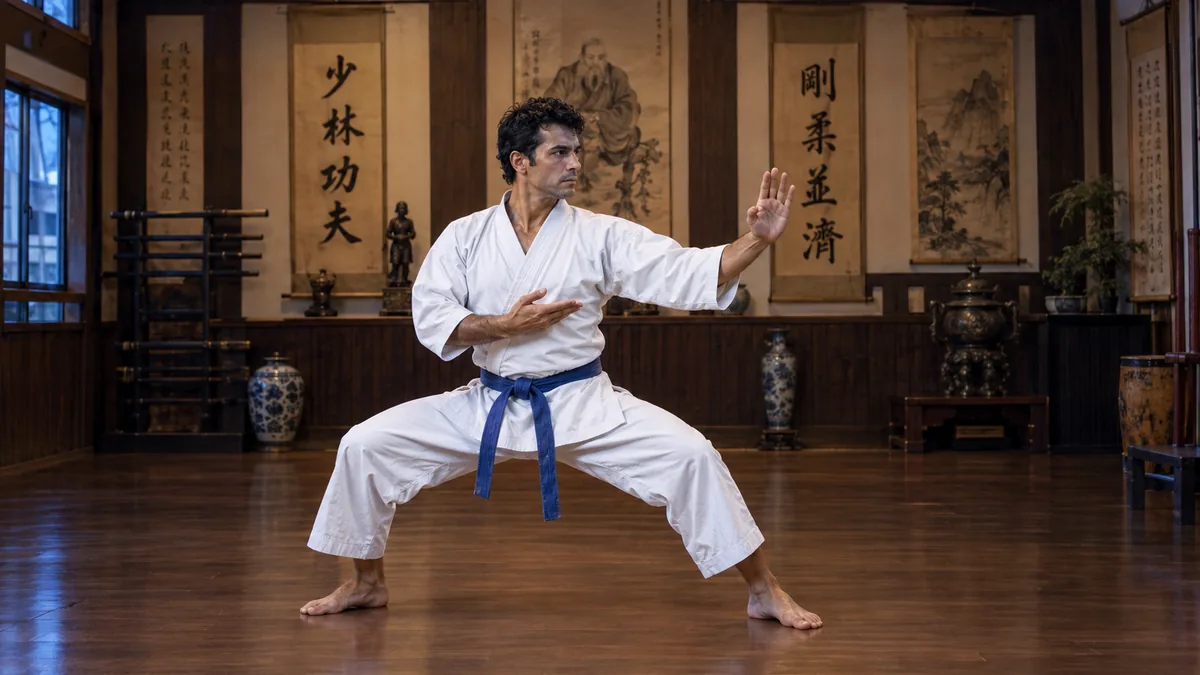
If you have been training Goju-Ryu for any length of time, you will have encountered its distinctive features: the ibuki breathing, the circular blocks, the paired demands of Sanchin and Tensho. What you may not have been told is that each of these is a specific answer to a specific question Chojun Miyagi spent years trying to resolve. Knowing what those questions were changes how you approach the mat.
The Breathing Is Not a Ritual
Miyagi made multiple trips to Fuzhou, in Fujian Province, China, and what he found there was a martial tradition - Fujian White Crane - that treated breath as a structural element of technique rather than something incidental to it. The breathing method he brought back involves a sharp nasal inhale with the glottis partially occluded, followed by an exhale through the mouth. That is ibuki. It is not a warm-up, and it is not a cultural flourish.
When you perform it correctly, the whole body contracts around the breath. You feel it in your core, your lats, your arms. It is simultaneously a conditioning drill and a coordination exercise - training the body to generate and absorb force as a single connected unit rather than as separate parts. Most beginners treat it as a breathing pattern. The shift to treating it as a strength drill is where real progress tends to begin.
The reason this matters is that Miyagi went to Fuzhou specifically to understand this principle. It was not something he picked up incidentally. Breath, structure, and movement were inseparable in the tradition he was researching, and he brought that integration back to Okinawa with intent.
Hard and Soft Are One Principle, Not Two Categories
The name Goju-Ryu came from a line in the Bubishi, a Chinese martial arts text: the way of inhaling and exhaling is both hard and soft. Miyagi took Go (hard) and Ju (soft) from that line when naming the style.
"The name is a technical description. Hard techniques - direct, linear, powerful - and soft techniques - circular, yielding, redirecting - are not opposites that happen to coexist in Goju-Ryu."
This is worth sitting with. If you train the kata treating hard and soft as two separate modes you switch between, you are missing the point. They are two ends of a single integrated principle. When a section of kata moves from a direct linear strike into a circular redirection, that is not a transition to get through - it is the principle being demonstrated in sequence.
The circular blocks in Goju-Ryu follow from this. They are not passive or evasive. The blocking arm makes contact with intent, redirecting the incoming technique while your body is already closing distance. Practitioners coming from more linear styles sometimes treat these as gentle parries. They are not. They are typically also a trap or redirect that sets up an immediate counter.
Sanchin and Tensho Are a Pair
Miyagi created Tensho himself, adapting the hand movements from the Rokkishu of White Crane, and he framed it explicitly as the soft counterpart to Sanchin. If you only train one of them, you are training half the system.
Sanchin builds structural integrity under pressure. The instructor checks this by pressing and striking lightly on the practitioner during performance - if the structure collapses, the breathing is wrong. The body should feel like a single connected unit.
Tensho requires something more difficult to describe but easy to feel when it is right: continuous tension with fluidity through the arm, from shoulder to fingertips, never fully releasing but never locking either. Beginners tend to go to one extreme or the other - either floppy arms or rigid ones. The correct sensation is closer to a rope under tension: flexible, but not slack.
Miyagi kept developing the system until his death in 1953. The Gekisai kata were created in 1940, with the deliberate aim of making karate more accessible and improving physical education. Goju-Ryu was never a fixed tradition to be preserved unchanged, and neither should your understanding of it be.
Checklist for Your Next Class
- Ibuki: Treat it as a conditioning drill, not a breathing exercise. Feel the contraction through your core and lats on the exhale.
- Circular techniques: Ask yourself whether your blocking arm is making contact with intent or just redirecting passively. If it is the latter, you are only doing half the job.
- Tensho hands: Check for the rope-under-tension quality. Neither floppy nor locked - continuous connection from shoulder to fingertip.
- Sanchin structure: If your structure collapses when pressed, your breathing is not doing its job. The breath and the body should be working as one unit.
- Hard-soft transitions in kata: When you move from a linear technique to a circular one, treat it as the principle in action rather than a change of gear.
- Ask why: For any distinctive feature of Goju-Ryu that seems unusual, ask what problem it was designed to solve. The answer usually improves how you train it.
For the complete version, with every drill explained, read Who Was Chojun Miyagi? The Founder of Goju-Ryu and How His Trips to China Shaped the Style on Karate Lifestyle.
Join the conversation: Facebook · Instagram · X · LinkedIn · Pinterest · Threads · Bluesky
More from Karate Lifestyle


Comments
Post a Comment