When Copying Your Instructor Is Holding Your Karate Back
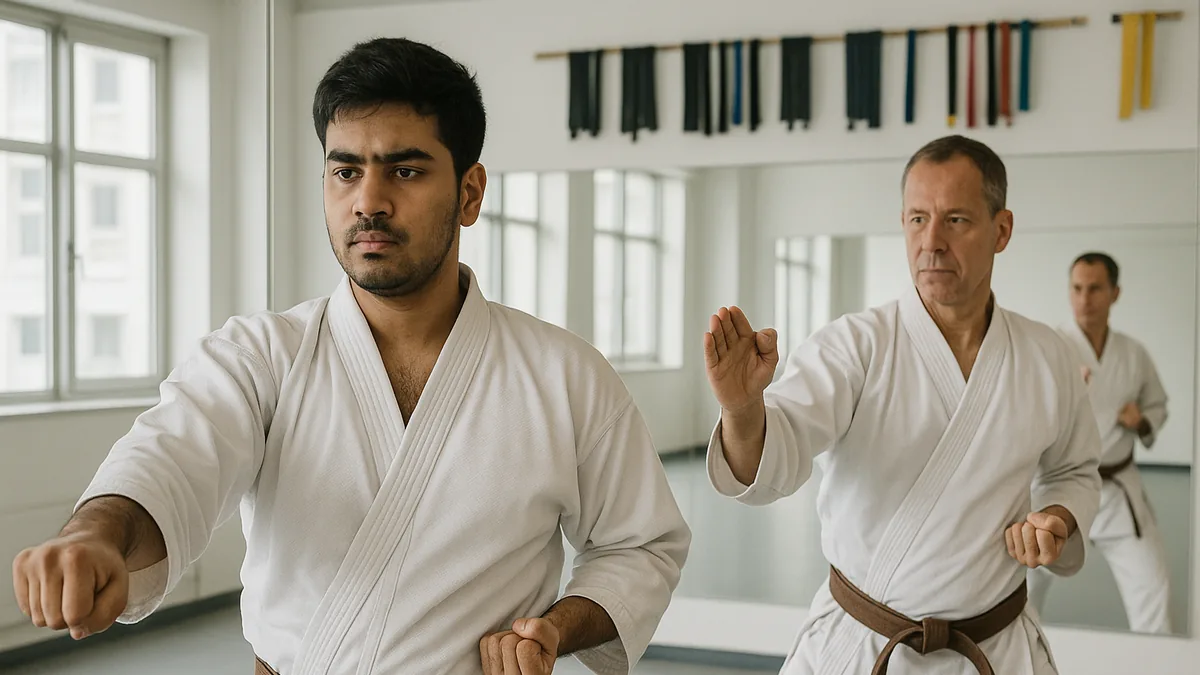
Somewhere between brown belt and shodan, a lot of practitioners hit a wall they can't explain. The training hours are going in, the corrections from the instructor are getting fewer, and yet nothing is really changing. The technique looks fine. It just doesn't work the way it should. More often than not, the cause is still relying on imitation long after it has stopped being useful.
This is a companion to a longer piece on KarateLifestyle.uk that goes deep on the mechanics and the research behind this. What follows is the practical version: what the ceiling of imitation actually looks like, and what to do differently at your next session.
What the Imitation Ceiling Looks Like in Practice
Copying your instructor's movement is the right approach when you're starting out. You don't yet have the body awareness to feel whether something is working, so you use their movement as an external reference. It's efficient, and it produces visible improvement quickly.
The problem is that this process has a natural end point. Once the shapes are roughly correct, continuing to refine the visual match stops producing development. Your technique breaks down under pressure, your kata looks clean but feels hollow, and your sparring resets to a position before every counter. These are the signs that you've learned technique from the outside but haven't yet owned it from the inside.
There's a structural reason this happens. Your instructor's technique has been shaped by their body - their reach, their hip mobility, their decades of accumulated adjustment. Matching their movement precisely will produce a slightly wrong version of their solution, not an effective version of yours.
"Imitation can teach you where your limbs go. It cannot teach you timing, pressure, intent, or the specific way your body generates force most efficiently."
From Matching Shapes to Understanding Mechanics
The shift that breaks through the ceiling is moving from "does this look right?" to "does this work, and why?"
Take gyaku-zuki as the example. The mechanical principle is a sequential chain through the body: the lower body initiates, the hip rotates, the shoulder follows, and the arm arrives last. Your job is to find how your body executes that chain, not to reproduce the visual shape of someone else doing it. When the mechanics are genuinely yours, the punch feels like your whole body arriving at a point. When it's still imitation, it feels like your arm moving with the rest of you somewhere behind it.
The same applies to kata. A technique you understand as a shape feels like a large arm movement. The same technique understood as a response to a specific pressure feels shorter, sharper, and structurally different. That change in understanding produces a change in how the movement feels and functions - and it can't come from watching someone else do it.
Training Methods That Reveal What's Actually Happening
The methods that break imitation ceilings all share the same quality: they force you to feel what's happening rather than watch what's happening.
- Slow the technique right down. Moving slowly removes momentum as a substitute for structure. If the mechanics aren't there, slowness exposes it immediately.
- Train with eyes closed. Removing visual feedback forces you to rely on what you can actually feel in your body. Notice where your awareness fails - that's where the work is.
- Work against resistance. A partner who resists your technique on a pad will show you where the force is leaking. Most practitioners discover their legs and hips are passengers when they expected them to be the engine.
- Seek feedback tied to outcomes, not appearances. "Does this look correct?" is a much weaker question than "would this work, and in what context?" Ask the second one.
More repetition alone will not fix this. The quality of attention during practice is what drives development, not the volume. Turning up to four sessions a week and running the same patterns with the same gaps in understanding will not break a plateau faster than two sessions where you're genuinely trying to feel what's happening and getting specific feedback on what you find.
A Checklist for Your Next Session
- Before class: Pick one technique to focus on. Not to count repetitions of - to investigate.
- During basics or kata: Slow it down once, deliberately. Can you feel every stage of it, or does it blur into a single movement?
- With a partner: Ask them to resist rather than receive. Notice where your force stops.
- Eyes closed: Try the technique or a section of kata without visual feedback. Where does your confidence drop?
- After class: Ask your instructor one specific question about whether the technique would work, not whether it looks right. Frame it around function, not appearance.
- At home: Before adding more solo repetitions, ask whether the pattern you're repeating is the one you want to reinforce.
For the complete version, with every drill explained, read The Problem With Copying Your Instructor's Karate: Why Imitation Has a Ceiling and What to Do When You Hit It on Karate Lifestyle.
Join the conversation: X · LinkedIn · Pinterest · Bluesky · YouTube · TikTok
More from Karate Lifestyle


Comments
Post a Comment