What Your Stances Are Actually Doing (And Why It Changes Everything)
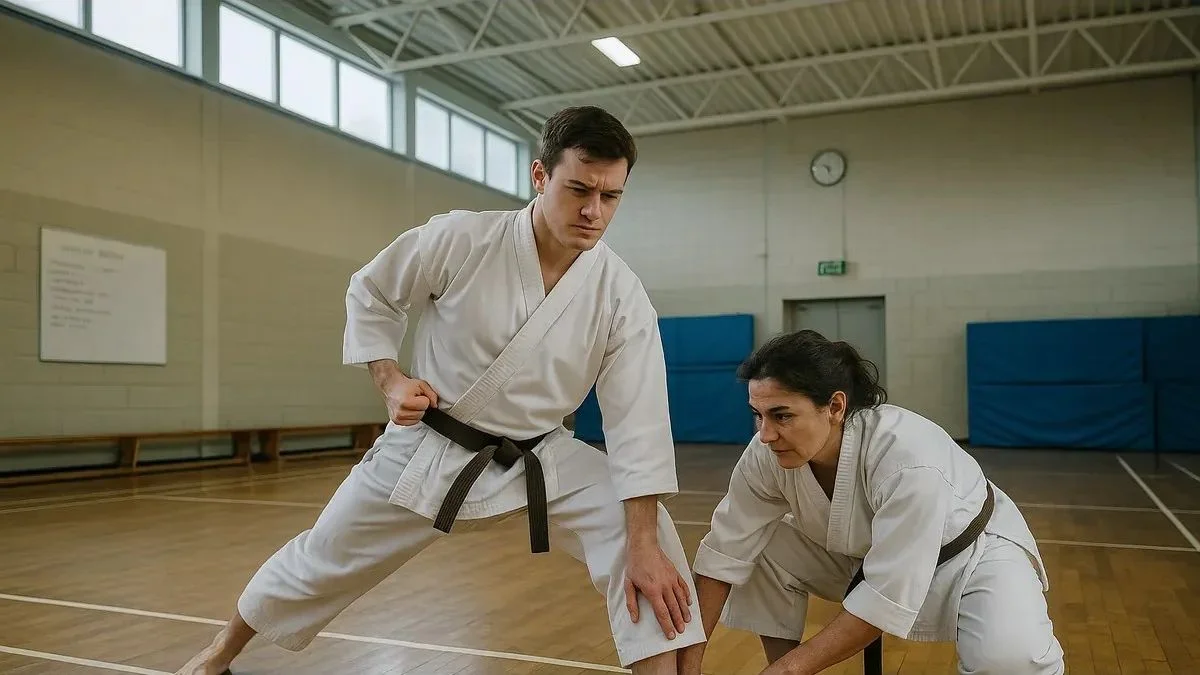
Most karateka spend years drilling stances without ever asking the right question. Not "is my stance deep enough?" or "are my feet at the right angle?" but simply: what is this stance actually for? Once you start asking that, your whole relationship with kihon shifts.
This is a practical guide to the stances that matter most, what they are doing mechanically, and how to take that understanding into your next class.
The Stance Is Not Separate From the Technique
The most important thing to understand - and the thing most practitioners take years to absorb - is that the stance and the technique are a single connected movement. Not two steps: get into stance, then execute. One continuous action.
"The punch does not start when your fist moves. It starts when your back foot pushes into the floor."
In zenkutsu dachi, the back leg is not just holding you up. Kept near-straight through muscular effort (not locked at the joint - that risks injury under load), it drives into the floor. That drive travels through the hip rotation and along the arm. When the back leg bends and stays passive, that chain breaks. You are throwing your arm forward with your arm, not with your whole body. It is a significant difference, and it is visible.
The same principle applies to kiba dachi. If you want the outward knee drive that makes the stance work, stop cueing yourself to push the knees out and instead try gripping the floor with your feet - spreading the toes, pressing through the outside edge. The knee drive follows almost automatically because the foot is now anchored correctly. It is a more effective cue than the obvious instruction most of us have heard dozens of times.
The Stance You Are Probably Misreading
Kokutsu dachi is the one most practitioners get wrong conceptually. It looks defensive, it appears when you are stepping back, and so the assumption forms that it is a passive stance - a way of buying distance.
It is not. The 70% of bodyweight loaded onto the back leg is a spring. That weight is not there to keep you safe; it is there to launch you forward the moment your opponent overcommits. The front leg, carrying almost nothing, is free to counter-kick with virtually no preparatory shift. If you are using kokutsu dachi to simply retreat, you are leaving its best quality completely unused.
Neko ashi dachi works on the same principle taken further. With roughly 90% of the weight on the back leg, the front foot is barely in contact with the floor. A mae geri from that front leg requires almost no weight transfer, which means almost no telegraphing. An opponent reading your body for early signals finds very little to read. That is not a coincidence - it is the stance doing exactly what it was designed to do.
What Stances Reveal About the Rest of Your Training
Kiba dachi is worth singling out here because it is the stance that shows you the truth about your basics. There is nowhere to hide in it. The qualities it demands - outward knee drive, even weight distribution, upright posture maintained under load - are the same qualities that underpin every other stance. Practitioners who never genuinely develop kiba dachi tend to show the same gaps elsewhere, because the underlying mechanics are shared.
Even musubi dachi, the stance you stand in at the start and end of class, is telling you something. Heels together, toes at 45 degrees, weight centred - it is a posture check. Practitioners who stand sloppily in musubi dachi tend to carry that same inattention into their kihon. It sounds minor. Over years of training, it compounds.
The other honest truth about stances is that they disappear in kumite. This is normal and expected, but it is worth understanding why: in kihon you are thinking about the stance, in kumite you are thinking about your opponent. The only route from one to the other is drilling until the stance becomes automatic. Conscious technique does not survive contact with a live partner. The stances you want in sparring are the ones you have drilled past the point of having to think about them.
Checklist for Your Next Class
- Zenkutsu dachi back leg - check it is near-straight and actively driving, not bent and passive. Feel the difference in your gyaku-zuki.
- Kokutsu dachi intent - remind yourself this is a loaded position, not a retreat. Notice how light the front leg feels and what that makes available.
- Kiba dachi feet - try gripping the floor and spreading the toes rather than just cueing the knees outward. Note whether the knee drive feels more natural.
- Neko ashi dachi front foot - feel how little weight is on it. Practise lifting the front leg from that position with no preparatory shift.
- Stance depth - ask whether your depth lets you move and generate force, or whether you are posing. Adjust accordingly.
- Transition, not position - pick one combination in kihon and focus on the stance and technique as one movement. No stopping in the stance before executing.
For the complete version, with every drill explained, read Karate Stances Explained on Karate Lifestyle.
Join the conversation: Instagram · X · LinkedIn · Pinterest · Threads · Bluesky · YouTube
More from Karate Lifestyle


Comments
Post a Comment