What Your Kata Is Actually Trying to Tell You
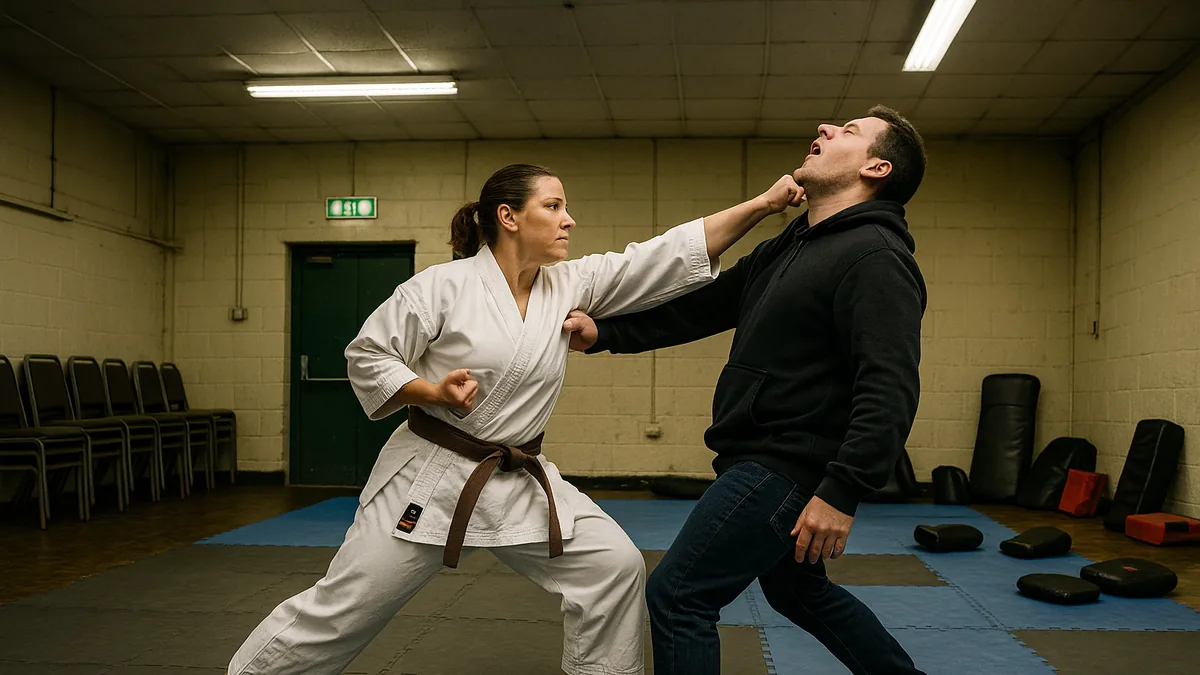
Most karateka can perform their kata to a reasonable standard. Stances are solid, transitions are sharp, kiai lands in the right place. And yet, ask them what a specific sequence is for and you'll often get a blank look or a vague gesture toward "blocking and countering."
That gap - between moving well and understanding what you're doing - is the central problem this companion piece is about. The full article goes deep into the history and the method. This is the practical version: what to focus on, and what to take to your next training session.
Why the Fighting Content Went Missing
This isn't about modern karateka being lazy or incurious. The removal of combative application from kata was a deliberate historical decision. When karate entered the Okinawan school system in the early twentieth century, the person responsible for introducing it made a conscious choice to teach the physical forms without the violent methods they encoded - because those methods were considered unsuitable for children.
That pragmatic decision allowed karate to spread widely. But what spread was a version of the art with the fighting logic already separated from the movement. By the time kata reached mainland Japan, and later the rest of the world, systematic application teaching had already eroded significantly. Sport and performance emphasis over the following decades finished the job.
The point is not to be resentful about this. The point is to understand that the absence of application knowledge in your training is not inevitable - it is a gap with a specific cause, and it can be addressed.
The Two Things Most Practitioners Get Wrong
The pulling hand is not decorative. The hikite - the hand that chambers back toward the hip - is one of the most misunderstood elements in kata. Trained as a simple retraction for the next punch, it looks like a stylistic habit. Understood correctly, it is almost always doing something to the attacker: controlling a limb, breaking their balance, or creating the structural setup for the next movement. Once you start thinking of it as an active part of every technique rather than a passive reset, your applications become considerably more coherent.
Most "blocks" are not blocks. This is the other widespread misreading. When you train a movement as a passive defence against an incoming strike, you are using roughly half of what it contains. The question worth asking is not "what does this movement do to the attack?" but "what does this movement do to the attacker?" Many of those so-called blocking movements are better understood as strikes, grabs, or redirections - and training them that way changes how they feel and how they function.
"You cannot fake intent when you actually know what you're defending against."
Pressure-Testing: The Four Stages
Knowing an application intellectually is not the same as being able to use it. The only way to find out whether something actually works is to test it against a partner who is not cooperating.
There is a structured way to do this that builds confidence without jumping straight to chaos:
- Stage one - cooperative drilling. Both partners know what is coming. This is just learning the shape of the application. Necessary, but not the destination.
- Stage two - semi-cooperative resistance. The attacker adds realistic speed and commitment. Most applications start showing problems here.
- Stage three - contextual drilling. The attacker varies their input within a defined range. The defender has to read the stimulus and apply the right response. Significantly harder and more valuable.
- Stage four - live application. Controlled sparring or grappling where the defender is specifically working to apply the kata technique when the opening appears.
The honest observation is that most practitioners spend their entire training lives at stage one. That is why kata does not transfer.
One useful indicator that an application is working properly: it stops feeling like you are executing a technique and starts feeling like the situation is resolving itself. When you find yourself forcing or muscling through, that is a signal to stop and diagnose - not to push harder.
Checklist for Your Next Class
- Pick one kata sequence - two or three movements together, not a single technique in isolation
- Before drilling it, ask: what realistic attack is this responding to? Grabs and committed strikes are more likely than stepping punches
- Identify what the hikite is doing in that sequence - what is it grabbing, pulling, or controlling?
- Run the application at stage one with a partner, then push toward stage two before the session ends
- If the technique only works when your partner makes it easy, note that honestly and keep working
- Drill the application at full speed at least once - kata pace builds mechanics, but your nervous system also needs to know what it feels like fast
For the complete version, with every drill explained, read Training Kata for Self-Defence on Karate Lifestyle.
Join the conversation: X · Pinterest · Bluesky
More from Karate Lifestyle


Comments
Post a Comment