What Your Home Dojo Actually Needs (And What It Doesn't)
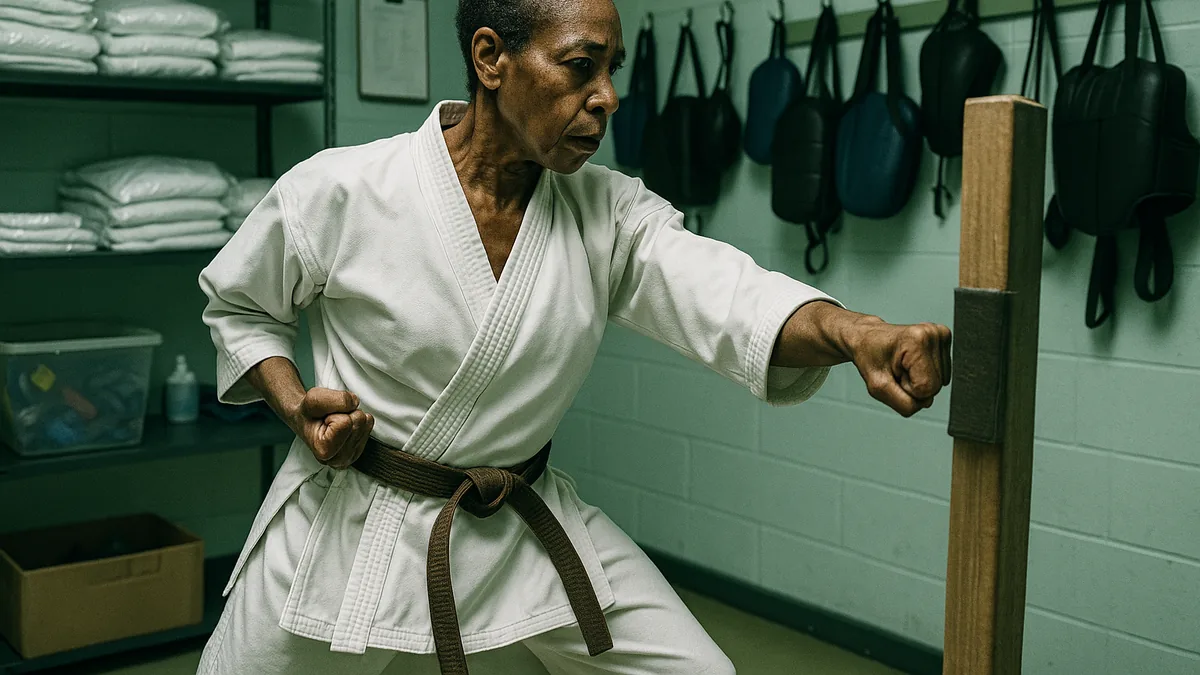
Most home training spaces fall into one of two camps: completely bare, or stuffed with equipment that rarely gets touched. Neither extreme is much use. The good news is that a small number of well-chosen tools, used with some discipline, will serve you far better than an expensive setup used carelessly.
Here is what actually matters, and why.
The Makiwara: More Honest Than Any Bag
If you train in a traditional style and you do not own a makiwara, this is the gap worth addressing first. Not because it toughens your knuckles - that is a misconception that tends to stick around in junior grades - but because it teaches you something a heavy bag simply cannot.
A heavy bag swings away when you hit it. The makiwara flexes and springs back. That rebound tells you immediately whether your whole body was unified behind the strike, or whether you were just using your arm. Poor structure becomes, as the article puts it, immediately, painfully obvious. When it goes right - when the hip drives properly and everything connects - you feel solid resistance travel back up the forearm. When it goes wrong, it feels like slapping a wall.
What the makiwara actually develops is kime, correct wrist and knuckle alignment, and the kind of whole-body force transfer that is easy to fake on a bag and impossible to fake here. For home use, a wall-mounted board is the practical choice if you are renting. Get the height right - solar plexus height is the conventional starting point - and progress slowly. Adaptation takes months. Joint pain means stop.
"The equipment that rewards correctness over volume tends to become more appealing as you progress."
The Heavy Bag: Useful Only If You Are Already Doing It Right
More bad habits develop on heavy bags than on almost any other piece of equipment. The bag rewards volume and penalises nothing. Hit it sloppily for ten minutes and you have trained yourself to be sloppy.
The correct approach is to use the bag for combinations you have already drilled properly in kihon - not to discover what combinations feel like. Use it to work on distancing, and pay attention to how the bag moves when you hit it. That movement gives you information about your structure.
One practical point worth taking seriously: ceiling mounts must go into a joist, not plasterboard. Even anchors rated for high static loads will not hold under the dynamic movement of a swinging bag. Freestanding bags are convenient but tend to migrate across the room under sustained use.
Resistance Bands and Mirrors: The Underrated Two
Resistance bands tend to get dismissed as warm-up tools or physiotherapy aids. Used properly for karate, they are neither. Anchor a band at hip height and work through the rotation of a gyaku-zuki against resistance, and you will feel exactly where your hip drive is breaking down in a way that bag work rarely reveals. They are also useful for hikite mechanics and shoulder preparation before heavier sessions. A set of three resistance levels is enough for most karate-specific work.
Mirrors are non-negotiable for solo training. Without an instructor watching, small errors drift and compound over months. A full-length mirror on the wall opposite your training space is the minimum; a second one at 45 degrees will show you things about your technique in profile that the front view hides entirely.
The trap to avoid: watching yourself continuously. Use the mirror to check, then look away and train by feel. Constant watching turns training into performance. The goal is kinaesthetic awareness - knowing what correct technique feels like from the inside, not just what it looks like from the outside.
Before Your Next Session: A Short Checklist
- Makiwara work - start slow, prioritise alignment over power, stop at any joint pain
- Heavy bag - only drill combinations you can already do correctly; watch how the bag moves
- Resistance bands - anchor at hip height for rotation drills; feel where the hip drive drops off
- Mirror - check your position, then train by feel; do not perform for it
- Mats - 20mm EVA foam is adequate for standing karate; 40mm or more if you are doing any breakfalls or groundwork
- Ceiling fixings - if you have a hanging bag, confirm the mount is into a joist before the next session
Build the space you will actually use consistently. A makiwara, a mirror, and decent mats will take your technique further than a full gym setup that only gets touched twice a week.
For the complete version, with every drill explained, read Karate Training Equipment for Home on Karate Lifestyle.
Join the conversation: LinkedIn · Pinterest · Bluesky
More from Karate Lifestyle


Comments
Post a Comment