What Your Belt Actually Means (And What It Doesn't)
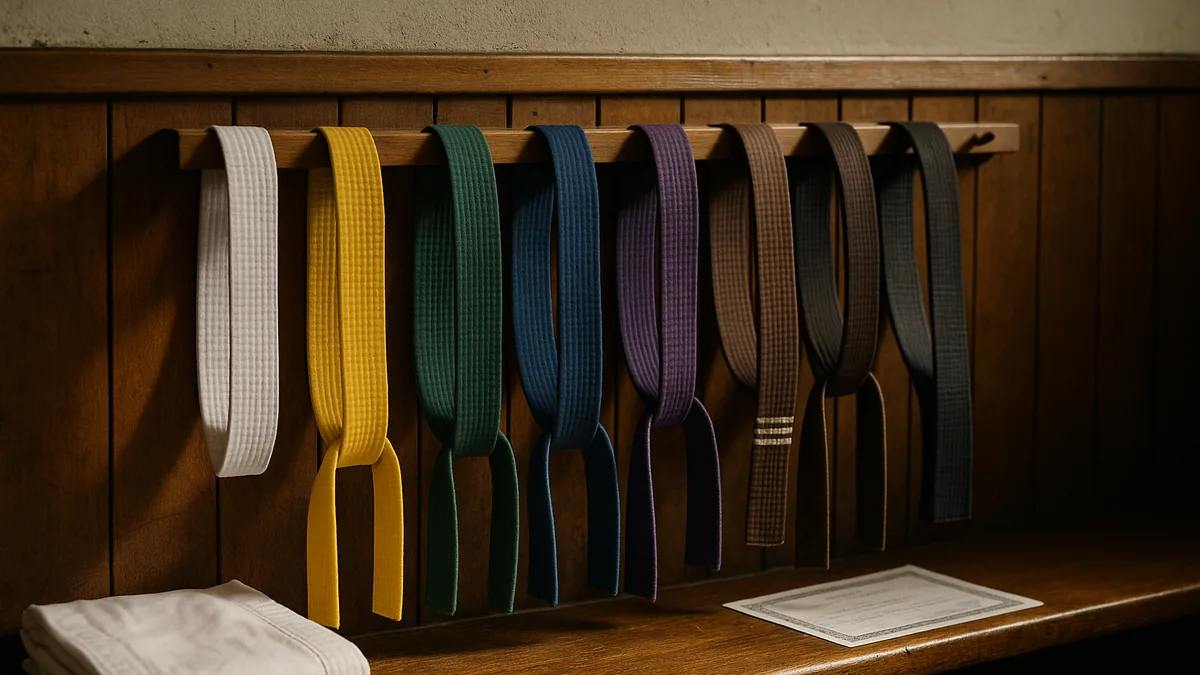
Most students walk into their first grading thinking of it as a pass-or-fail test. That framing causes more problems than it solves. A grading is a snapshot of where your training currently stands, and the belt that follows is a marker of that stage - not a prize for effort. Getting clear on that distinction early will change how you prepare, how you train between grades, and how much the whole process actually means to you.
What the Colours Are Really Telling You
Belt colours indicate a stage of development, but the stage is about your relationship with the art, not just the length of your technique list. At white and yellow belt, almost everything is about coordination - your body is learning movement patterns it has never used before, and that takes time. By blue and green belt, coordination is mostly handled. The question becomes whether you can perform consistently under pressure and against a moving partner.
Brown belt is where many students stall. The techniques are familiar. What is being demanded now is quality of execution, not volume of knowledge. That gap between knowing a technique and performing it cleanly under grading conditions is precisely what brown belt training is designed to close.
One thing worth knowing: the colour sequence you train under is not universal. Different styles and associations use different colours in different orders. A blue belt in one Shotokan club might represent a completely different kyu level from a blue belt in another. If you ever need to compare rank between styles, kyu numbers are the only reliable reference point - colours on their own mean very little across associations.
How Examiners Actually See a Grading
Most gradings follow the same basic structure: kihon, kata, and kumite. Each section is testing something different, and understanding what that is will help you prepare more honestly.
In kihon, the question is not whether you know the technique. It is whether you can execute it with correct form, consistent timing, and appropriate power - repeatedly, under observation. Rushing through basics to show how many you know is one of the most common errors at lower grades. Examiners want to see understanding, not speed.
In kata, memorising the sequence is the starting point, not the finish line. Every movement should have intent behind it - your eyes should be directed at where an attacker would be, your weight committed, each movement with a clear beginning and end. When a kata is performed as a memorised routine without that intent, it is obvious from the other side of the room. As the article puts it:
"Students who treat belts as targets tend to plateau. Students who treat them as checkpoints keep improving."
In kumite, particularly at lower grades, examiners are not watching to see who dominates. They are watching for composure and control. Students who perform well in kihon can fall apart completely the moment someone steps toward them. Staying calm under that pressure is itself a skill, and it is one examiners are specifically looking for.
One point that catches many students off guard: the assessment begins when you walk into the room, not when the grading formally starts. How you bow, how you stand while waiting, how you respond to instruction - all of it is being observed.
Common Grading Errors Worth Knowing About
Switching modes before grading. Students sometimes train normally for months, then shift into a careful, deliberate mode in the final week or two before a grading. The problem is that your body performs what it has actually practised, not what you intend on the day. Training every session as though you are being assessed is the only preparation that reliably transfers.
Holding your breath. Tension in grading situations causes people to stop breathing through entire sequences. Movement tightens, technique loses its snap, and the kiai sounds forced. The kiai is not decoration - it is a breath out, a moment of full commitment. When it is missing or strained, examiners notice.
Performing rather than executing. There is a version of kata that looks polished but feels hollow - students thinking about how they appear rather than what they are doing. The simplest correction is to pick a fixed point in space and treat it as a real opponent. Every block, every strike, every step is directed at something. That single change transforms the quality of the kata and it reads completely differently to an examiner.
Taking It Into Your Next Class
- Direct every kata movement at a specific point in space - treat it as a real target, not a rehearsed gesture
- In kihon practice, slow down deliberately - structure and correctness tell an examiner far more than speed
- Train each session as though you are being assessed, so your body has nothing new to adjust to on grading day
- Remember that minimum time between grades is a floor, not a target - readiness is about execution quality
- In any kumite work, practise staying calm when someone moves toward you - composure is part of what gets assessed
- When your kata feels purposeful and your basics feel automatic rather than effortful, that is a genuine signal of readiness
For the complete version, with every drill explained, read Karate Belt System Explained on Karate Lifestyle.
Join the conversation: X · LinkedIn · Pinterest · Bluesky
More from Karate Lifestyle


Comments
Post a Comment