What the Heian Series Is Actually Teaching You (And When to Move On)
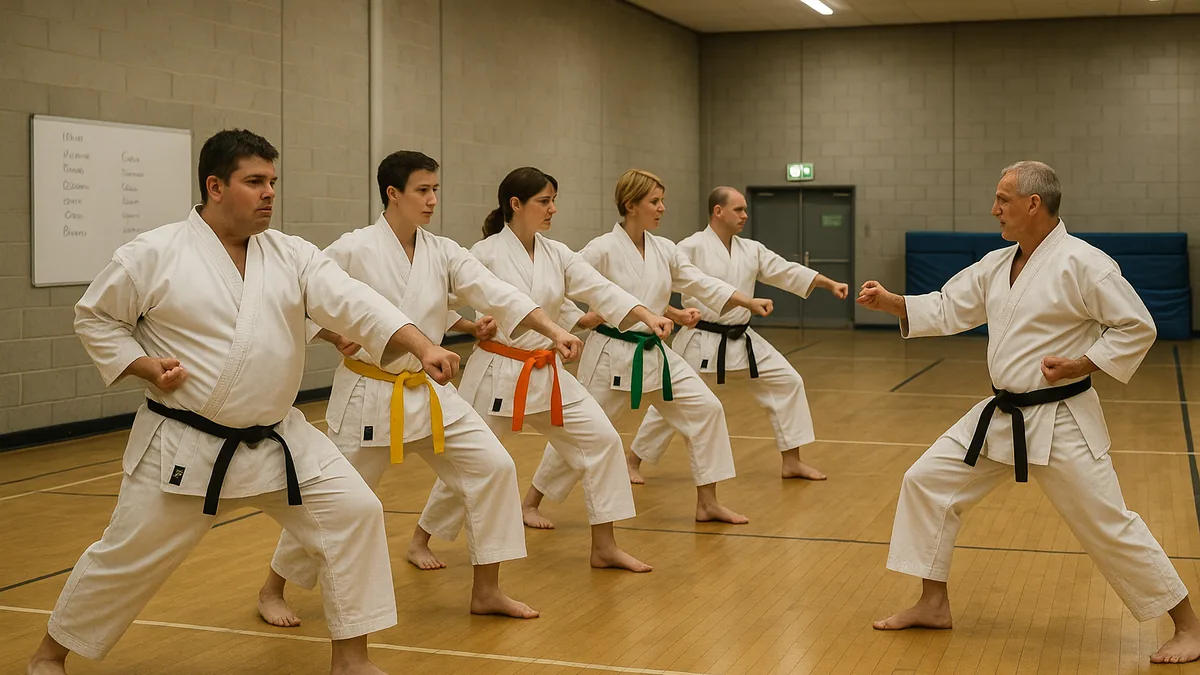
Most kyu-grade students experience the Heian series as a queue - five kata to get through before the interesting stuff begins. That framing is understandable, but it is also why so many brown belts can perform Heian Shodan from memory without being able to say what it actually trained them to do. They were never told what to look for.
This guide breaks down the specific lesson in each kata and what poor performance at each stage usually looks like. Use it alongside your training, not instead of it.
Shodan and Nidan: The First Two Lessons
Shodan is not primarily about learning gedan barai or oi-zuki. The techniques are almost incidental. What the kata is actually training is whole-body coordination - specifically, the connection between your foot landing and your technique arriving. When the foot touches the ground and the punch arrives half a second later, you are effectively punching while standing still. The movement of the body is supposed to drive the technique, not precede it.
A second common problem at this stage: students snap their head to look before a turn, then pause before the body follows. The eyes should lead, but the body should follow immediately. When there is a gap between the two, the kata breaks into disconnected events.
Nidan introduces rhythm - not just speed, but variation in speed. The kata has moments that are meant to be slow and controlled, followed by explosive acceleration. A student who performs Nidan at a uniform tempo from start to finish has missed the central lesson, regardless of how clean the individual techniques are. The fast moments only read as fast because there is something slower around them. Without that contrast, everything flattens.
Sandan and Yondan: Coordination and Flow
Sandan asks you to do two things simultaneously, and most students at this stage cannot yet. They complete one movement and then add the next, rather than having both arrive together. The elbow strike and the stamping kick landing at the same moment produce a specific physical sensation - a compression through the centre - that is quite different from either arriving alone. That feeling is what Sandan is trying to develop.
Yondan is the most underestimated kata in the series. Students often treat it as the one before Godan rather than as a lesson in its own right. What it is teaching is fluidity - the ability to move from one technique into the next without a reset between them. If your foundation has gaps, Yondan will find them. Students who work the transitions in Yondan seriously tend to develop a quality of movement that carries over into their kumite as well.
One mistake worth flagging: students who put extra effort into the more dramatic techniques and lose the one that follows. The flashy moment is not the point. What you land into is the point.
Godan: Where It All Has to Come Together
Godan is demanding precisely because it requires everything the previous four kata have been building - coordination, rhythm, close-range control, and fluid transitions - all at once. Students often fixate on the jump, but the jump is probably the least technically difficult part of the kata. The harder work is in the slower sequences and the uke combinations.
The most common problem with Godan is uneven kime. Students tend to have strong, focused technique in the sequences they have drilled most, and noticeably weaker technique in the transitions or in sections they find harder. Examiners notice this unevenness more readily than individual technical errors. The fix is straightforward in principle, if not in practice: find your weakest sequence, drill it in isolation until it matches the rest, then put it back into context. Running the whole kata repeatedly will not repair the weak section on its own.
On the question of when to move on from each kata:
"The kata is ready when the student is ready - not when the calendar says so."
Grading timelines are a practical necessity, but they are a poor guide to readiness. Some students need to see the whole series before individual stages make sense. Others need to fully inhabit each stage before the next one becomes accessible. What is consistent is that students who keep training the kata they already know - rather than setting it aside the moment they have passed their grading - develop stronger fundamentals across the board.
Checklist for Your Next Class
- Shodan: Check that your foot and technique are landing at the same moment, not in sequence
- Shodan: Make sure your turns are one continuous movement, not a head snap followed by a pause
- Nidan: Identify the explosive moments and deliberately slow down just before them
- Sandan: Work the simultaneous arrivals - elbow and stamp together, not one after the other
- Yondan: Focus on the technique you are landing into, not the one you are coming from
- Godan: Find your weakest sequence and drill it separately before running the full kata
- All kata: Keep training the previous kata in the series - not just the one you are currently learning
For the complete version, with every drill explained, read The Heian Series: What Each Kata Teaches on Karate Lifestyle.
Join the conversation: X · Pinterest · Bluesky
More from Karate Lifestyle


Comments
Post a Comment