Weight Categories in WKF Kumite: Compete Sharp, Not Light
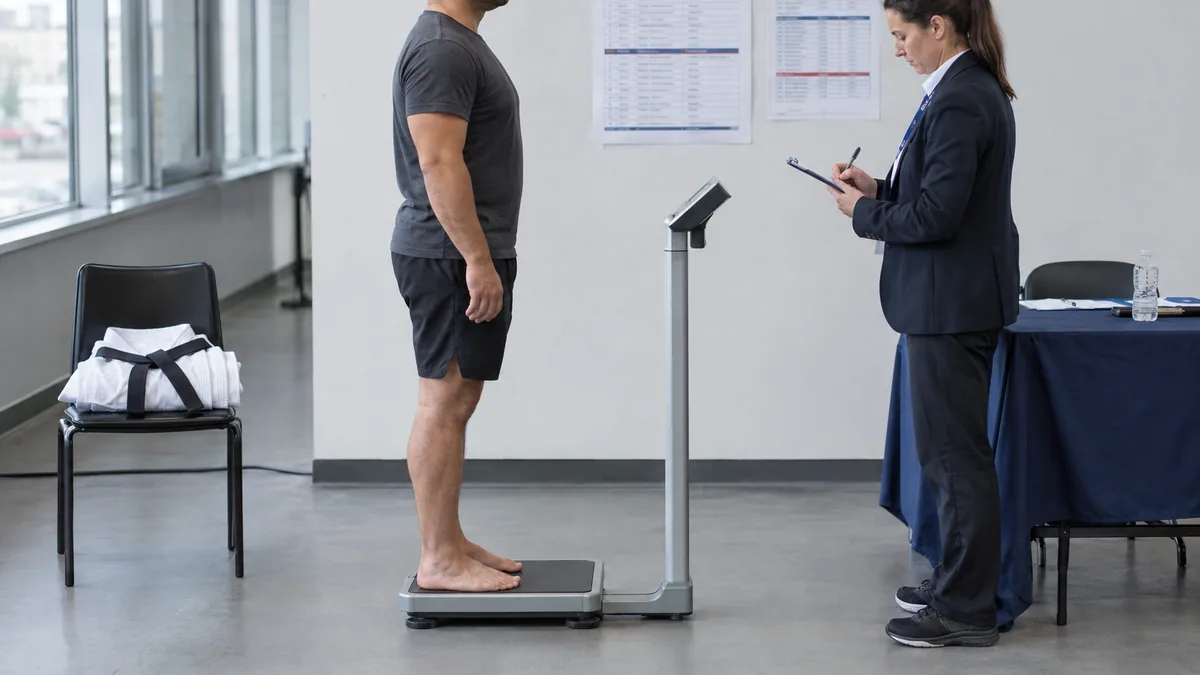
Most club-level competitors approaching their first WKF-sanctioned event spend a lot of time worrying about the scales. Should they cut to a lower category and gain a size advantage? Can they rehydrate in time? Is the tolerance band a useful buffer? These are reasonable questions, but they are often built on assumptions that do not hold up once you look at how the weigh-in process actually works and what the research says about recovery. Here is what you need to know before you make that call.
How the WKF Weigh-In Actually Works
Weigh-in at WKF-sanctioned events takes place the day before competition, not on the morning of your bouts. That gives you somewhere between 16 and 24 hours of recovery time before your first match. Many competitors hear that and feel reassured. The problem is that reassurance may not be warranted if your cut is significant.
The tolerance band - 0.2 kg for male categories, 0.5 kg for female categories - is there to account for differences in scale calibration between venues. It is not a buffer you can plan around. You step on the scales once during the official weigh-in window. If you are over, you are disqualified outright. You do not move to the next category and you do not get another attempt. That is the rule, and it catches people every season.
Understanding this changes how you should think about preparation. The weigh-in is not a hurdle you clear and then forget about. It is the starting point for whatever recovery you can manage before your first bout.
The Recovery Window Is Shorter Than You Think
The overnight gap between weigh-in and competition sounds generous compared to sports where athletes weigh in on the same day they compete. But the evidence on combat sport athletes suggests that 24 hours is often not enough to fully restore hydration status after a meaningful water cut, and that some performance variables do not return to baseline even after rehydration attempts. Research points to 48 hours or more as the window needed for complete recovery from a significant cut.
This matters enormously in kumite, where reaction time is arguably the most decisive physical variable. A technique you would normally read and counter becomes the one you miss when your processing is even slightly off. The performance cost of dehydration is not always obvious when you are standing at the scales feeling relatively normal. It shows up in your first exchange.
"The correction that changes most competitors' approach is understanding that a fresh, sharp version of you at 75 kg beats a dehydrated version of you at 67 kg almost every time."
The competitors who manage weight cuts successfully tend to be those with years of experience doing it, precise knowledge of how their own body responds, and proper nutritional support. For most club-level competitors, those conditions do not apply.
Your Category Should Shape How You Fight
There is a point that goes beyond the weigh-in logistics, and it is worth sitting with. Weight categories are not just a safety measure to prevent mismatches. They also define the tactical environment you are competing in.
Lighter divisions tend to be won on explosive speed and combination volume. The margins are fine and the competitor who fires first, cleanly, usually scores. Heavier divisions reward composure and efficient power generation. The pace is different, the errors are different, and the penalties you are likely to see are different too.
If you cut to a lower category, you are not just fighting dehydrated. You are also fighting in an environment shaped by a different style of athlete, while being physically compromised. The category advantage you were hoping to gain can disappear quickly when your timing is off and the person across from you is fully recovered and right where they belong.
Competing at your natural weight means competing in the division where you can train properly, recover properly, and make the scale without a significant cut. That is the environment where your preparation translates into performance.
Your Pre-Competition Checklist
- Check the event bulletin for the exact weigh-in time and location well in advance - do not assume it follows a standard schedule.
- Weigh yourself regularly during training in similar conditions to weigh-in. Know where you actually sit, not where you think you sit.
- If you are more than the tolerance amount over your target category during a normal training week, either address your nutrition over time or move up a division before the event.
- Do not plan around the tolerance band - treat it as a calibration allowance, not a preparation buffer.
- If you do cut, keep it within 3 to 5 percent of total body weight and build in at least 24 hours for rehydration - knowing that even this may not fully restore all performance variables.
- Read your category's tactical demands and make sure your training reflects them, not just generic kumite preparation.
- Arrive at weigh-in ready to step on the scales once - there is no second attempt.
For the complete version, with every drill explained, read Kumite Weight Categories Explained: How They Work in WKF Competition, Why They Matter, and How to Compete at Your Natural Weight on Karate Lifestyle.
Join the conversation: Facebook · Instagram · X · LinkedIn · Pinterest · Threads · Bluesky
More from Karate Lifestyle


Comments
Post a Comment