Train Smart: A Practical Injury Prevention Guide for Karate Students
Karate injuries rarely announce themselves dramatically. More often, they build quietly over weeks and months of repeated mechanical errors and poor load management, until one session tips the balance. The good news is that most of them are preventable - if you know what to look for and act before things go wrong.
This guide pulls together the key practical points around the three most common injury sites: shins, knees, and wrists. Bring it to your next class.
Shins: A Load Management Problem, Not Just Weakness
Shin splints are almost a rite of passage for newer students, but that does not mean you have to accept them. They happen because the tibia needs time to remodel under the stress of repetitive impact, and the early months of basics training on hard floors can easily outpace the body's ability to adapt. Exceeding roughly 10% increases in training volume week on week is where things tend to go wrong.
The critical point is not to confuse shin splints with ordinary muscle soreness and train through them. Continuing to load a symptomatic shin increases the risk of progression to something more serious. Pain that is focal, sharp, and persists at rest needs a GP or sports physio, not another session of kihon.
Prehab that actually helps:
- Tibialis anterior raises - lift your toes repeatedly from a seated position. Simple, underused, effective.
- Calf raises (straight-leg and bent-knee) - the bent-knee version targets the soleus, which most people neglect.
- Single-leg balance work - builds ankle stabilisers that reduce impact forces further up the chain.
- Eccentric heel drops off a step - slow and controlled. Not exciting. Worth doing.
Knees: Look to the Hip, Not Just the Joint
Knee pain in karate is often blamed on the knee itself - stance depth, landing mechanics, overload. But looking only at the knee frequently misses the picture. A student whose knee collapses inward slightly during zenkutsu dachi may be exhibiting dynamic knee valgus, which is a recognised risk factor for serious non-contact injury regardless of its exact cause. The research on whether hip weakness definitively drives the pattern is unsettled, but correcting the movement remains a priority.
A useful cue: push the floor away with the outside edge of your foot and drive the knee towards your little toe. When it clicks, you will feel the difference through the hip and thigh immediately.
Prehab worth adding:
- Clamshells and lateral band walks - non-negotiable for anyone with knee history.
- Single-leg squat progressions - single-leg loading exposes tracking problems straight away.
- Hip flexor stretching - tight hip flexors alter knee loading in every stance you perform.
- Terminal knee extensions with a resistance band - targets the VMO, which is often underactive in people with tracking issues.
Wrists: The Injury That Comes From an Unexpected Place
Most practitioners assume wrist injuries come from blocking. Blocking is a factor, but poor push-up mechanics and weak grip are more common culprits. Standard flat-palm push-ups place the wrist in near-maximal extension under a significant proportion of bodyweight, and doing that repeatedly over months will eventually cause a problem.
If push-ups cause wrist discomfort, switch to fist push-ups. This keeps the wrist in a neutral position and removes the hyperextension that causes most of the damage. It also reinforces correct fist alignment for punching.
For building wrist resilience:
- Wrist circles before every session - both directions, full range.
- Prayer and reverse prayer stretches - 30 to 45 seconds each.
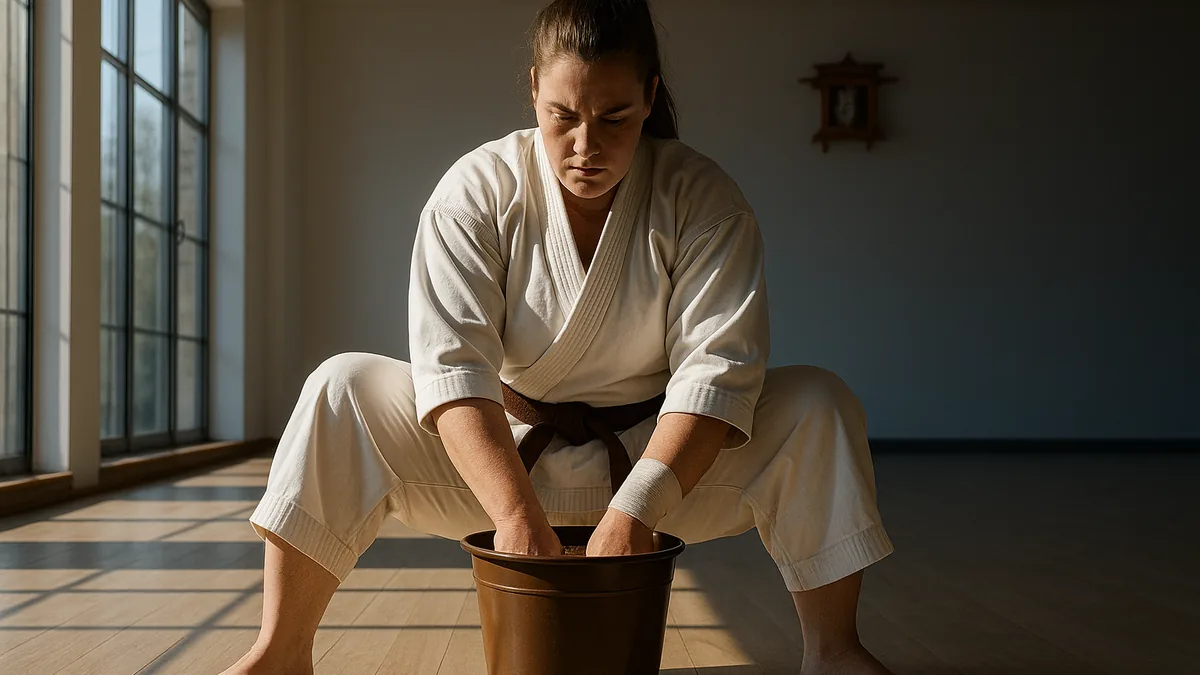
- Rice bucket training - traditional, time-consuming, and genuinely effective for grip endurance and wrist stability.
- Farmer's carries - the isometric demand on wrist stabilisers is consistently underrated.
The Warm-Up Is Part of Prevention
A structured warm-up that is specific to the session ahead makes a measurable difference to injury rates. A generic jog and some arm circles before heavy kihon and partner work does not adequately prepare your joints. Move through the ranges you are about to load, under low demand, before adding speed and power.
And on the question of pushing through pain:
"The students who push through early warning signs tend, more often than not, to end up with longer-term problems that cost them months of training rather than the week or two they would have lost by backing off early."
The skill worth developing is distinguishing between adaptation discomfort - muscle soreness, fatigue, the burn of a hard session - and damage pain, which is sharp, localised, joint-based, or present at rest. One is part of training. The other is a signal to act on.
Pre-Class Checklist
- Did I warm up through the ranges I am about to use?
- Have I done my tibialis anterior raises and calf work this week?
- Is my training volume increasing by more than 10% week on week? If so, pull it back.
- Are my knees tracking over my toes in every stance? Check in a mirror or ask your instructor.
- Am I doing push-ups with wrists in a compromised position? Switch to fists if so.
- Is any pain I am feeling sharp, localised, or present at rest? If yes, do not train through it.
For the complete version, with every drill explained, read Preventing Common Karate Injuries on Karate Lifestyle.
Join the conversation: X · LinkedIn · Pinterest · Bluesky
More from Karate Lifestyle


Comments
Post a Comment