The Goju-Ryu Syllabus: Why Twelve Kata Is Enough
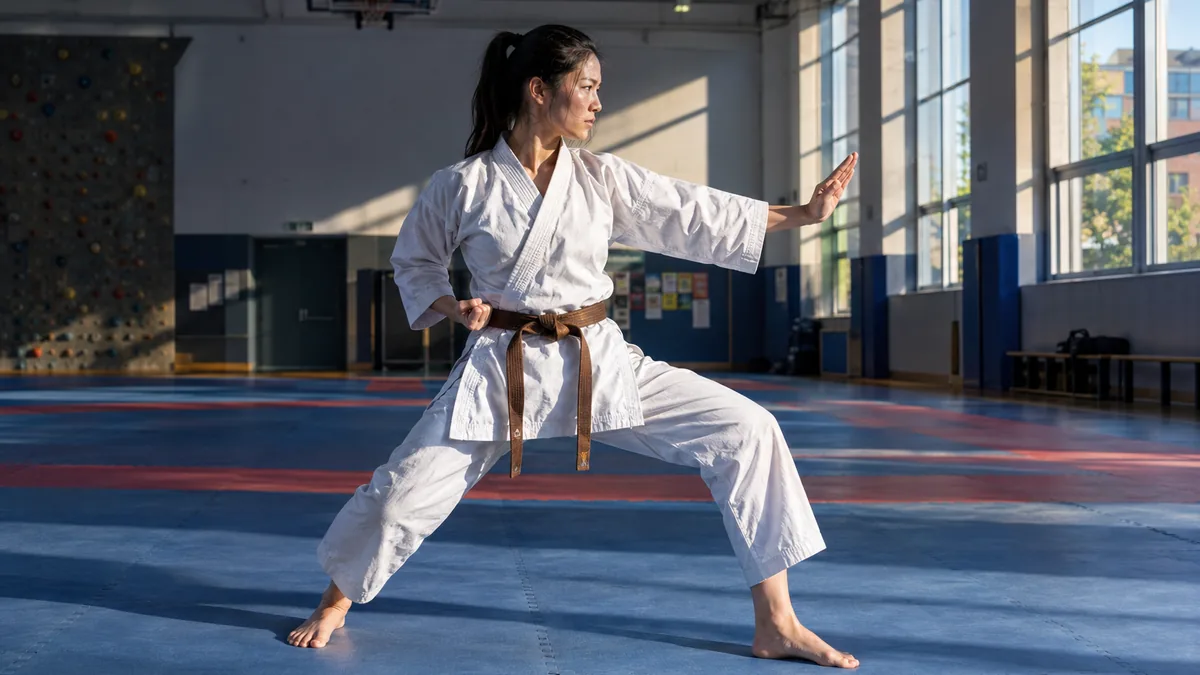
Most Goju-Ryu students reach brown belt able to rattle off the syllabus in order. Far fewer can explain what each form is actually for, or why the set stops where it does. That gap shows up in performance - and it is worth closing before you go any further.
This guide pulls out the practical core: what to understand about the structure of the syllabus, what each group of kata is doing, and what to take into your next training session.
The Syllabus Is a System, Not a Collection
Twelve kata. That number is not arbitrary - it reflects a deliberate design. The forms divide into distinct groups, each with a different job.
Sanchin and Tensho sit in a category of their own: they build the body and the breath. The Gekisai pair introduces Goju-Ryu's core principles in accessible form. The classical kata - Saifa through to Suparinpei - progressively develop range, complexity, and application depth, with Suparinpei drawing together everything that came before it.
Nothing in that structure is redundant, and nothing is missing. The syllabus has remained stable across traditional Goju-Ryu organisations because it is already complete. Adding forms would not deepen it - it would spread attention thinner across something that rewards concentrated, long-term study.
"The depth is vertical, not horizontal - train the forms you have more thoroughly, not more forms."
Sanchin and the Gekisai Kata Deserve More Credit Than They Get
Two common mistakes, both involving underestimating forms that appear early in training.
Sanchin is not something you graduate beyond. Many senior practitioners consider it the most demanding kata in the system precisely because there is nowhere to hide. When an instructor applies shime - striking, pushing, and checking alignment during performance - the places where your structure is failing become immediately obvious in ways you simply cannot detect on your own. The integration of breath, posture, and movement that Sanchin demands takes years to develop properly. If you have stopped working on it, you have stopped working on the foundation.
Tensho, its complement, is not a relaxed kata. The circular, flowing hand movements express the ju quality of Goju-Ryu, but the breath and structural engagement remain. Thinking of it as Sanchin with the tension redirected rather than removed is a more useful frame than thinking of it as the easy one.
The Gekisai kata were created in 1940 as teaching tools - deliberately constructed to introduce principles to students who were not yet ready for Sanchin's demands. They are not ancient forms, and they are not something to move past. The bunkai is direct and clear, which is intentional. If you cannot explain every movement in Gekisai Dai Ichi as a coherent self-defence response, you are not ready to carry those principles into the classical forms.
Each Classical Kata Has a Dominant Quality - Find It
The most consistent mistake across all grades is performing every kata in the same register: same pace, same emotional tone, same physical intensity regardless of which form it is. Sanchin should feel nothing like Saifa. Kururunfa should feel nothing like Seisan.
Every classical kata has a dominant quality, and performing it in that quality is what separates competent from excellent.
- Seiunchin is heavy and grounded. If it feels light, your stance is too shallow.
- Saifa's turning movements are not directional changes - they are throws and takedown entries. The rotation is the application.
- Kururunfa's pauses are not rest. They are loaded, active tension. The contrast between stillness and explosive action is the entire point of the kata.
- Seisan is direct and relentless. It does not ask for subtlety.
- Sepai is angular and deceptive. Without understanding the directional logic, the form looks arbitrary.
Before you perform any kata, identify its dominant quality and let that shape every movement from the opening position. When it works, the techniques feel purposeful. When it is missing, they feel sequential.
Checklist for Your Next Class
- Sanchin: Ask your instructor to apply shime. Note where your structure collapses - that is your current priority.
- Tensho: Do not let the circular movements become soft in the wrong sense. Keep the breath and body engagement present throughout.
- Gekisai Dai Ichi: Pick three movements and explain their bunkai out loud. If you cannot, spend time on that before moving on.
- Your current classical kata: Name its dominant quality before you begin. Heaviness? Deception? Explosive contrast? Directness? Let that quality lead.
- Kururunfa: If you train this form, check your pauses. You should feel loaded during the holds, not switched off.
- Bunkai: Take one application from any kata and find a way to test it against a partner who is not cooperating. Note what holds up and what does not.
For the complete version, with every drill explained, read Goju-Ryu Kata List: Every Form in the Syllabus, Its Purpose, and Why the Set Has Stayed Unchanged for Decades on Karate Lifestyle.
Join the conversation: Facebook · Instagram · X · LinkedIn · Pinterest · Threads · Bluesky
More from Karate Lifestyle


Comments
Post a Comment