Tekki Shodan: What You're Actually Training When You Think It's Just a Stance Kata
If you're a brown belt preparing Tekki Shodan for grading, there's a reasonable chance you've been treating it as something to get through rather than something to understand. It looks contained. It stays on one line. Compared to what comes later, it can feel like revision. That reading is worth challenging before your next session.
Tekki Shodan is a close-quarters system. Everything in it - the stance, the stepping, the strikes - is built around what you do when space has already been taken from you. Once that framing clicks, the kata stops looking simple.
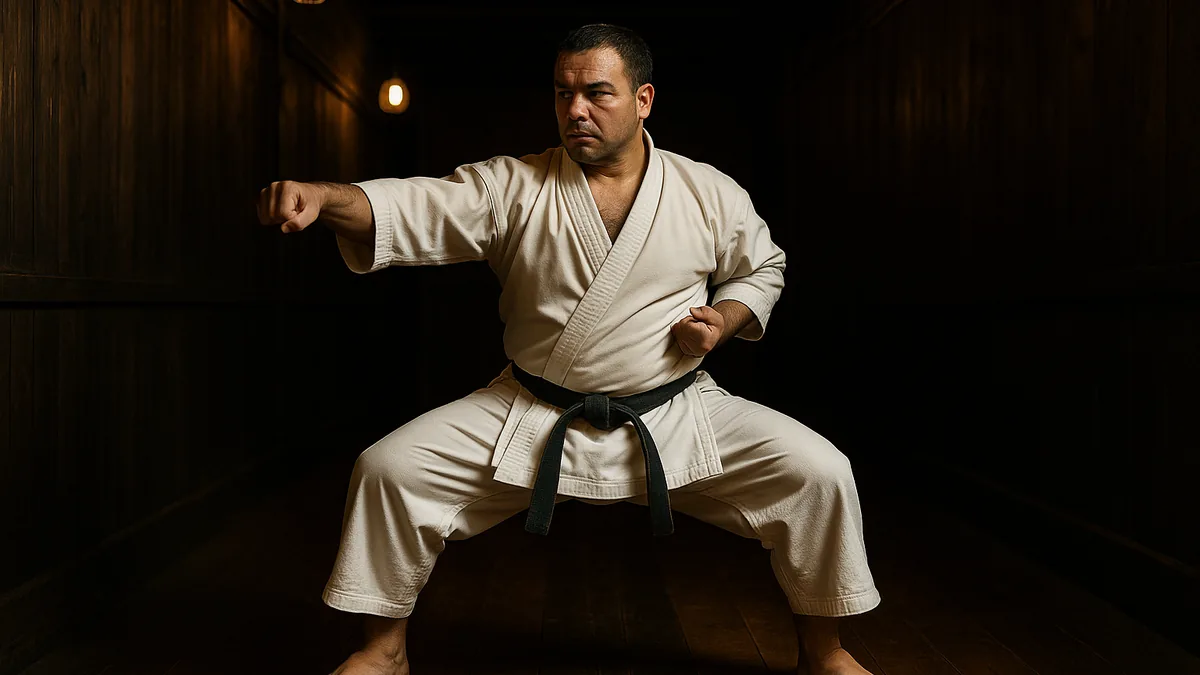
Kiba-Dachi Is Not a Shape You Stand In
Most beginners learn kiba-dachi as a position: feet wide, knees out, hips low. That's a starting point, not the finished product. The stance only works when it's active.
The correction that tends to make the biggest difference is imagining you are trying to pull the floor apart with your feet - not lifting, not pushing forward, but driving outward. That external rotation loads the hips in a way that passive standing never does, and it changes what your strikes can generate.
"The movement in Tekki is the technique."
Every punch, block, and elbow in this kata draws power from that base. If kiba-dachi is just a shape you're holding between hand techniques, the techniques will feel weak - because they are weak. Senior practitioners often note that Tekki punches seem to underperform until you stop trying to generate power the same way you would in a forward stance. The hip drive in kiba-dachi is compressed and lateral, not rotational in the usual sense. Once you feel the difference, the hand techniques change entirely.
The Stepping Is the Kata
The most common mistake in Tekki is treating the lateral movement as transition - something that happens between the techniques. Step across, arrive, then strike. That sequence is the problem.
Weight transfer in Tekki should feel like controlled falling. You shift, the body follows, and you land already loaded. The strike happens with the arrival, not after it. Breaking that connection - stepping and then preparing to hit - is the single most reliable way to identify a practitioner who has memorised the pattern without understanding it.
A useful approach is to remove all the hand techniques for a few weeks and work only the footwork. Stepping pattern, weight transfer, nothing else. When each position stops feeling like a separate event, you're ready to add the arms back in.
Head height is your diagnostic throughout. If it stays level across every transition, the stance is holding. If it rises and falls, the stance is collapsing during the step, and the drill needs more time without the arm movements.
Nami-Gaeshi and Bunkai: Where Understanding Shows
Nami-gaeshi - the returning wave kick - is the moment that separates practitioners who understand Tekki from those who have learned its shape. What most people perform is a vague foot lift and a passive return to the floor. That is not nami-gaeshi.
The technique is a continuous motion that changes direction. Energy travels upward through the rising foot and that same momentum drives the foot back down with force. The return to kiba-dachi should feel like stamping your base back into the ground. A half-committed nami-gaeshi usually signals that kiba-dachi isn't stable enough to support it - which is another reason stance work comes first.
Bunkai matters more in Tekki than in most kata at this level. The techniques are compressed and the angles are unusual, and without working through the applications with a partner they read as a collection of odd movements rather than a coherent system. Performing them at full extension misunderstands the distance they are designed for. The hook punch makes no sense at arm's length; at elbow range, with someone directly beside you, it makes complete sense. Work the applications, and the kata becomes readable.
Checklist for Your Next Class
- Stance first. Spend part of the session in static kiba-dachi, actively pulling the floor apart with your feet. If you feel it only in your quads, you're sitting passively - drive the knees outward.
- Strip out the hands. Run the stepping pattern alone. Focus on weight transfer and head height. If your head bobs, return to this drill before adding arm movements.
- Arrive loaded. Each lateral step should end with you already ready to strike. If you're stepping and then preparing, the sequence is broken.
- Commit to nami-gaeshi. Do it slowly until the hip snap is present, then build speed. A slow, sharp nami-gaeshi is better than a fast, vague one.
- Work bunkai with a partner. Pick two or three techniques and feel them at the correct distance. The kata will read differently afterwards.
- Check your head height throughout. Level means the stance is working. Rising and falling means go back to the footwork drill.
For the complete version, with every drill explained, read Tekki Shodan Breakdown on Karate Lifestyle.
Join the conversation: X · LinkedIn · Pinterest · Bluesky
More from Karate Lifestyle


Comments
Post a Comment