Tekki or Naihanchi? What the Differences Actually Mean for Your Training
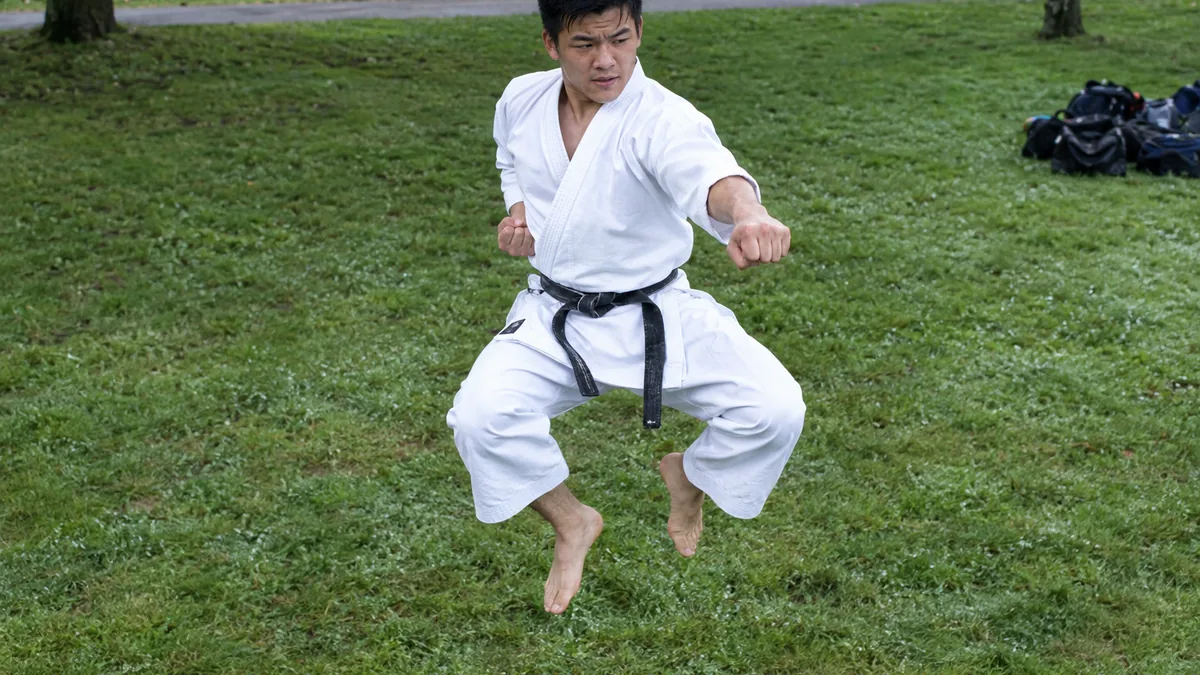
If you train Shotokan, you know it as Tekki. If you come from a Shorin-ryu or Okinawan background, it is Naihanchi or Naifanchi. Most practitioners know these are related, but fewer understand why they feel so different to perform - or what those differences are actually telling you about how to train the kata properly.
This is a companion guide to the full article on KarateLifestyle.uk. It pulls out the practical points worth taking into your next session.
The Name Reflects a Real Divergence, Not Just Spelling
Naihanchi and Naifanchi are not two different kata - they are two ways of romanising the same name, one following Japanese pronunciation and one following the Okinawan reading. Tekki is something else: a deliberate rename by Gichin Funakoshi, chosen partly to give the form a Japanese identity and distance it from its Chinese origins. The characters used for Tekki refer to the horse-riding stance that defines the kata.
That naming choice matters because it signals a broader shift. As the kata passed from Okinawa to mainland Japan, Funakoshi's successors - particularly within the JKA - developed the wide, low, fixed kiba-dachi into a training tool in its own right. That was a deliberate decision, not a mistake. The Okinawan version uses a more upright, mobile stance where weight can shift. The Shotokan version holds the position and generates force laterally from a fixed base. Both approaches are building something real. They are just building different things.
What the Stance Is Actually For
The most common error in Tekki training is making the stance the point of the exercise. Practitioners spend enormous energy getting the kiba-dachi right - width, depth, knee alignment - and treat the arm movements as things that happen while you hold the stance. That is the wrong way round.
The stance is a platform. The hip drives the technique. When you feel the rotation of the hip connecting to an elbow strike or a morote-uke, the stance suddenly makes sense as a support structure rather than a destination. Shift your attention to what the torso and arms are doing and let the stance serve that, and you will get more from the kata in a single session than months of stance-focused drilling.
This connects to something that takes years to develop but is worth understanding early:
"They did not just learn different versions. They built different bodies through different training sequences."
The Okinawan tradition often introduces Naihanchi very early - sometimes as the first kata a student learns - which means the body mechanics it teaches become the foundation for everything that follows. Shotokan typically introduces Tekki Shodan around purple or brown belt, after the Heian series. That sequencing shapes how you read every technique in the form.
Close Range Is the Context for Everything
Every technique in this kata is designed for the distance where you are already in contact with an opponent. The elbow strikes, the gedan techniques, the crossing step - none of them make full sense if you are thinking about mid-range punching distance.
A practical correction: when you perform the gedan techniques and the elbow work, picture yourself already against someone rather than reaching towards them. That single adjustment changes the feeling of the whole kata. The movements stop looking cramped and start feeling purposeful.
The crossing step deserves particular attention. It is not a transition between techniques. It is the kata's central movement idea - lateral displacement when retreat is not an option. Performing it tentatively is one of the most reliable signs that a practitioner has not yet found the kata's logic.
Training Nidan and Sandan alongside Shodan, rather than treating them as optional extras, is also worth doing seriously. The three form a connected system, and that coherence is only visible when you work them together.
Checklist for Your Next Session
- Before you start: remind yourself that the stance serves the technique, not the other way around. Put your attention on the hip and torso from the first movement.
- On the crossing step: commit to it. Stamp with intention. If it feels tentative, slow down and do it properly before building speed.
- On the elbow and gedan techniques: adjust your mental spacing. You are at clinch range. Feel the difference that makes to how the techniques arrive.
- On the sequence: if you know Nidan or Sandan, run all three in order at least once. Notice what Nidan adds that Shodan does not contain.
- After the kata: ask yourself whether you felt the force moving upward from the floor through the hip, or whether you were pushing techniques out with muscular effort. That distinction is what you are working towards.
For the complete version, with every drill explained, read Naihanchi, Naifanchi, Tekki: Why the Same Kata Has Three Names, Three Histories, and Is Trained Completely Differently Depending on Your Style on Karate Lifestyle.
Join the conversation: X · LinkedIn · Pinterest · Bluesky
More from Karate Lifestyle


Comments
Post a Comment