Switching Between WKF and Traditional Kumite: What Actually Trips You Up
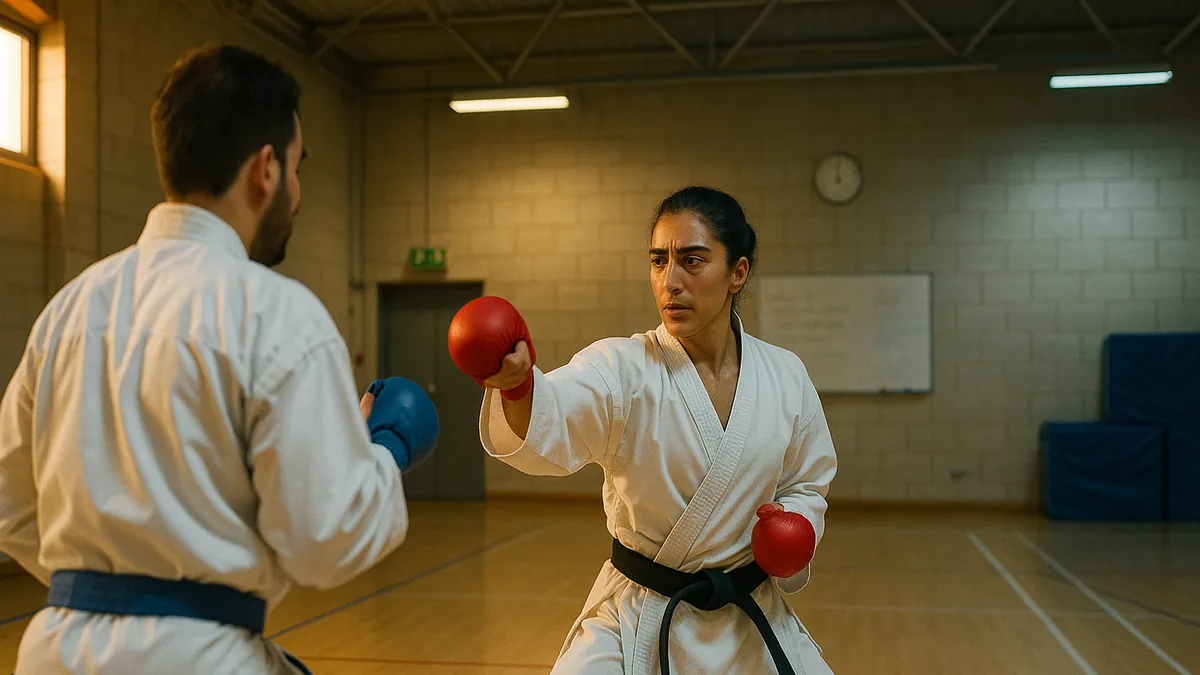
Most karateka who train seriously in both WKF competition and a traditional dojo will tell you the same thing: the transition is harder than it looks. Not because the techniques are different, but because the assumptions you carry in with you are wrong. This guide is for practitioners who are either crossing between the two environments or trying to understand what training exclusively in one is quietly costing them.
The Contact Level Is a Different Language
This is the one that catches people out most often. WKF senior competition defines its contact level as skin touch - reaching the target without driving energy into it. You are demonstrating that you could have landed the technique, not that you did in any forceful sense.
If you have come from a harder contact background, you will almost certainly be penalised in a WKF bout - not for bad karate, but for doing exactly what you have trained to do. You hit. WKF wants you to show.
Go the other way - a WKF competitor stepping into traditional jiyu-kumite with real commitment behind the techniques - and the adjustment is equally jarring. The light, controlled touch that scores in competition can feel timid and ineffective when the person in front of you is not disengaging after each exchange.
Before you spar in any new environment, find out what the contact expectations actually are. Do not assume.
Scoring Logic Shapes What You Drill
In WKF, a jodan kick scores three points, a chudan kick two, and a punch one. That structure is not neutral - it rationally pushes competitors to spend a disproportionate amount of training time on head kicks, because the return is higher. That is a sensible response to the game being played, not a flaw in anyone's character.
Traditional kumite tends not to work from a points table at all. The question is whether the technique was decisive and whether it created a genuine moment of control. A head kick that scores three points in WKF but leaves you off-balance and exposed is, in a traditional context, a poor trade.
The article frames this contrast directly: WKF teaches you to be first, and traditional kumite teaches you to be right. Both qualities matter. They are just not the same quality, and training that only develops one will leave gaps in the other.
It is also worth noting that some formats are almost the inverse of WKF in their logic. Kyokushin knockdown kumite, for example, permits full-contact body kicks and low leg kicks but prohibits all hand strikes to the head - almost the mirror image of WKF, where controlled hand strikes to the face score and kicks carry the highest point values. Crossing between those two systems requires a near-complete reset of priorities.
The Mental Reset Matters More Than the Technical One
Practitioners switching systems tend to focus on the technique list - what is and is not allowed, which targets are valid, whether sweeps are permitted. That is useful, but it is not the hard part.
"The correction that makes the biggest difference when switching systems is not technical - it is mental."
What that means in practice is that you have to genuinely change your understanding of what success looks like before the technical adjustments will stick. A WKF competitor who steps into traditional free sparring and keeps disengaging after each technique is not being technically incorrect - they are following a deeply trained habit that makes perfect sense in their usual context. The habit is the problem, not the execution.
The same applies in reverse. A traditional practitioner who commits fully and drives through every technique in a WKF bout will accumulate penalties and probably lose, despite - or because of - doing what they have been trained to do well.
Checklist for Your Next Class
Take this with you when you are about to train in a format that is not your usual one.
- Ask before you spar. Find out the contact expectations of this specific dojo or competition format. Do not guess.
- Identify which scoring logic applies. Are techniques being judged on decisiveness and commitment, or on speed and controlled demonstration?
- Notice your disengagement habits. Do you automatically reset after a technique lands? That is a WKF pattern that may not serve you in a traditional context.
- Check your contact level on the first exchange. Adjust before you get penalised or hurt someone, not after.
- Leave your points table at the door. If you have been drilling jodan kicks for their three-point value, recognise that logic does not transfer to a format where the question is martial effectiveness.
- Reset what winning means. Before you worry about technique, be honest about what you are trying to achieve in this environment - and whether your definition of success matches the system you are actually in.
For the complete version, with every drill explained, read WKF vs Traditional Kumite Rules on Karate Lifestyle.
Join the conversation: LinkedIn · Pinterest · Bluesky
More from Karate Lifestyle


Comments
Post a Comment