Structure Your Solo Karate Sessions: A Practical Interval Guide
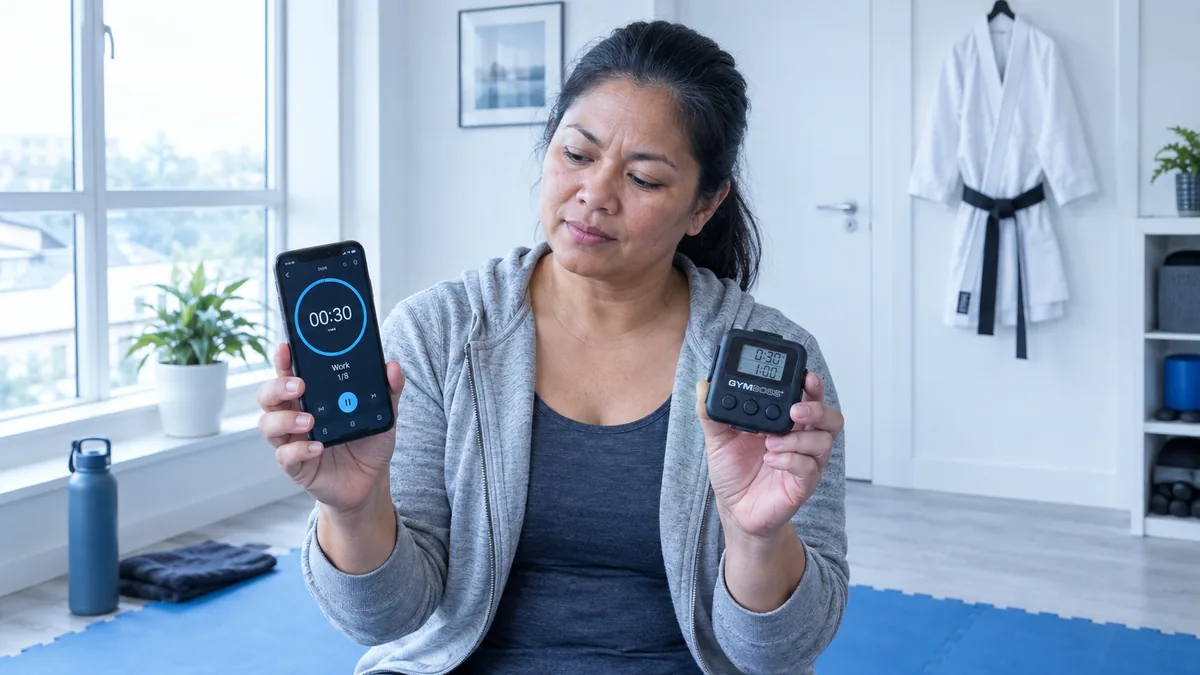
Most of us who train alone put the effort in. The problem is rarely commitment - it is the absence of any framework to make that effort count. Sessions blur into comfortable repetition, rest periods quietly stretch, and fatigue is managed by slowing down rather than confronted directly. A timer does not solve everything, but it makes the problems visible. Here is how to use one properly.
Why Your Rest Period Is Not a Reward
The single most common mistake in solo interval training is treating the rest as dead time. It is not.
"The rest period is not optional and it is not a reward. It is part of the training."
What you do between rounds shapes the quality of the round that follows. Stand upright. Breathe deliberately. Check where the last sequence broke down. If you collapsed on the floor and stared at the ceiling, you have wasted the most instructive part of the session. The breakdown point - where your hips stopped turning, where your guard drifted, where your steps shortened - is exactly what you need to correct before the next round begins. Passive recovery teaches you nothing.
This matters especially because karate technique fails in a predictable sequence under fatigue. Hip rotation goes first. Then the guard drops. Then footwork shortens. If you are not using your rest to notice and reset, you are simply rehearsing tired technique repeatedly, which is worse than useless.
Match the Protocol to the Goal
Interval training is not one-size-fits-all, and applying a generic protocol to karate-specific goals produces generic results.
For kata grading preparation, the priority is timing consistency, not cardiovascular output. Set a countdown timer to your kata's expected duration and practise finishing at exactly the right moment across multiple repetitions. Then track your times. If your first repetition takes 35 seconds and your sixth takes 48, you have found a real gap - and no amount of general fitness work will close it. Only practising under controlled fatigue will.
For kumite conditioning, the protocol needs to reflect actual match demands. Research on elite kumite shows that high-intensity actions typically last well under two seconds, with active effort periods in the range of roughly 6 to 18 seconds. That means work periods of 10 to 15 seconds at maximum effort, followed by active recovery - moving, not standing still - are closer to what a real bout requires than a standard Tabata block. More general cardiovascular fitness is useful, but it will not replicate the specific demands of repeated explosive exchanges.
For general conditioning, protocols like Tabata - 20 seconds maximum effort, 10 seconds rest, eight rounds - are well supported. The research behind Tabata showed a 14% improvement in aerobic capacity and a 28% improvement in anaerobic capacity over six weeks, gains that steady-state training could not match on the anaerobic side. Any reliable timer handles this. Do not overcomplicate it.
The trap to avoid is choosing a protocol because it sounds demanding rather than because it targets your actual weakness. If your technique collapses under fatigue, more cardio is not the answer. Shorter intervals with higher technical demands are.
Apps vs Dedicated Devices
For most home sessions, a well-chosen app is sufficient. Look for one that lets you save custom protocols, set distinct audible signals for work and rest, and name your rounds. The key discipline is to set your protocol once, save it, and leave it alone. Adjusting your timer mid-session means your structure has already failed.
A dedicated interval device - something that clips to your clothing and vibrates rather than beeps - earns its cost in specific circumstances: training in noisy environments, or combining bag work with kihon drills where glancing at a phone would break your flow entirely. A vibration cue on your waistband keeps you in the session. For quiet home training without equipment, the app does the job.
Large gym-style display timers are worth considering if you have a permanent training space and want something visible from across the room. They are not portable and not cheap, but for a dedicated home dojo they are the cleanest option.
Checklist for Your Next Solo Session
- Save your protocol before you start. One work period, one rest period, number of rounds. Simple and done.
- Use the rest actively. Stand upright, breathe, identify what broke down, and reset before the next round.
- Track your kata times across rounds. Write down the first and last repetition. The gap is your diagnostic.
- Set work periods that match your goal. Kata timing needs countdown work. Kumite conditioning needs short explosive intervals, not long cardio blocks.
- Note where technique degrades first. Hips, guard, footwork - in that order. That is where your interval work should focus.
- Do not rebuild your timer settings each session. If you are adjusting mid-session, simplify the protocol.
For the complete version, with every drill explained, read Karate Timer Apps and Interval Training Devices: Which Tools Actually Improve Your Solo Sessions on Karate Lifestyle.
Join the conversation: Facebook · Instagram · X · LinkedIn · Pinterest · Threads · Bluesky
More from Karate Lifestyle


Comments
Post a Comment